


The best walkable destinations in Europe revealed - as gorgeous Italian coastline bags the top spot
Joanne Lynn, head of European Product at Riviera Travel, has revealed the best destinations on the continent for a walking holiday.
From a dreamy UNESCO Italian hotspot to an iconic canal city, find out which of Europe's cities are the easiest to discover on foot.
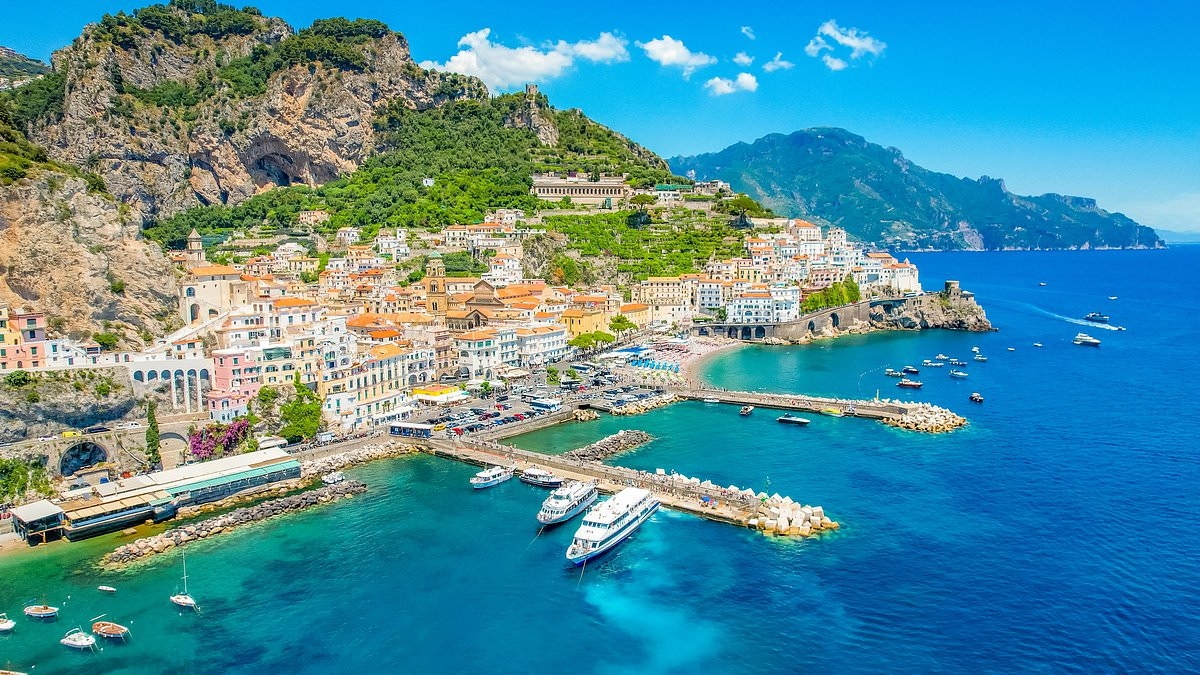
Amalfi Coast, Italy
One of Italy 's prettiest holiday destinations, the Amalfi Coast is also one of Europe's most walkable holiday hotspots, according to Riviera Travel.
Joanne says: 'Situated between the Gulf of Naples and Salento, the Amalfi Coast offers stunning views of Italian landscapes and the Mediterranean Sea, providing an exceptional backdrop for a breathtaking walking holiday.'
A UNESCO heritage site, the Amalfi Coast is world-renowned and loved for its lemon trees and colourful clifftop villages.
And the beautiful holiday destination is set to get easier to reach with BA launching new flights to Salerno later this May.
Amsterdam, Netherlands
It might be best known for cycling but Amsterdam is also a fantastic destination to explore on two feet.
Joanne explains that the Dutch capital has a combination of 'walkable streets' and 'pedestrian-only zones'.
She adds: 'The canals dotted throughout the city only add to the scenic nature, providing some great views while travellers stroll around this bustling location.'
Many of the city's top attractions including the Anne Frank House, Rijksmuseum and Vondelpark are within a half an hour walk of each other.
Dubrovnik, Croatia
The historic city of Dubrovnik is an ideal option for a walking holiday, according to Joanne.
She says: 'The city's Old Town is car-free, with its cobbled streets only accessible by foot. Additionally with the city located on the coast, travellers can enjoy some amazing views of the Adriatic Sea and the surrounding Dalmatian islands.'
Walking Dubrovnik's historic walls is one of the city's highlights but tourists will need to buy a ticket to do so.
However, the city's main attractions are all within an easy walk of each other which means tourists can save on the cost of car hire.
Florence, Italy
The Italian city's 'flat and compact' centre means it's 'easily accessible for exploration on foot'
Florence is a popular honeymoon destination but it's also a great choice for holidaymakers who like to walk.
Joanne says: 'Often considered the birthplace of the Renaissance, Florence is a city everyone should visit at least once during their lifetime.
'Located in the region of Tuscany, Florence is a wonderful city, home to well-known landmarks including Ponte Vecchio, Campanile di Giotto and Uffizi Gallery.'
The Italian city's 'flat and compact' centre means it's 'easily accessible for exploration on foot'.
Krakow, Poland
Krakow, Poland's second-largest city, is another fantastic destination for holidaymakers who like to walk.
'The Polish city is relatively compact and easy to navigate on foot, with pedestrian-only zones in place in the city's Old Town,' reveals Joanne.
She adds: 'Furthermore, there's plenty of history and medieval architecture to discover, making it a great place to explore while boosting fitness.'
Tourists can walk from Rynek Glowny, the city's main square, to Wawel Royal Castle in just 15 minutes.

Try Our AI Features
Explore what Daily8 AI can do for you:
Comments
No comments yet...
Related Articles


Daily Mail
 an hour ago
- Daily Mail
I visited one of Italy's famous bucket-list destinations - here's why I would NEVER go back
An idyllic hotspot in Italy that has fast become a must-see destination on social media has been branded 'overpriced and overhyped' by a visitor who explained why she would never return. Curiosity got the better of Phoebe Cornish when she began noticing a quaint, rustic, romantic town appearing extensively on her TikTok and Instagram feeds. Bellagio, located in Lake Como, has seen a surge in popularity in recent years thanks to its narrow cobblestone streets, colourful buildings, striking mountain backdrops and dreamy lakeside promenade. Mesmerised by online clips showcasing its traditional Italian charm, the lifestyle reporter decided to book a flight and see if the 'pearl of Lake Como' was truly worth the hype. According to Lake Como Experiences, Bellagio is easily accessible from Milan, with direct trains run from Milan Centrale to Como San Giovanni station and journeys taking approximately 37 to 47 minutes. For those driving, Milan to Bellagio is roughly one hour and 36 minutes, where ferries from Como connect directly to the village, with trips taking about two hours. Writing for the Express, Phoebe explained that she was immediately 'impressed' once she had stepped off at the ferry port in early June and was greeted by the picturesque setting she had only seen on a screen beforehand. Though she described the area as 'breathtaking' during the day, even whilst wading through hordes of tourists, it soon became apparent that the village was nothing more than an 'overhyped' TikTok destination. She wrote: 'As the sun sets, the atmosphere fades away. Most restaurants closed surprisingly early - around 9pm or 9.30pm - with only a few remaining open until 10pm or 11pm. 'After a full day of exploring the lake, we craved a relaxed late dinner or a drink with a view. However, Bellagio was already winding down.' She admitted she was 'naive' in expecting the same night-time buzz experienced in bustling cities such as Milan, and became especially frustrated when returning from late evenings out in nearby towns, such as Lenno. Despite its culinary backdrop and mile-long queues, Phoebe felt let down by the 'unremarkable' food offered in restaurants across the village, including a 'very dry tiramisu' served by one host. She added that meals were generally overpriced, lacked flavour and felt underwhelming. The writer rounded up her thoughts with a scathing take: 'It is the busiest, most tourist-saturated town on Lake Como and feels far more commercialised than the quieter, more authentic areas.' She also noted that Bellagio 'fails to be accessible' to visitors who are less mobile, and that there are limited options when it comes to public transport in the town itself. Despite leaving the town deflated, Phoebe noted that Bellagio is 'not without its appeal.' She enjoyed practicing Italian with her warm and welcoming Airbnb host, ate fresh fish each day, and took in breathtaking views across the lake during the trip, which made her feel 'genuinely connected' to the village. Phoebe also encouraged visitors to hop onboard the £18 slow ferry from Como to Bellagio, where passengers can cruise past the charming villages of Tremezzo and Cernobbio, a journey she described as 'scenic and relaxing.' Meanwhile, a popular British tourist hotspot has banned walking barefoot, picnics, and drinking booze on the streets among a swathe of other prohibitions in a brutal crackdown. Holidaymakers visiting Portofino, a small coastal town on the Italian Riviera in Liguria, are now facing fines for carrying out a variety of actions typically enjoyed abroad. Starting today, travellers in Portofino will no longer be able to walk through the town barefoot, in swimwear, or topless - or sit in the piazza in such attire. Consuming alcohol on public streets has also been prohibited, with only restaurants, bars, and designated areas left to booze in. Begging, sitting, or lying on the streets, walls, sidewalks and parks has also been banned along with having picnics. The new ordinance, signed by Mayor Matteo Viacava, will take effect during the summer season and temporarily expire on September 30.

Daily Mail
2 hours ago
- Daily Mail
Aussies confess the WORST things about living Down Under - so do you agree?
Australia has always been nicknamed the 'lucky country'. But a recent discussion saw many locals admit there were several major downfalls to living in Australia. The topic ignited on a popular 'Australian living' thread when a woman encouraged fellow locals to dish on 'the worst part about living Down Under'. 'I see a lot of posts about the best things in Australia, but what is your least favourite thing about living [here]?' she asked. 'Personally, I hate that barely any (non-Australian) musicians come here,' she offered as a springboard for the conversation. By far the most common response was the issue of Australia's geographic isolation and the fact that it was 'so far from everywhere'. 'It honestly is a long way to go to see the world,' read the most popular response. 'I can't just up and drive to another country,' lamented another. That sentiment was especially felt by Aussies who regularly travelled internationally for work or to visit loved ones. Some Aussies even admitted that the burden of 'long haul flights' was ultimately a breaking point for them to move abroad. 'I travel a lot and couldn't justify any more long haul flights just to get home,' one person replied. '[It] was just too much to handle.' 'Australia is in the worst location for people that just wanna go somewhere new and different for the weekend,' another person replied, adding that they had since 'moved to Europe'. Some comments also noted that the inverse was also an issue. Namely, that not only was it difficult for Aussies to get anywhere overseas, but that international visitors were reluctant to make the huge pilgrimage down under. '[I]t's a long way to go for the world to see us,' added one sad reply. 'We miss out on so many bands, and when they do come, they only visit three cities,' the person added, echoing the original poster's complaint. However, some noted this very issue about Australia being so far away simultaneously contributed to what made it great. 'The worst thing is also the best thing - we are so far away from so many places,' they replied. They elaborated that the distance ensured Australia remained a quiet, peaceful and uncrowded place. But this also raised another related issue among many, who claimed Australia is 'boring'. Several commenters felt Australia's major cities lagged behind other cosmopolitan places around the world. 'In comparison to a lot of other countries, nightlife here is pretty boring and museums are kind of meh,' claimed one. 'People go to work, drive home, and watch tv. There's no community or "Joie de Vivre",' another echoed. On a totally different note, the other major repeated complaint concerned how unaffordable housing and property was in Australia, and the inflated cost of living. 'Housing cost s*cks,' one wrote. '[T]he housing market is broken here, but I do like the weather,' added another. 'Cost of living is also obscene. Cars, houses, food, utilities, fuel, insurance, coffee, restaurants, and damn near everything else,' reflected one more. Perhaps surprisingly, the 'copious amounts of bugs' that thrive in Australia were also called out as an annoying by-product of being Down Under. 'Flies, mozzies, spiders, beetles, wasps, and the greatest number of ants I've ever seen,' one wrote. 'Sydney's cockroach problem (partly caused by the high humidity which is another worst thing about living here) is absolutely awful,' another said.


Times
8 hours ago
- Times
Holidaymakers with pet separation anxiety simply pack the pooch
It's not a dog's life if you are a pet in Britain. Our national capacity to spoil our furry friends extends to taking them on holiday with us, according to research. A study has found that growing numbers of people are taking their dogs — and sometimes other animals — on trips because they cannot bear to be separated from them. The study found that roughly one in four (26 per cent) of owners have taken their pets on foreign holidays, and the trend is driven by young people. Half of 24 to 34-year-olds have travelled abroad with their animals, compared with less than one in ten over-55s (9 per cent). Londoners are the most likely to take their pets with them. Holidaymakers may not have noticed the trend because the law forbids pets, except guide dogs, from travelling in the cabin of aircraft to and from the UK. However, most flag carriers, such as British Airways and Air France, have long-established pet cargo schemes. You won't see touring pets in the cabin of the aircraft, they have their own area ALAMY The research found that two thirds of owners would like to be able to travel on a plane with their pets, a practice that is allowed for animals below a certain size and weight on many European and American routes. Most owners who take their dogs with them on holiday to Europe use ferries and Eurotunnel, which both accept animals. Pets are allowed to leave and return to the UK under the Pet Travel Scheme, provided they meet the entry and exit requirements, such as having a microchip, a rabies vaccination and an animal health certificate. The certificates must be issued by a vet within ten days of travel. Ferries and Eurotunnel allow for fuss-free travel, but get the paperwork in order ALAMY The survey of more than 1,200 pet owners by the Co-op found that more than half (56 per cent) of those who take their pets abroad do so because 'they're part of the family'. However, roughly one in eight (12 per cent) said they do so because pet boarding facilities are too expensive. Most licensed kennels charge £17 to £20 per dog per day. Rates in London are often far higher — up to £90 a night for standard kennels and even £120 a night for high-end 'canine country clubs'. A third (33 per cent) of owners said they take their pets along because it ensures they will stay active on holiday, but one in three (31 per cent) said they 'couldn't bear the thought of leaving them at home' and would miss them too much. Another factor is that veterinary services are considerably cheaper on the Continent. An investigation by The Times in 2023 found that some procedures are up to three times more expensive in the UK than in France. • 13 of the best dog-friendly Airbnbs in the UK The Co-op says owners need to be careful when travelling abroad with pets because most standard insurance policies do not cover them for emergency treatment overseas. Andrew Nevitt, of Co-op Insurance, said: 'If you are taking your pet abroad, it's important that you ensure you have the correct documentation and they have had the necessary vaccines.' He added: 'Having the right insurance policy in place is also crucial as it will provide you with peace of mind that, should your pet require any treatment, any vet bills will be covered.'
