



‘What else could Cyril have done?' South Africans praise calm Ramaphosa after White House ambush
CNN —
Many South Africans are praising President Cyril Ramaphosa's calm demeanor as President Donald Trump's multimedia ambush unfolded in front of the world's press. He pushed back gently whenever he could, but he didn't raise his voice or show anger, displaying his decades of negotiation experience.
'What else could Cyril have done?' asked veteran journalist Milton Nkosi. 'You're damned if you do, damned if you don't. I think they were caught completely unawares. How on earth could you have planned for that?' said Nkosi, who's a senior research fellow at the Africa Asia Dialogues think tank.
On social media and across South Africa's broadcast outlets, consensus seemed to quickly form that Ramaphosa did the best under the circumstances. He remained 'calm, collected and humble in the face of bigotry and lies,' posted one user on X. 'You were a leader today. Went to build not to fight.'
Ramaphosa brought his own White billionaire to the meeting – luxury goods magnate Johan Rupert, who's behind brands like Cartier – who told Trump that violent crime affects all races, but his words fell on deaf ears.
Rupert even threw tech billionaire Elon Musk, who was also in the room, a bone.
'We have too many deaths. But it's across the board,' Rupert said. 'It's not only White farmers. It's across the board. We need technological help. We need Starlink at every little police station. We need drones.'
One White South African called Rupert a traitor to his fellow Afrikaners in a social media post.
Another prominent White South African, agriculture minister John Steenhuisen, also tried to convince their Oval Office host that he had been misled.
The most dramatic part of the scene was when Trump called for lights to be dimmed and screened a four-and-a-half minute montage claiming to show evidence of a White genocide. It included far-left opposition leader Julius Malema singing 'Kill the Boer, kill the farmer' as a crowd chanted along.
Officially named 'Dubula iBhunu' in the Xhosa language, the song emerged in the 1980s to fight the unjust system of segregation. South African courts have ruled that it doesn't mean a literal call to kill White farmers.
The Supreme Court of Appeal ruled in 2024 that any 'reasonably well-informed person' would see it as a 'historic struggle song, with the performance gestures that go with it, as a provocative means of advancing his party's political agenda.'
Trump confronted Ramaphosa on why he had not arrested Malema for it.
Malema, leader of the the Economic Freedom Fighters party, responded in his typical fiery way on X: 'A group of older men meet in Washington to gossip about me,' he said, disputing the claims of a genocide. 'We will not agree to compromise our political principles on land expropriation without compensation for political expediency.'
Malema was expelled from Ramaphosa's African National Congress (ANC) party more than a decade ago and came third in the most recent election.
Most of the information that Trump used to try to prove that 'White genocide' is happening in South Africa has repeatedly been disproven.
Some South Africans have said that they believe that the information is 'AfriForum propaganda' – referring to a White Afrikaner lobby group criticized as being a White nationalist group.
Its chief executive told CNN the group was pleased with how the meeting went.
'It shows that the South African president and the ANC leadership cannot just simply sweep real problems that we have in the country under the carpet and think they will disappear,' Kallie Kriel said in a voice note.
CNN has looked at data from the South African police and has found no evidence of a 'White genocide.' A video played by Trump purported to show thousands of White farmers buried along the side of the road – but Ramaphosa said that he did not recognize the video, and that there was no evidence it showed what Trump claimed it displayed.
It was the toughest public test yet for Ramaphosa, a skilled dealmaker who led negotiations for Nelson Mandela in talks that ended apartheid.
'It is absolutely absurd to sit and watch the president of the most powerful country in the world telling the man who negotiated to end apartheid, who was locked up in solitary confinement, that there's White genocide in South Africa, which is a lie. That is crazy,' Nkosi told CNN.
It was a good day for South Africa's White nationalists. The president of the United States repeated their talking points from the bully pulpit of the White House, giving them the highest-profile validation they could have ever dreamed of.
The South African delegation expected a confrontational meeting, but nothing could have prepared them for the ambush that awaited them.
Hashtags

Try Our AI Features
Explore what Daily8 AI can do for you:
Comments
No comments yet...
Related Articles

Al-Ahram Weekly
 7 hours ago
- Al-Ahram Weekly
US widens metals tariffs to hit industrial goods, baby products - Economy
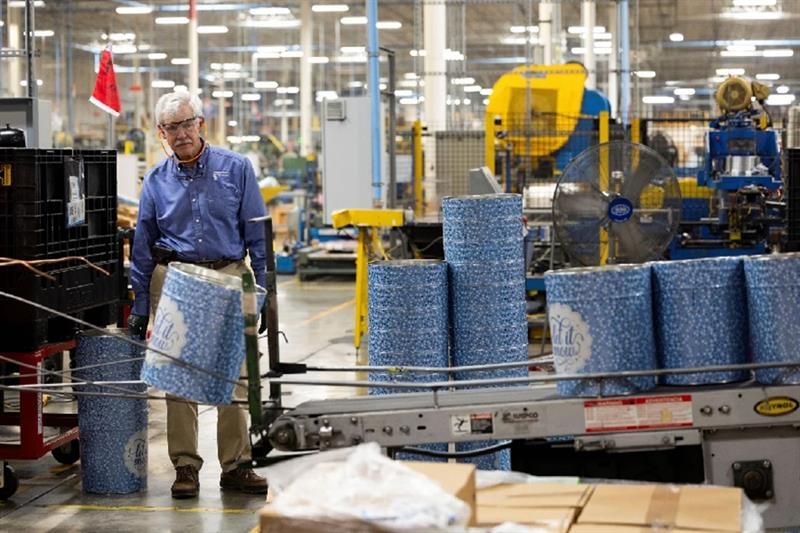
The United States has broadened the reach of its steel and aluminum tariffs, the Commerce Department said Tuesday, impacting hundreds more products that contain both metals such as child seats, tableware and heavy equipment. The Bureau of Industry and Security said in a recent notice that it was adding 407 product types to a list of items considered steel and aluminum "derivative products." This means a 50-percent tariff on both metals, imposed by President Donald Trump earlier in the year, will apply to their steel and aluminum content. The widened scope took effect Monday, and the notice detailing the changes was published in the Federal Register on Tuesday. "Today's action covers wind turbines and their parts and components, mobile cranes, bulldozers and other heavy equipment, railcars, furniture, compressors and pumps, and hundreds of other products," said the Commerce Department on Tuesday. The move "shuts down avenues for circumvention," Under Secretary of Commerce for Industry and Security Jeffrey Kessler said, reiterating the aim of boosting the US steel and aluminum industries. Since returning to the presidency, Trump has imposed a 10 percent tariff on almost all US trading partners, alongside varying, steeper levels on dozens of economies, such as the European Union and Japan. Certain sectors have been spared from these countrywide tariff levels, but instead have been targeted under different authorities with even higher duties. In the case of steel and aluminum, Trump initially unveiled a 25-percent tariff on imports of both metals before doubling this to 50 percent in June. Though the impact of Trump's tariffs on consumer prices has been limited so far, economists warn that their full effects are yet to be seen. For now, some businesses have coped by bringing forward purchases of products they expect will encounter tariffs. Others have passed on additional costs to their consumers or absorbed a part of the fresh tariff burden. But analysts note that importers and retailers will unlikely be able to eat these costs indefinitely, and could eventually raise consumer prices. Some economists argue that the inflation hit will be one-off, but others are wary of more persistent effects. The latest Commerce Department additions came after a window for the public to submit product inclusion requests. Follow us on: Facebook Instagram Whatsapp Short link:
Al-Ahram Weekly
8 hours ago
- Al-Ahram Weekly
Claims Egypt blocking aid to Gaza are ‘a big lie': FM Abdelatty to CNN - Foreign Affairs
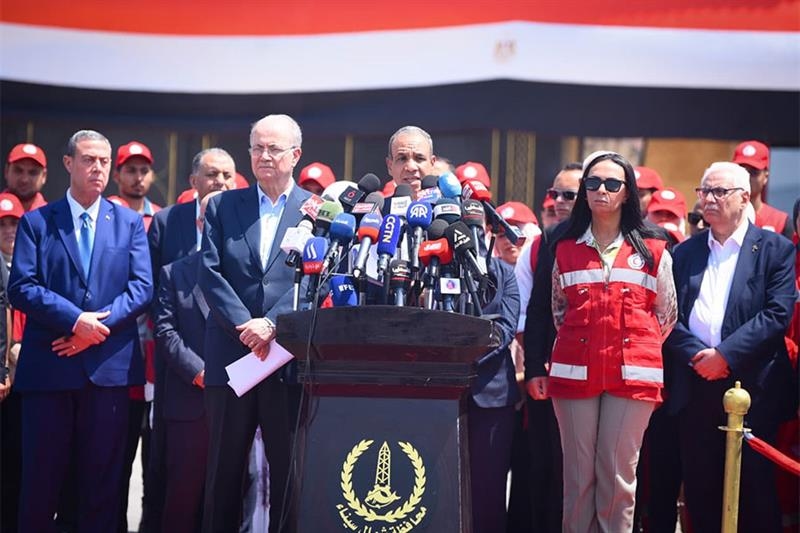
Egypt's foreign minister Badr Abdelatty has rejected accusations that Cairo is obstructing humanitarian aid to Gaza as a 'big lie', insisting that Israel alone controls the Palestinian side of the Rafah crossing and is responsible for blocking relief supplies. The foreign minister's statements came in an exclusive interview with CNN's Becky Anderson on board a plane on the way to an international press conference on the Egyptian side of the Rafah crossing on Monday. Abdelatty explained to Anderson that the Egyptian terminal of the Rafah border crossing between Egypt and Gaza remained open, while the Palestinian terminal on the other side 'was destroyed by Israel four times by Israel.' 'The Israelis are physically there, preventing any truck or person from moving in. Israel is the main country blocking and putting restrictions on the flow of humanitarian and medical aid,' he said. Abdelatty also warned against attempts to forcibly displace Palestinians through Rafah, describing displacement as a 'red line.' He said: 'There is no moral, ethical, legal, or political justification for displacement. Those people are attached to their homeland. Displacement is a one-way ticket … it means only one objective: the liquidation of the Palestinian cause.' Asked by Anderson about the usefulness of a peace treaty that 'cannot be negotiated,' Abdelatty defended Egypt's 1979 treaty with Israel, calling it 'the main pillar of stability in our neighbourhood.' He stressed that Cairo maintains security and intelligence contacts with Israel, but said the real obstacle is 'the lack of political will' to reach a political settlement. In Rafah, on the Egyptian side, during a joint press conference with Palestinian prime minister Mohamed Mustafa at Rafah, Abdelatty reiterated Cairo's rejection of 'Greater Israel' illusions and any attempt to displace Palestinians, a position Mustafa praised as 'an impregnable barrier' to Israeli plans. On Sunday, Cairo urged other states not to become complicit in any ethnic cleansing efforts as they constituted a war crime under international law. Since 27 July, Egypt has dispatched 17 aid convoys, in collaboration with the UN and its humanitarian partners, to stem famine conditions in Gaza amid a five-month-old Israeli blockade on the strip. However, Israel has prevented the entry of hundreds of aid truck into Gaza by imposing endless inspections of content and arrestining truck drivers. Follow us on: Facebook Instagram Whatsapp Short link:
Al-Ahram Weekly
10 hours ago
- Al-Ahram Weekly
Egypt sends 18th aid convoy as starvation deaths rise in Gaza - Foreign Affairs
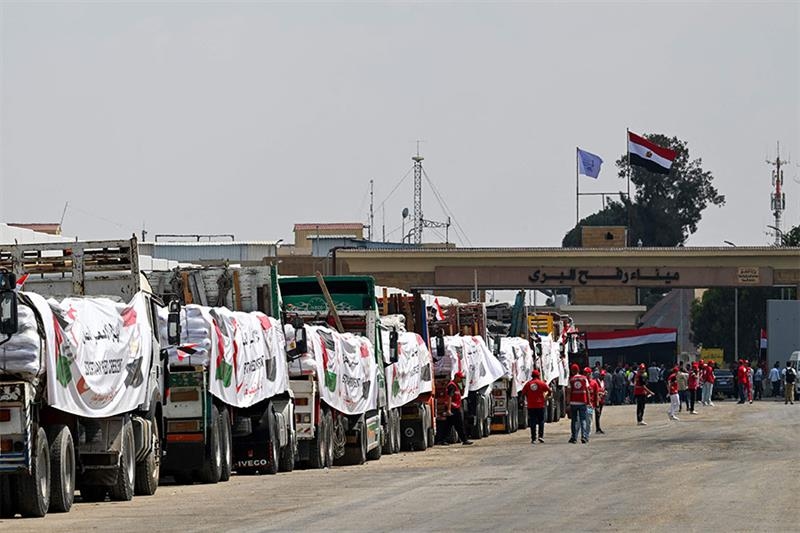
Egypt has sent its 18th humanitarian convoy to Gaza, with 2,400 tonnes of food, flour, medical supplies and other relief crossing via Rafah on Tuesday, as starvation-related deaths in the strip rise to 263, including 112 children. The deliveries, part of the Zad El-Ezza: From Egypt to Gaza initiative launched in late July, come amid worsening famine in the territory under Israel's deadly five-month blockade. Overall, Israel's genocidal war on Gaza has killed nearly 62,000 Palestinians, most of them women and children. Israel's seizure of the Rafah crossing on 7 May 2024 shut down its Palestinian side, forcing aid to be rerouted through the Israeli-controlled Karm Abu Salem crossing. Thousands of trucks remain stranded in Egypt pending Israeli clearance, with more than 5,000 waiting at Rafah alone. Since October 2023, Egypt has delivered over 70 percent of all aid reaching Gaza: 45,125 trucks carrying 500,000 tonnes, of which 368,000 tonnes came directly from Egypt and 132,000 from other countries. Seventeen convoys have entered Gaza since 27 July despite repeated Israeli obstruction. Accusations that Cairo has blocked aid are 'a big lie,' foreign minister Badr Abdelatty told CNN on Monday, saying Israel alone controls Rafah's Palestinian terminal, which its forces have destroyed four times. 'They are physically there, preventing any truck or person from moving in,' he said. On Sunday, Egypt's foreign ministry reiterated its rejection of any attempt to displace Palestinians from Gaza or the occupied West Bank, whether by force or 'through policies of starvation, land confiscation, settlement expansion and rendering life untenable.' Follow us on: Facebook Instagram Whatsapp Short link:
