


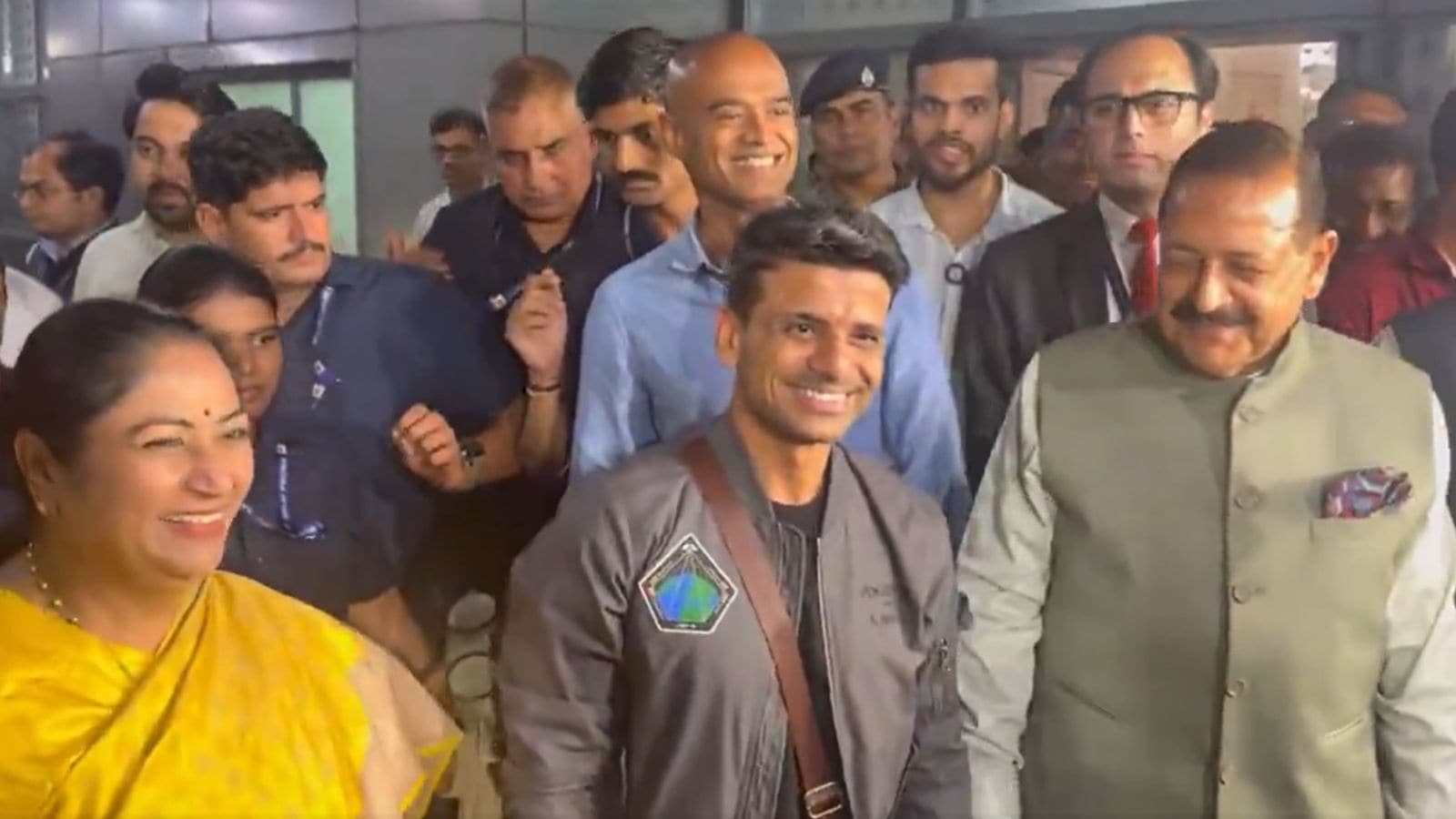
Astronaut Shubhanshu Shukla reaches Delhi, set to meet PM Modi today
Shukla, who returned to Earth on July 15, landed in Delhi in the early hours of Sunday.
He was received at Delhi's IGI airport by Union Minister Jitendra Singh, Delhi Chief Minister Rekha Gupta, as well as his family, including his wife and son, reported ANI.
A moment of pride for India! A moment of glory for #ISRO! A moment of gratitude to the dispensation that facilitated this under the leadership of PM @narendramodi.
India's Space glory touches the Indian soil… as the iconic son of Mother India, #Gaganyatri Shubhanshu Shukla… pic.twitter.com/0QJsYHpTuS
— Dr Jitendra Singh (@DrJitendraSingh) August 16, 2025
Shukla was part of NASA's Axiom-4 Space Mission, which took off from NASA's Kennedy Space Centre in Florida, US, on June 25. He became the first Indian in 41 years to travel to space.
In a post on X, Singh wrote, 'A moment of pride for India! A moment of glory for ISRO! A moment of gratitude to the dispensation that facilitated this under the leadership of PM Narendra Modi. India's Space glory touches the Indian soil… as the iconic son of Mother India, Gaganyatri Shubhanshu Shukla lands at Delhi in the early hours of morning today. Accompanying him, another equally accomplished Group Captain Prasanth Balakrishnan Nair, one of the astronauts selected for India's first Human mission Gaganyaan who was India's designated backup for the mission to the International Space Station ISS.' 'Privileged to receive both of them at the New Delhi Airport along with Delhi CM Smt. Rekha Gupta, ISRO Chairman Dr. V. Narayanan and later welcomed by a group of students,' he added.
Hashtags

Try Our AI Features
Explore what Daily8 AI can do for you:
Comments
No comments yet...
Related Articles


Time of India
 2 hours ago
- Time of India
Mission next: Isro sets sights on building rocket as high as 40-storey, among tallest in world
1 2 Hyderabad: The Indian Space Research Organisation ( ISRO ) is gearing up to develop one of the tallest rockets ever built by man -- a nextgen launch vehicle as high as a 40-storey building (over 120 meters) to put a 75,000 kg (75-tonne) payload in low Earth orbit (LEO), ISRO chairman V Narayanan said here on Tuesday. "Do you know what the capacity of a rocket (launcher) is? The first launcher, which was built by Dr APJ Abdul Kalam Ji, had a 17-tonne lift-off mass and was capable of placing 35 kg in LEO," Narayanan said at the 84th convocation ceremony of Osmania University (OU) in Hyderabad. "Fifty years ago, we were in the phase of launching the first satellite. Now, we are shoulder to shoulder with every developed nation," Narayanan said. You Can Also Check: Hyderabad AQI | Weather in Hyderabad | Bank Holidays in Hyderabad | Public Holidays in Hyderabad | Gold Rates Today in Hyderabad | Silver Rates Today in Hyderabad Elon Musk 's SpaceX currently holds the distinction of building the world's tallest rocket – Starship – which stands nearly 122 meters tall. On India's ambitions to put man on the moon, the ISRO chief said that, as suggested by PM Modi during his meeting with Shubhanshu Shukla, ISRO is in the process of developing a pool of 40 to 50 astronauts for India's future space missions. This even as ISRO is already in advanced stages of its Gaganyaan human space flight mission, where Indians astronauts will travel to space on an Indian rocket for the first time. "The first unmanned mission is planned very shortly... PM recently rolled out the broad envelope of where our space programme has to reach in the coming years. The Chandrayaan-4 programme is already approved and this mission shall be planned as a sample-return mission," Narayanan added. "An Indian has to land on the moon and return safely by a fully indigenous moon mission by 2040," he added. By 2035, a 52-tonne mass space station - Bhartiya Anthariksha Station (BAS) - is going to be built by the ISRO, reiterated Narayanan, adding that the initial modules in space for the same shall start as early as 2027. He also revealed key events that unfolded prior to Indian astronaut Shubhanshu Shukla's successful journey to the International Space Station (ISS) and back, which was the first step in the ambitious Gaganyaan mission , and said that had the rocket taken off as per the initial schedule it would have been a "catastrophic failure". While the original launch of SpaceX Falcon rocket was planned for June 11, he said a day prior to the launch, a team led by him, that was camping at the Kennedy Space Centre, detected a leak in the rocket, pushing the launch date to June 25. "When there was a discussion, 14 questions were asked but none of them were answered satisfactorily, including where the leak was. Finally, we put up a demand on behalf of the Indian govt and the leakage was fixed. Based on the insistence of Indians, the Indian education system, and ISRO training, the fault was corrected. Today we have accomplished a safe mission, not only for Shubhanshu Shukla but also for three other international astronauts," he explained. These key missions apart, ISRO is also working on the Venus Orbiter Mission (VOM) (Shukrayaan) in which a spacecraft will be sent to study Venus. ISRO also plans to launch the Technology Demonstration Satellite (TDS) and GSAT-7R, an Indian military communication satellite specifically designed for the Indian Navy to replace the existing GSAT-7 (Rukmini) satellite, this year among other initiatives. He said India's premier space agency is also working on executing a significant mission in the next three months — of placing a 6,500 kg communication satellite built by the US, into orbit using an Indian rocket. Other projects in the pipeline include the Navigation with India Constellation system (NAVIC) satellite and the N1 rocket. The ISRO Chief also said that the NISAR (NASA-ISRO Synthetic Aperture Radar) satellite, which was launched on July 30 this year to monitor the changes in Earth's ecosystems, is working "fantastically well". "In fact, this morning, we saw that the first product has come from the satellite, which is going to be useful for the entire global community," he added. The agency is also developing a G20 satellite for the G20 countries, which aims to help the countries of the global south. Pointing out that India has 55 satellites in orbit right now, Narayanan said the number will increase threefold in another three to four years. On the occasion, a degree of Doctor of Science ( was also conferred upon the ISRO director making him the 50th recipient of this honorary doctorate from OU. MSID:: 123388926 413 | Stay updated with the latest local news from your city on Times of India (TOI). Check upcoming bank holidays , public holidays , and current gold rates and silver prices in your area.


Hindustan Times
2 hours ago
- Hindustan Times
Rural roots, cosmic dreams: 75 shortlisted students from Pune ZP schools to visit ISRO & NASA
In a first-of-its-kind initiative to bridge the gap between rural and urban access to advanced science education while inspiring rural students to dream big and pursue careers in science and technology, the Pune Zilla Parishad (ZP) in collaboration with the Inter-University Centre for Astronomy and Astrophysics (IUCAA) on August 19 finalised a list of 75 students who will soon get the rare opportunity to visit the Indian Space Research Organisation (ISRO) in Bengaluru and the National Aeronautics and Space Administration (NASA) in Washington, DC. Of the 75 shortlisted students, 50 will visit ISRO while the remaining 25 will visit NASA. This is part of the 'Curious Rural Student Exposure Programme' launched on April 25, 2025, through a memorandum of understanding (MoU) between IUCAA and the Pune ZP. Deputy chief minister Ajit Pawar, who attended the MoU signing, praised the initiative saying, 'Visits to ISRO and NASA will not only educate but also inspire our rural students to dream big.' Shubhra Renuse, a student from ZP Primary School, Pabe, is also among the 75 shortlisted students. (HT) The programme comprised a three-stage selection process, beginning with a large-scale written examination held on July 5 across 141 centres in Pune district. Eligible candidates included students from ZP schools studying in classes 6 and 7. Out of 16,121 students who registered, 13,671 appeared for the exam conducted in multiple-choice format. At the second stage, an online test was held on July 19 that was taken by 1,541 students. Based on these students' performance, 235 students were shortlisted for personal interviews conducted at the IUCAA between August 6 and 8. At the third stage, 75 students were selected for the exposure visits with 50 travelling to ISRO and the remaining 25 travelling to NASA. The final 25 students chosen for the NASA visit include four each from Shirur and Khed talukas; two each from Ambegaon, Baramati, Bhor, Daund, Haveli and Mulshi; and one each from Indapur, Junnar, Maval, Purandar and Rajgad. The Pune ZP has already started planning the students' travel arrangements, with the ISRO visit scheduled in the coming months and the NASA visit to follow. Pune ZP CEO Gajanan Patil said 'This initiative marks a milestone in rural education. We believe talent is abundant in our villages, and our goal is to improve the quality of education across the entire district. The 75 selected students will get the opportunity to visit ISRO and NASA, inspiring them to dream bigger and broaden their horizons. The remaining students will be rewarded with visits to the Nehru Planetarium, GMRT Khodad and Rashtrapati Bhavan, ensuring that every deserving child is celebrated.' Bhaskar Taware, a student from ZP Adarsh Primary School, Sangavi, who is among the 75 students shortlisted for the exposure tours, told Hindustan Times, 'I am in class 7 and was preparing for this exam online. My teacher, Sunita Khalate, helped me a lot to clear every concept. The first-level exam was very hard for me, and I did not expect to crack it. The interview was easier, and they asked astronomy-related questions. My father works in a factory, and I never imagined that a student like me could ever get a chance to go to NASA. I am feeling so happy and really excited to see how scientists conduct research at NASA. In future, I want to build my career in this field. I even spent my entire summer vacation studying for the exam.' Shubhra Renuse, a student from ZP Primary School, Pabe, who is also among the 75 shortlisted students, said, 'My father died in an accident when I was a child, and my mother raised me. It is a really great opportunity for me to be able to go and see NASA. I studied very hard for it. During the summer, we did not go anywhere because of this exam. My teachers also worked very hard; we used to study every night from 8 pm to 11 pm, solving tests and mock papers which made it easier. Block education officer Sangram Patil also conducted mock interviews for all selected students to give us an idea of how to face the interview. That gave me confidence, and I already knew I would clear this exam. I am missing my father; he would have been very happy for me.' The programme is not limited to just foreign exposure tours. A year-long enrichment component has been designed, featuring hands-on science workshops, interactive activities, lectures by experts, and guided visits to science centres across India. This will ensure that the selected students continue to benefit academically and personally from the experience, even after their visits are over. This pioneering initiative is expected to become a model for similar science outreach programmes across the country, opening new horizons for India's rural youth.

Time of India
3 hours ago
- Time of India
Uranus New Moon Discovery Explained: How many moons does the planet have? Here's its size, name and who detected it
Uranus New Moon Discovery Explained — NASAWebb (@NASAWebb) How Many Moons Does Planet Have? Live Events Uranus New Moon Size, Name Uranus New Moon Discovery: James Webb Space Telescope Role Uranus' Moons Naming and Classification Comparison with Voyager 2 Observations Uranus New Moon Discovery Scientific Significance FAQs (You can now subscribe to our (You can now subscribe to our Economic Times WhatsApp channel Astronomers using NASA's James Webb Space Telescope have detected a small moon named S/2025 U1 . This discovery expands Uranus' known system of moons to 29. Scientists say the finding shows how modern space telescopes continue the work of earlier missions such as Voyager New Moon Discovery was confirmed after observations from NASA's James Webb Space Telescope. The moon, provisionally called S/2025 U1, is around six miles wide and follows a near circular orbit about 35,000 miles from Uranus' discovery brings the total number of Uranian moons to 29. Researchers say its faint size made it invisible to previous telescopes and even Voyager 2's cameras during its 1986 estimate the new moon to be the size of 90 football fields. The Southwest Research Institute team in Colorado detected it by combining ten separate 40-minute exposures with Webb's Near-Infrared small satellite orbits among Uranus' inner moons, inside the paths of the larger bodies Miranda, Ariel, Umbriel, Titania, and Oberon. The new moon has not yet been formally named, but the International Astronomical Union will approve one in the James Webb Space Telescope provided high-resolution imaging that made the Uranus New Moon Discovery possible. Its instruments revealed the faint body, which scientists say demonstrates the telescope's importance in outer planet believe the findings also highlight Uranus' complex ring and moon system. The new observations suggest that Uranus' history involved strong interactions between moons and rings, shaping its current moons are traditionally named after characters from the works of Shakespeare and Alexander Pope. The newly found moon, S/2025 U1, will receive an official name once approved by the International Astronomical Uranus has 13 rings and 29 known moons. Scientists think more small moons may exist, waiting to be revealed by instruments like the James Webb Space 2 became the only spacecraft to pass Uranus in 1986. It delivered over 7,000 images and discovered 11 new moons and two rings. However, it was unable to detect S/2025 Uranus New Moon Discovery shows how Webb builds upon Voyager 2's legacy. Nearly 40 years later, astronomers are still uncovering new details about Uranus' moons and Uranus New Moon Discovery may help explain the interactions between Uranus' 29 moons and its ring system. Small moons may stabilize the rings and influence their stress that the discovery of S/2025 U1 confirms that Uranus remains a key subject for planetary science. It also highlights the continuing role of space exploration in advancing knowledge of the solar newly discovered moon S/2025 U1 is about six miles in diameter. Astronomers continue to analyze its exact size and orbit using data from NASA's James Webb Space the Uranus New Moon Discovery, Uranus now has 29 confirmed moons. The new moon joins a system of inner and outer satellites around the planet and awaits official naming.
