


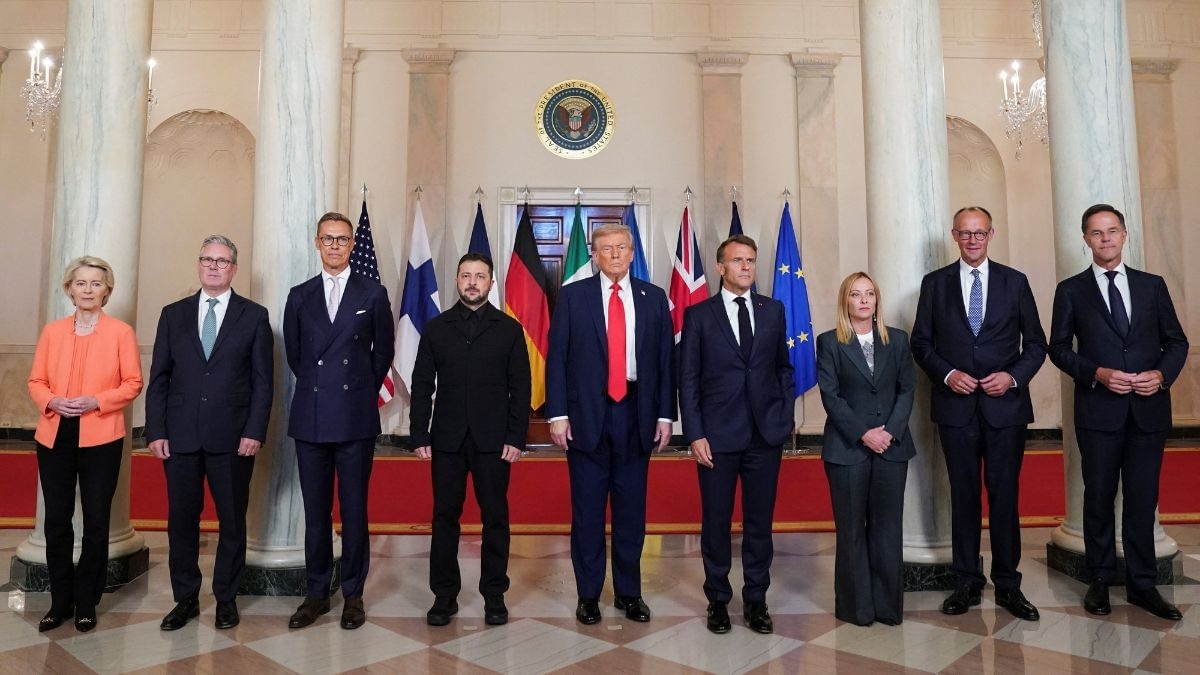
Trump begins arranging Zelenskyy-Putin meet, commits to coordinating security guarantees for Ukraine
New Delhi: US President Donald Trump Monday said that he has begun preparations for a meeting between Russian President Vladimir Putin and Ukrainian President Volodymyr Zelenskyy, following the latter's visit to the White House accompanied by a raft of European leaders.
'During the meeting, we discussed Security Guarantees for Ukraine, which Guarantees would be provided by the various European Countries, with coordination with the United States of America. Everyone is very happy about the possibility of PEACE for Russia/Ukraine. At the conclusion of the meetings, I called President Putin, and began the arrangements for a meeting, at a location to be determined, between President Putin and President Zelenskyy,' Trump posted on Truth Social.
The American president added: 'After that meeting takes place, we will have a Trilat, which would be the two Presidents, plus myself. Again, this was a very good, early step for a War that has been going on for almost four years.'
Trump appointed US Secretary of State Marco Rubio, along with special envoy Steve Witkoff, to coordinate with Moscow and Kyiv for these meetings. Trump's weekend of diplomacy has been perceived as a victory for Putin, who had been isolated by the Western leaders following the start of the current phase of the Russia-Ukraine war in February 2022.
Trump had promised to end the war within 24 hours of assuming power at the White House, while on the campaign trail last year. However, any deal, including a partial ceasefire between Moscow and Kyiv has remained elusive. In the early months of his current presidency, Trump had applied pressure on Zelenskyy to accept his demands for peace negotiations, but in the last few weeks, he has taken aim at Putin for failure to end the war.
Besides training his sights on the Russian president, Trump has also taken aim at India for funding Russia's war machine through New Delhi's continued purchases of oil from Moscow. The US president imposed additional tariffs of 25 percent on India on 6 August, raising the total tariff burden placed on imports from New Delhi to 50 percent, which is set to begin at the end of this month.
Also Read: Amid Trump's tariff bombs, India's business with America surged while imports from Russia dipped 10%
US tilts towards security guarantees for Ukraine
French President Macron told reporters after the hours-long meeting between the leaders that the 'most important' outcome was Trump's commitment to work on security guarantees for Ukraine with his European counterparts.
The US president in the past has ruled out any guarantees to defend Ukraine, in case any peace deal with Russia breaks down in the future, while also making it clear that Washington DC does not support Kyiv's accession to NATO.
'We discussed security guarantees. This is a key issue, a starting point towards ending the war. We appreciate the important signal from the United States regarding its readiness to support and be part of these guarantees…The US President also supported a meeting at the level of leaders. Such a meeting is necessary to resolve sensitive issues,' Zelenskyy wrote in a post on X Monday.
The Ukrainian president added: 'Today was an important step, a demonstration of genuine unity between Europe and the United States. The leaders personally came to support Ukraine and to discuss everything that will bring us closer to real peace, to a reliable security architecture that will protect Ukraine and all of Europe.'
Zelenskyy was dressed in a suit during the current visit to the White House, after the falling out he had with Trump and Vice President J.D. Vance during his last visit to Washington earlier this year.
Russian spokesperson Maria Zakhorova, before the meeting of the European leaders, rejected any potential peacekeeping force from NATO in Ukraine, asserting that such a situation could potentially lead to unpredictable consequences, according to media reports.
Moscow has been pushing for Ukraine to concede territory, especially the Donbas—provinces of Donetsk and Luhansk—a demand Zelenskyy has ruled out. Moscow has also laid claim to two other provinces of Ukraine—Zaporizhzhia and Kherson.
(Edited by Mannat Chugh)
Also Read: 'Dialogue & diplomacy' only way forward, says MEA as it welcomes Trump-Putin's Alaska summit

Try Our AI Features
Explore what Daily8 AI can do for you:
Comments
No comments yet...
Related Articles


Deccan Herald
 5 minutes ago
- Deccan Herald
The rhetoric and real costs of trade wars
India misread the tariffs brought on by the United States and, at a broader level, the Trump administration. We were one of the first to approach the US on this matter, and we continued to believe that we would have a favourable deal till recently, given what we felt was a great rapport between Modi and Trump. Mainstream electronic media houses were complicit in driving this narrative. To understand why India got it wrong, it would be useful to connect two disparate data dots. Top that with India's misreading of Trump's desire to be seen as a look at the first irritant and its impact. India exports roughly $90 billion, paying approximately 2 per cent tariffs currently, and imports roughly $45 billion at 12 per cent tariffs. The trade deficit of $45 billion carries a tariff differential of $5 billion per year in India's favour after adjusting for exempted products. We should have seen this imbalance in America's trade deficit and tariffs long ago and proactively addressed this. Modi is now overhauling the tax rates in a bid to boost the economy. This is expected to cost $20 billion, four times the tariff differential India was enjoying. .The other irritant is oil imports. In 2021/22, India imported roughly 2.5 million barrels of oil every day. Under the tacit approval of the West, India's imports from Russia grew from 2 per cent then to 40 per cent today. India buys 45 per cent of the exported oil from Russia, a growth of 1900 per cent from pre-war levels. China buys the same percentage, a growth of 50 per cent from pre-war levels. So why did India need this extra oil suddenly? It was because we processed this extra oil and sold it for a profit overseas. Therefore, the rhetoric is misplaced, as we are profiting and fuelling the Russian war machine. Predicting the flow of events, we should have scaled down our offtake back to the 2022 levels and with that, justify our need to fuel the Indian economy and keep inflationary tendencies in check. We have now started to do this, drawing a balance between the US and predict that the impact of tariffs at 25 per cent is likely to be in the region of $11-12 billion per annum on tariffed goods and about 0.25 per cent on GDP. In the earliest days of cranking up our imports of oil, the difference was around $30 a barrel, leading to a gain of $16 billion. That has now come down to around $5 a barrel after accounting for logistics, etc. The benefit we get is estimated today to be only $3.5 billion, a delta of $8.5 billion from what we lose out on with the long commentators have suggested many responses, ranging from the knee-jerk to keeping the long-term in mind. The real issue is what we do now. There is no pattern in the madness. Why have the four treatments of the BRIC countries been different? Because there is a different playbook with each one. With Brazil, the US has a trade surplus. Why then, do they have tariffs of 50 per cent, which is higher than China and equal to India? Bolsonaro? With China, 150 per cent was brought down to 30 per cent; here, it is about the rare earths. For the quantities required, the ecosystem is expensive, and the returns don't work out for a commercial operation. The CCP subsidised this for leverage and their long-term plans to pursue electric mobility and clean energy. This leverage on supplies was used to resolve the $650 billion of trade at stake between the US and China. .India made public its hypocritical treatment at the hands of the US, as it bought palladium, uranium, etc. from Russia. However, the reality is that US imports from Russia were at best $3 billion, down some 45 per cent from the previous year. India's imports from Russia stood at $70 billion, almost twice what it imports from the must now not get caught in the whirlpool of its rhetoric. And it certainly must not seek to appease China and Russia in a hurry and on the rebound. One can expect that this is short-term. There are many moving parts – Russia and Ukraine could arrive at a truce as early as next month. India has already started to demonstrate it is willing to reduce its import of Russian oil while not displeasing Russia. The midterms in the US could go against Trump, and the US courts could reverse Trump's executive decisions. Importantly, Trump does not define the long-standing US relationship with India. Trump himself may not have a long-term view on this the US, it seems clear. The average tariff on its imports has seen inflows of $28 billion, three times post these levies were collected in June. This aggregates to $350 billion. Add to this DOGE cuts and some others, and we have $500 billion being saved or added to the US treasury. This pays half its annual interest cost of $1 trillion, which, if left alone, is not sustainable. This is good for no one, as it is the world's biggest market by the short term, one sees no harm in subtly managing the relationships and dynamics at play and being practical. In the long term, anyway, as economist John Maynard Keynes said, we are all dead..(The writer is the former managing director of a Tata Company and now runs a Bengaluru-headquartered corporate finance practice)


Hindustan Times
5 minutes ago
- Hindustan Times
Did Trump 'defend' slavery? Post targeting the Smithsonian sparks backlash
A social media post by US President Donald Trump sparked backlash for allegedly defending slavery, considered one of the darkest chapters in the US's history. On Monday, Trump criticized the Smithsonian Institution for highlighting "how bad Slavery was." President Donald Trump.(REUTERS) Many on social media were quick to interpret the 79-year-old's post as a defense of slavery, which was abolished on December 18, 1865, under the 13th Amendment. Calling the Smithsonian "out of control," Trump said: 'The Museums throughout Washington, but all over the Country are, essentially, the last remaining segment of 'WOKE'.' 'The Smithsonian is OUT OF CONTROL, where everything discussed is how horrible our Country is, how bad Slavery was, and how unaccomplished the downtrodden have been — Nothing about Success, nothing about Brightness, nothing about the Future,' he added. This story is being updated.


NDTV
5 minutes ago
- NDTV
Trump Says Putin 'Tired' Of War, But Possible He Doesn't Want To Make Deal
Washington: US President Donald Trump said on Tuesday he hoped Vladimir Putin was going to "be good" and move forward toward ending the war in Ukraine, but conceded it was possible the Russian president doesn't want to make a deal. "I don't think it's going to be a problem, to be honest with you. I think Putin is tired of it. I think they're all tired of it, but you never know," Trump said in an interview with the Fox News "Fox & Friends" program. Trump spoke the day after hosting Ukrainian President Volodymyr Zelenskiy and European leaders at the White House for talks on his peace efforts, a meeting that followed his summit with Putin in Alaska last Friday. "We're going to find out about President Putin in the next couple of weeks ... It's possible that he doesn't want to make a deal," Trump said, adding that Putin faced a "rough situation" if that were not the case. After Monday's talks, Trump had said that he had called Putin to help set up a one-on-one meeting between Putin and Zelenskiy that would be followed by a trilateral meeting to include himself. Trump said in the Fox News interview he thought relations between Putin and Zelenskiy might be "a little bit better" or else he would not have pursued their one-on-one meeting. He also cited his own warm relationship with Putin even as he acknowledged the potential for a deal to fall through. "I hope President Putin is going to be good, and if he's not, it's going to be a rough situation. And I hope that ...President Zelenskiy will do what he has to do. He has to show some flexibility also," Trump said. On security guarantees for Ukraine that Kyiv and its allies are seeking as part of any peace settlement, Trump said that while Europe was willing to commit troops in some form, the United States would not, although it could provide other assistance. "There'll be some form of security. It can't be NATO," he said. "They're willing to put people on the ground. We're willing to help them with things, especially, probably, if you could talk about by air." Asked what assurances he could give that the US troops would not be on the ground defending Ukraine's border, he said: "You have my assurance. You know, I'm president."
