


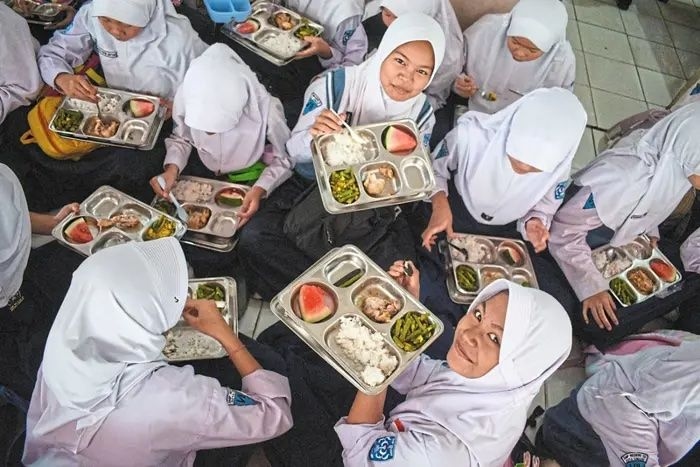
Indonesia cuts outlay on giant free meal plan
JAKARTA: Indonesia has trimmed spending plans for what could still be the world's second-most expensive free meal programme, offering modest relief from fiscal pressures as President Prabowo Subianto advances a host of big-ticket projects.
Planned spending on the programme, which targets reaching 83 million people in the coming months, is now forecast at 350 trillion rupiah next year after officials revised ingredient cost estimates lower by a third, said Dadan Hindayana, head of the newly created National Nutrition Agency.
That marked a 22% drop from spending plans earlier this year.
This year's expenditures are expected to total about US$7.5bil, Hindayana said in a recent interview.
That represented a 29% reduction from prior plans. The recalibration of the five-days-a-week programme, aimed at improving health outcomes for students, children under five, and pregnant or breastfeeding women in the world's fourth-most populous nation, could ease some investor concerns about Indonesia's budget deficit outlook. — Bloomberg
Hashtags

Try Our AI Features
Explore what Daily8 AI can do for you:
Comments
No comments yet...
Related Articles


New Straits Times
 29 minutes ago
- New Straits Times
Gold hits near three-week low on stronger dollar, Fed symposium in focus
LONDON: Gold prices inched lower on Wednesday to their lowest level in nearly three weeks as the dollar strengthened, while investors awaited the Federal Reserve's Jackson Hole symposium later this week for clues on the path for monetary policy. FUNDAMENTALS Spot gold was down 0.1 per cent at US$3,312.79 per ounce, as of 0035 GMT, after reaching its lowest level since August 1. US gold futures for December delivery fell 0.1 per cent to US$3,355.20. The US dollar index climbed to its highest level in more than a week, making gold less affordable for buyers using other currencies. Fed Chair Jerome Powell's speech at the Jackson Hole symposium through August 21–23 is the main focus, with investors watching for any pushback against market pricing of a rate cut next month. Minutes of the Fed's July meeting, due later in the day, are anticipated to offer further insights into the central bank's policy stance. Interest rate futures point to two rate cuts of 25 basis points each this year, with the first one expected in September. Gold typically performs well in a low-interest-rate environment and amid heightened uncertainties. US President Donald Trump ruled out deploying ground troops to Ukraine on Tuesday but suggested air support could be part of a deal to end Russia's war in the region. Ukrainian President Volodymyr Zelenskiy hailed the White House talks as a "major step forward" towards ending Europe's deadliest conflict in 80 years and setting up a trilateral meeting with Russian President Vladimir Putin and Trump. Elsewhere, spot silver held steady at US$37.35 per ounce, platinum gained 0.3 per cent to US$1,309.35 and palladium was down 0.4 per cent to US$1,110.50.
New Straits Times
29 minutes ago
- New Straits Times
Dollar grinds higher with Fed in focus in run-up to Jackson Hole
TOKYO: The dollar got off on the front foot on Wednesday following two days of gains as traders awaited the Federal Reserve's Jackson Hole annual symposium later this week for clues on the path for monetary policy. A speech on Friday by Fed Chair Jerome Powell is the main focus, with the market watching for any push back against market pricing of a rate reduction next month. Traders currently place 84 per cent odds on a cut next month, and expect around 54 basis points of reductions by year-end. The dollar index, which measures the currency against six major counterparts, edged up to 98.393 early on Wednesday, the highest since August 12. It had gained about 0.4 per cent in the first two days of this week. "Given the relatively high bar for Powell to meet, there's a bit of risk being baked into the markets that he leans to the hawkish side and the proverbial rug gets pulled from beneath investors," said Kyle Rodda, an analyst at In Asian hours, the Reserve Bank of New Zealand sets policy later in the day, with a large majority of economists predicting a quarter-point cut to the cash rate. The New Zealand dollar drooped close to Tuesday's nearly two-week low, last changing hands at US$0.5895. "There's little reason for RBNZ to keep rates on hold," said Rodda. "Inflation is within its target band, and although it is no longer mandated to target the labour market, the unemployment rate is at a post-COVID high." For the Fed, traders ramped up bets for a cut on September 17 after a surprisingly weak payrolls report at the start of this month, and were further encouraged after consumer price data showed limited upward pressure from tariffs. However, a hotter-than-expected producer price reading last week complicated the policy picture. Powell has said he is reluctant to cut rates due to expected tariff-driven price pressures this summer. The Fed will release minutes from its July 29-30 meeting later on Wednesday, when the central bank held rates steady, although they may offer limited insight as the meeting came before the weak jobs numbers. The dollar advanced 0.1 per cent to 147.78 yen. The euro eased 0.1 per cent to US$1.1633, the weakest since August 14. Sterling slipped 0.1 per cent to US$1.3476, the lowest since August 12. Australia's dollar edged down to US$0.64485, a level last seen on August 1.


The Star
an hour ago
- The Star
Pakistan's invisible millions
AHMED Raza is invisible in the eyes of his government, unable to study or work, because like millions of other Pakistanis, he lacks identification papers. In the South Asian nation of more than 240 million people, parents generally wait until a child begins school at the age of five to obtain a birth certificate, which is required for enrolment in most parts of Pakistan. Ahmed slipped through the cracks until the end of elementary school, but when his middle school requested documentation, his mother had no choice but to withdraw him. aryam and Ahmed working in the kitchen in their house in Karachi, both not registered with National Database and Registration Authority. Ahmed is invisible in the eyes of his government, unable to study or work, because like millions of other Pakistanis, he lacks identification papers. — AFP 'If I go looking for work, they ask for my ID card. Without it, they refuse to hire me,' said the 19-year-old in the megacity of Karachi, the southern economic capital. He has already been arrested twice for failing to present identification cards when stopped by police at checkpoints. Ahmed's mother Maryam Suleman, who is also unregistered, said she 'didn't understand the importance of having identity documents'. 'I had no idea I would face such difficulties later in life for not being registered,' the 55-year-old widow said from the single room she and Ahmed share. Pakistan launched biometric identification cards in 2000 and registration is increasingly required in all aspects of formal life, especially in cities. In 2021, the National Database and Registration Authority estimated that around 45 million people were not registered. They have declined to release updated figures or reply to repeated requests for comment. To register, Ahmed needs his mother's or uncle's documents – an expensive and complex process at their age, often requiring a doctor, lawyer or newspaper notice. The paperwork, he says, costs up to US$165 – a month and a half's income for the two of them, who earn a living doing housework and odd jobs in a grocery shop. Locals whisper that registration often requires bribes, and some suggest the black market offers a last resort. 'Our lives could have been different if we had our identity cards,' Ahmed said. In remote Punjab villages like Rajanpur, Unicef is trying to prevent people from falling into the same fate as Ahmed. They conduct door-to-door registration campaigns, warning parents that undocumented children face higher risks of child labour and forced marriage. Currently, 58% of children under five have no birth certificate, according to government figures. Registration fees depend on the province; some free, others from US$0.70 to US$7 – still a burden for many Pakistanis, about 45% of whom live in poverty. 'Our men have no time or money to go to the council and miss a day's work,' said Nazia Hussain, mother of two unregistered children. The 'slow process' often requires multiple trips and there is 'no means of transport for a single woman,' she said. Saba, from the same village, is determined to register her three children, starting with convincing her in-laws of its value. 'We don't want our children's future to be like our past. If children go to school, the future will be brighter,' said Saba, who goes by just one name. Campaigns in the village have resulted in an increase of birth registration rates from 6.1% in 2018 to 17.7% in 2024, according to Unicef. This will improve the futures of an entire generation, believes Zahida Manzoor, child protection officer at Unicef, dispatched to the village. 'If the state doesn't know that a child exists, it can't provide basic services,' she said. 'If a child does not have an identity, it means the state has not recognised their existence. The state is not planning for the services that the child will need after birth.' Muhammad Haris and his brothers, who have few interactions with the formal state in their border village in the mountainous province of Khyber Pakhtunkhwa, have not registered any of their eight children. 'The government asks for documents for the pilgrimage visa to Mecca,' a journey typically made after saving for a lifetime, he said. For him, this is the only reason worthy of registration. — AFP
