



Tiruchendur temple consecration to be held in Tamil: Min
The minister told reporters that the ceremony will be held on July 14 from 6am to 7.15am. Work worth around Rs 2.5 crore is being carried out at the temple. "As thousands of devotees are expected to gather for the consecration happening after 14 years, LED screens will be set up. Sufficient facilities such as food, drinking water, and toilets will also be arranged. Since the DMK govt came to power, consecration ceremonies have been carried out at 117 Murugan temples across the state," he added.
Sekarbabu said DMK and 'Dravida model' govt are prioritising welfare of temple devotees, which is why Rs400 crore is being spent on the consecration of Tiruchendur Murugan temple. "Earlier too, the court heard cases and the state govt made it clear that consecration ceremonies can be conducted in Tamil as well. It is the DMK govt that is incentivising priests to perform 'Archanai' in Tamil," he said.
On the upcoming Murugan devotees' conference planned by Hindu right-wing outfits, the minister said the Murugan conference held in Palani was the one attended by real devotees, and that is enough. "No political party leaders were invited for it. No special incentives like free buses or trains were operated or receipts collected. It was completely voluntary. People from all walks of life, from judges and spiritual leaders to devotees, even from countries like China and Japan, attended.
There was no talk of politics. The same cannot be said about the upcoming conference," he said.

Try Our AI Features
Explore what Daily8 AI can do for you:
Comments
No comments yet...
Related Articles


The Hindu
 29 minutes ago
- The Hindu
When DMK opposed a Vice-President candidate from Tamil Nadu 41 years ago
Shortly after the BJP-led NDA fielded Maharashtra Governor and former Coimbatore MP C.P. Radhakrishnan as its candidate for the upcoming polls for the post of Vice-President, several political party leaders, including AIADMK leader Edappadi K. Palaniswami and TMC (Moopanar) leader G.K. Vasan, had appealed to parties in Tamil Nadu to sink differences and back his candidature. The last time a candidate hailing from Tamil Nadu was fielded for the post was 41 years ago – when R. Venkataraman entered the fray. However, now, the Opposition INDIA bloc, of which the ruling DMK in Tamil Nadu is a constituent, has announced former Supreme Court judge B. Sudarshan Reddy, who hails from Telangana, as their nominee to take on Mr Radhakrishnan. While Mr. Radhakrishnan's victory is likely guaranteed on account of the NDA's numbers in both Houses of Parliament, the DMK and its allies shall be opposing the 'son of the soil' for political reasons. However, such a stand is not new for the Dravidian party. On August 1, 1984, the Congress (I) Parliamentary board formally nominated R. Venkataraman, who was serving as the Defence Minister in Prime Minister Indira Gandhi's Cabinet, for the office of Vice-President of India. He had earlier served as a Minister holding various portfolios in Madras State, playing an instrumental role in the State's industrialisation. A report published in The Hindu on August 2, 1984, said that after nominating Venkataraman, also called R.V., Indira Gandhi apprised Satyasadan Chakraborty, the CPI(M) leader in the Lok Sabha, of the views of the Congress board members. The CPI(M) leader, in turn, informed his colleagues in the Opposition about the ruling party's decision, as the Prime Minister had sought their support to ensure Venkataraman's election by consensus, even though the Congress nominee could win comfortably on the party's own strength. Referring to the archival reports of Murasoli, the DMK's mouthpiece, R. Kannan, the author of The DMK Years and biographer of Dravidian stalwarts C.N. Annadurai and M.G. Ramachandran, noted that failing to achieve consensus, leaders of the Opposition parties, including Era. Mohan of the DMK, Atal Bihari Vajpayee of the BJP and Indrajit Gupta of the CPI convened a meeting on August 2, 1984, and decided to field B.C. Kamble, a former MP from the Republican Party, was their joint candidate, fully realising that the contest would only be token in nature. Mr. Chakraborty said the Opposition had nothing personal against R.V. but regretted that the Prime Minister had not followed the procedure of choosing a candidate on the basis of all-party consensus. The Opposition was keen that a member of the weaker sections be given an opportunity to occupy the post of Vice-President, The Hindu reported. Despite not being a part of the Congress-led alliance in the Parliamentary elections in 1980, the AIADMK, which eventually showed signs of moving closer towards the Congress in the early 1980s, supported R.V.'s candidature for the Vice-President post. The election held on August 22, 1984, ended as expected with R.V. defeating Kamble by a comfortable margin. In a statement, Chief Minister M.G. Ramachandran (MGR) thanked Indira Gandhi, saying, 'I am happy that Mr. R. Venkataraman has been elected Vice-President of the Indian Republic. You made it possible by enabling a Tamilian to contest the election and to win it. On behalf of the people and the Government of Tamil Nadu and on my own behalf, I express my sincere thanks to you for having fulfilled a long-cherished wish of the people of Tamil Nadu.' Three years later, when the Congress nominated R.V., the incumbent Vice-President, for the post of President, the AIADMK, by then in alliance with the Congress, backed him. The Opposition parties convened a meeting in New Delhi and unanimously decided to field eminent jurist V.R. Krishna Iyer for the top post. Even this time, the DMK opposed R.V.'s candidature and backed the Opposition as it was part of it. R.V. comfortably won the elections and went on to become the eighth President of India. Chief Minister MGR, in a statement, congratulated R.V. and said, 'Your election to the highest office of the Indian Republic is thus a natural culmination of your eventful public life and is a most fitting tribute to your selfless service. It is a matter of supreme pride for the people of Tamil Nadu, and I am profoundly happy in sharing this pride with them.' The DMK President M. Karunanidhi, in a telegram to R.V., said, 'Please accept my hearty congratulations on your election as the President of India.' AIADMK, DMK both backed Kalam In 2002, when the BJP-led NDA proposed the name of A.P.J. Abdul Kalam, an eminent scientist and native of Tamil Nadu, for the post of President of India, both the ruling AIADMK and the DMK rallied behind him. The DMK was then a key constituent of the NDA. Despite not being a part of the combine, AIADMK supremo and Chief Minister Jayalalithaa described Kalam as the ideal choice and said her party was happy to extend support. In a statement, she said Prime Minister Atal Bihari Vajpayee had spoken to her over the phone about Kalam's candidature. 'I told him that I was delighted with the choice…. Apart from the fact that Dr. Kalam is an eminent and internationally renowned scientist who is respected all over the world, it is a matter of great pride and happiness for the AIADMK that he belongs to Tamil Nadu,' The Hindu reported on June 12, 2002, quoting Jayalalithaa. A report published in this daily on June 16, 2002, noted how the DMK too welcomed Kalam's nomination. Reacting to the Left's contention that Kalam lacked political experience and knowledge of the Constitution, DMK president M. Karunanidhi said political experience was not listed as a necessary qualification for the post of the President of India. Comparing Kalam to former Presidents S. Radhakrishnan and Zakir Hussain, Karunanidhi said all three were eminent in their fields. 'In the current situation, a non-political, secular, non-partisan person like Dr. Kalam was best suited for the role,' he said. On July 18, 2002, the 71-year-old scientist was elected as the President of India. With the support of the NDA, the Congress, the Telugu Desam Party and the Samajwadi Party, Kalam secured nearly 90% of the valid votes against his sole rival Captain Lakshmi Sahgal. After his victory, Kalam addressed his critics who had doubted his suitability for the presidency because of his lack of political background. 'I have been working from 1982 onwards directly with the Government, whether it be related to research, launch vehicles or nuclear programmes. Unless political decisions are taken, satellites will not be in orbit. Political decisions are vital for the success of any programme. I have worked with six Prime Ministers, I know how to handle politics,' a report published in The Hindu on July 19, 2002, quoted Kalam.


Time of India
an hour ago
- Time of India
NSUI first to release manifesto, promises e-bike stations and mental health counselling
Chandigarh: Solar rooftops, subsidised canteens, 24×7 health centres, ramps and lifts, even e-scooter stations- NSUI opened the manifesto season at Panjab University with a catalogue of promises that sounded ambitious, but to many on campus, familiar. Tired of too many ads? go ad free now Last year's commitments of placements, self-defence classes and pad-vending machines still remain unfulfilled, and doubts are already circling whether this manifesto will fare any better. The Congress-backed student body released its document at Chandigarh Congress office, with NSUI national president Varun Choudhary and Chandigarh Congress chief H S Lucky present. Choudhary said the manifesto "reflected the aspirations of every student" and would help NSUI "sweep the elections." Asked how the long list would be assured, Lucky replied, "Manifesto means manifestation, and the motive is to strive for it. " The manifesto covers nearly every aspect of campus life: OBC reservation in admissions and hostels, scholarships for EWS students, a "One PU, One App" for grievances and results, 24×7 innovation hubs in unused classrooms, subsidised food with daily menu voting, women's safety desks, leadership programmes, sports scholarships, and more. Yet PU's lived reality points to a wide gap. As reported earlier this week, manifestos at PU "promise the moon but deliver not even an email ID." On disability access, NSUI talks of ramps and lifts. But even after a Punjab State Human Rights Commission directive and memorandums by students from 2023, PU still lacks a basic ramp at the SBI fee counter where every student queues, as reported in June. An accessibility audit in 2024 exposed further deficits, while last year's council chose to prioritise cultural fests instead. Tired of too many ads? go ad free now Women's safety is another major plank. NSUI promises a 24×7 task force, grievance desks and full CCTV coverage. But PU already struggles with inadequate security staff, and despite budget approval in December for CCTV expansion, installation is yet to begin. As TOI reported in July, even with the library buzzing 24×7, many women students avoid the dark, poorly lit roads leading back to their hostels. Mental health counselling, too, finds mention. But counselling is already mandatory under UGC norms, and PU has only one part-time counsellor for over 16,000 students- a crisis TOI exposed in July. Likewise, the pledge for a YouTube channel ignores that PU already runs one. With the university facing a financial crunch and still awaiting over Rs 47 crore for hostel construction, proposals like solar rooftops, e-scooter stations and 24×7 doctors sound more like slogans than plans. The much-touted "One PU, One App", pitched as a digital hub for results, grievances, library and transport- also seems a distant dream. PU councils have failed for years to provide students even a basic official email ID, despite repeated assurances in manifestos. Against that backdrop, an all-in-one app looks more like a distant hope than a deliverable. Choudhary admitted NSUI could only "pressurise" the administration, without explaining how the projects would move from manifesto to implementation. Still, by releasing its manifesto first, NSUI has forced other groups to catch up. Whether this document turns into delivery or another year of recycled paper promises is the question weighing on PU voters.

Indian Express
an hour ago
- Indian Express
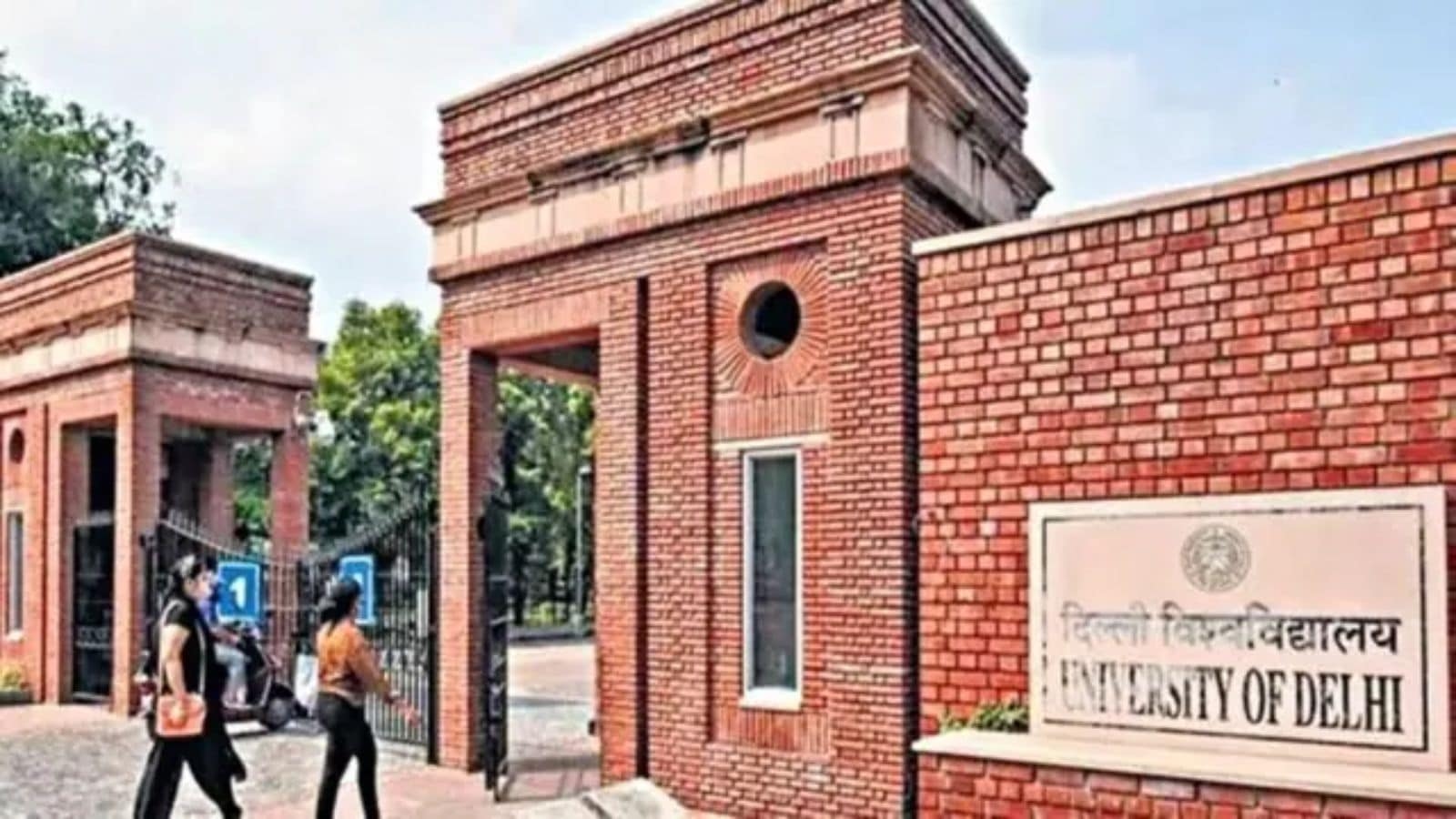
DUSU office vandalised by unidentified men, student wings trade barbs
Ahead of the Delhi University Students Union (DUSU) election, which is scheduled for next month, its office was vandalised on the intervening night of Monday and Tuesday. According to Delhi University officials, a group of 20 to 25 unidentified men forced their way into the DUSU building, after allegedly kicking open the main gate and thrashing the guards who tried to stop them. 'They spoke to the guards in an arrogant manner,' said Prof Rajni Abbi, Director of the South Campus. 'The police are investigating the matter, and based on the outcome of the probe, we will take action against those responsible,' she added. The incident has once again sharpened the rivalry between the two dominant student groups — the Akhil Bharatiya Vidyarthi Parishad (ABVP) and the National Students' Union of India (NSUI) — with one accusing the other of orchestrating the violence. Holding the ABVP responsible, outgoing DUSU president Ronak Khatri told The Indian Express, 'It is a clear attempt by the ABVP to intimidate…' Meanwhile,ABVP member Rishabh Chaudhary said 'I had a couple of days ago held Khatri responsible and shared that he had not done any work in the past year… he himself must have orchestrated this vandalism.' The office of then DUSU president Tushar Dedha was demolished in a similar manner last year, forcing the university to spend nearly Rs 22 lakh on renovations. On Tuesday morning, as the tenure of the DUSU executive for 2024–25 formally ended, university officials sealed the vandalised office, which will now only be reopened once the new representatives are elected.
