


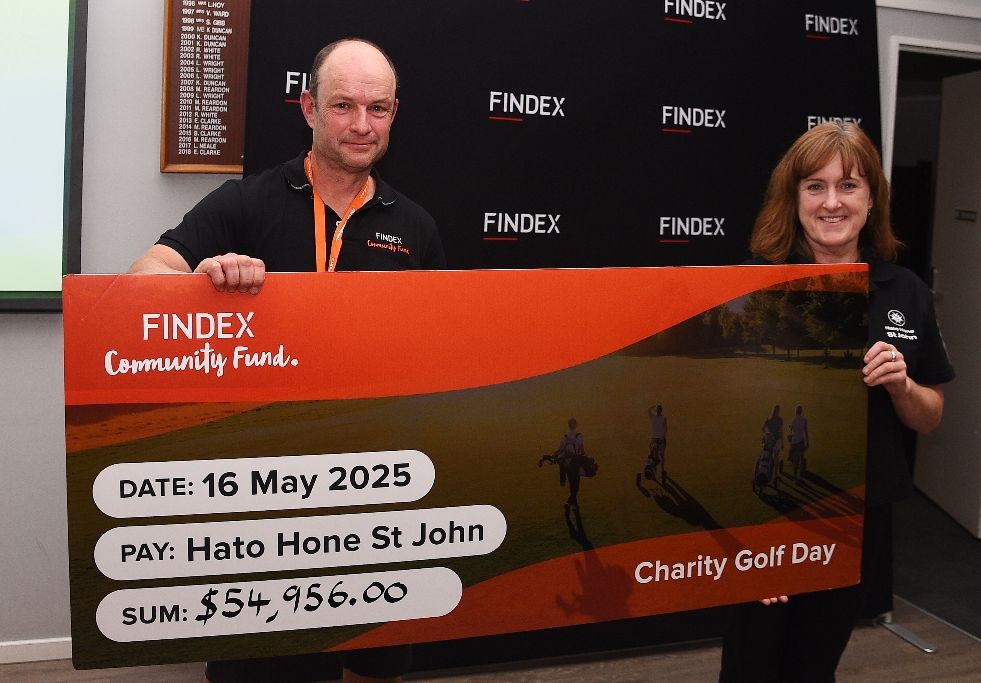
Findex Charity Golf Day Racks Up Record Support For Hato Hone St John
This year, the event was in support of Hato Hone St John's new Nelson Tasman Ambulance Hub in Richmond, a critical project enhancing emergency services for surrounding towns including Nelson, Richmond, Motueka, and Golden Bay.
Under clear skies with Tasman Bay's stunning vistas, the Ambrose-style 18-hole tournament at Nelson Links welcomed players of all skill levels, from business owners to weekend warriors. The day buzzed with excitement, kicked off by a Hato Hone St John ambulance sounding the siren for the shotgun start. 'Now that,' says Andrew Smith, Nelson Findex Managing Partner, 'Was a crowd-pleasing moment that underscored the event's purpose!'
On-course BBQ and drink stations fuelled players, while the 'Party Hole,' hosted by platinum sponsor Tax Management New Zealand, turned up the fun with burgers, music, and a festive vibe. The Bowater Motor Group's Hole-in-One contest, offering a $40,000 car and a matching donation to St John, kept hopes high, though no player claimed the prize.
It was awesome to see the energy and community spirit in action, especially knowing each swing helped fund Hato Hone St John's life-saving services, says Matt Rama, Chief Commercial Officer, of Platinum sponsor TMNZ.
'For TMNZ, supporting the Findex Community Fund just made sense. As a purpose-led business, we share Findex's values around making a real difference. A big thank you to all the players, sponsors, and the Findex team who made the day happen. Together, we've helped make a real impact for a cause that supports New Zealanders.'
Smith is thrilled with the turnout. 'A full draw, on point aural branding from Hone Hato St. John, and perfect weather made this one of our best golf days yet,' he enthuses. 'Every swing helped us support a Hub that will save lives in our region.'
Debbie Zwies, Hato Hone St John South Island Fundraising Manager echoed Smith's enthusiasm: 'With 86% of our Emergency Ambulance Service funding coming from the government, we rely on a mix of third-party support, fundraising, and community generosity to bridge the gap. Support from organisations such as Findex helps us continue delivering vital services across Aotearoa.'
She adds, 'We're pleased to be part of the Findex Community Fund Golf Day and appreciate their contribution to our cause.'
The Hub, with a secured site, will feature four ambulances, six rest areas, and a public training facility to future-proof emergency care – all of which, of course, come at a cost. That's why the impact of initiatives like the Golf Day are so crucial, particularly as Hato Hone St John faces rising costs and ageing infrastructure, adds Zwies.
'The Nelson Tasman region is growing, and so are the demands on our ambulance services. That's why we're raising funds for the purpose-built ambulance hub—to provide more space, improved facilities, and future-proof emergency care for the community.'
Findex's 2025 event aimed to surpass its 2022 record of $18,000, and early estimates suggested it did just that. Indeed, renowned for their financial acumen if not their prowess on the golf course, once the Findex accountants ran a calculator over the numbers, the total collected is $54,956. 'Not too bad for a day's work…ah, golf,' smiles Smith.
Since 2018, the Findex Community Fund has donated over $4.1 million to charities, and this event adds to that legacy. Findex extends gratitude to sponsors including Tax Management New Zealand, alongside players and volunteers.
Hashtags

Try Our AI Features
Explore what Daily8 AI can do for you:
Comments
No comments yet...
Related Articles


Scoop
 44 minutes ago
- Scoop
Transpower Proposes Investment To Future-Proof Upper South Island Network
Transpower has today submitted a proposal to the Commerce Commission for approval to invest $193 million in the upper South Island as electricity demand in the region continues to grow. The option put forward by Transpower is to build two new switching stations near Orari and Rangitata, upgrade two transmission lines through the Waitaki Valley, and to install voltage management equipment. Transpower Executive General Manager Grid Development Matt Webb said the proposed grid upgrades will strengthen the transmission network and ensure areas north of Twizel will continue to have a reliable electricity supply into the future. 'Demand in these areas has been growing steadily, particularly during the summer months when power is used for irrigation,' he said. 'With more homes and businesses switching to electricity use, and forecast electrification of South Canterbury's farming and primary processing sectors, demand for electricity is expected to increase even further.' There is limited electricity generation north of Twizel, so power travels from the Waitaki Valley via high voltage transmission lines to Christchurch and further north to reach the top of the South Island. Mr Webb said that electricity transmitted over long distances needs voltage support to keep the supply stable and avoid surges or other disruptions. 'The more electricity we move, the more voltage support we need. Our proposed upgrades will create connections between existing electricity circuits, increase transmission line capacity, and help keep voltage stable,' he said Transpower is also considering what other solutions could support or defer this investment. 'Our proposal includes $7 million for initiatives that could defer or avoid some investment in transmission infrastructure,' Mr Webb said. 'Known as 'non-transmission solutions', these include large batteries and demand response, where industrial customers or electricity retailers work with their customers to shift demand away from peak demand periods. 'By investing in our national network now, we are future- proofing a reliable electricity supply that serves a huge part of the South Island, enabling its people and businesses to thrive. This investment will ensure this part of our upper South Island's network has the strength and resilience it needs to meet increased demand into the 2030s. 'We've engaged extensively on what the options are to continue to provide a reliable power supply and, overall, our key stakeholders support our investment proposal and acknowledge that grid reinforcement in the region is required.' The proposed investment amount includes an allowance for inflation and interest during construction. The Commerce Commission will consider Transpower's investment proposal, including consulting on it, as part of its process to ensure New Zealanders receive good value for money from Transpower's investments.

RNZ News
3 hours ago
- RNZ News
Gilbert Enoka on teams, leadership and tools for success
When Gilbert Enoka started working with top rugby teams in the 80s, the idea of a 'mental skills coach' was frowned upon. So much so that when he was with a Canterbury team in the late 80s , he had to be disguised as a masseur whenever senior rugby officials were around. But the sports psychologist would soon be accepted and then sought after by some of sports' greatest teams. He was taken into the All Blacks setup by Wayne Smith in 2000, and his ideas on leadership, culture and mental performance would then later become 'the secret ingredient' for a team that won two rugby world cups and dominated the sport for over a decade. Gilbert has since gone on to work with other elite teams: the Black Caps, the Silver Ferns, the Crusaders and Chelsea Football Club in England. He's written about what he has learnt over the years in a book: Become Unstoppable: The blueprint from the world's most successful sports team. To embed this content on your own webpage, cut and paste the following: See terms of use.


NZ Herald
9 hours ago
- NZ Herald
Consumer debt dips to $14.5b but 470,000 Kiwis are behind on payments
'What we've noticed is that consumer arrears across all sectors, retail, energy, banking, credit card, buy now pay later, it's about 470,000 New Zealanders who are currently in arrears,' McLaughlin said. 'But over the last 12 months, that's stabilised at around about that level. We really saw a spike going back a couple of years ago where every year defaults and insolvencies climbed.' Consumer arrears vary across the country according to the latest Centrix Credit Indicator Report, with arrears higher in the North Island compared to the South Island. Tasman District had the lowest level of consumers in arrears at 8.2%, while Wairoa District had the highest at 18.12%. McLaughlin said although past weather events like Cyclone Gabrielle and flooding are factors, he thinks the uplift in the primary industries and the closure of manufacturing businesses are central to the change. A high milk price payout to dairy farmers has bolstered the rural economy. 'The first payments tend to go back to the lenders, back to the banks, because they're carrying a fair bit of debt over the period. 'The second lot went to the IRD and I think it's only now that the rural sector are going to have some disposable income, which hopefully will trickle down into the local economy.' McLaughlin said the South Island was benefiting from lower unemployment, high agricultural gains and lower housing costs, resulting in smaller mortgages. Financial hardship cases increased year-on-year for July, up 7.1%. Almost half (45%) relate to cases of mortgage payment difficulties, with the remainder coming from credit card debt (29%) and personal loan repayments (18%). The highest rate of financial hardship is among those aged between 35 and 49. McLaughlin said households are balancing their budgets a lot better than in the past, and are not spending money on discretionary items as much as they used to. He said buy-now-pay-later purchases and personal loan arrears were not increasing at levels like they were 18 months ago, with buy-now-pay-later arrears comprising about 8%-9% of borrowing. While the situation is good for households, McLaughlin said it places pressure on small to medium-sized businesses that rely on discretionary spending. '[Households are] saying 'if we can't afford it, we're not going to do it now, we're going to be conservative'. That's had a flow-on impact to those small businesses. 'Small businesses rely on their household mortgages to finance their business. They've had increasing wages and other costs going up, they've had interest rates going up and they've had their sales going down because people aren't spending the money.' McLaughlin thinks the current economic climate is affecting more people than during the Global Financial Crisis (GFC) in 2008, and said although the GFC affected people who were invested in the sharemarket, the fallout from Covid was across the population. He said the older demographic had been less impacted by what has happened because they are on better salaries, have greater job security and generally have lower mortgages. McLaughlin said the biggest challenge for borrowers at the moment is non-discretionary debt, and the flexibility being able to borrow money provides can help in times of need. Nation of Debt series Monday: NZ nears trillion-dollar debt burden Tuesday: Government debt: Are higher taxes inevitable? Thursday: Student debt: How big? How bad? Tom Raynel is a multimedia business journalist for the Herald, covering small business, retail and tourism.
