



SAD veteran Gobind Singh Longowal hopes for Akali unity when rebels choose new chief
Talking about the upcoming session of the rebels on Aug 11, he said they will elect the new president, and the five-member committee leading the reorganisation had extended an invitation to SAD president Sukhbir Singh Badal to attend the session. "We have always been votaries of unity. Even the Akal Takht has called for panthic unity. That is our guiding principle," said Longowal.
Asked about SGPC president Harjinder Singh Dhami and former SGPC president Kirpal Singh Badungar backing out of the seven-member committee formed by the Akal Takht on Dec 2, 2024, and reducing it to five members, Longowal said they had only bowed before the directions of the Akal Takht.
"We will continue to follow the Sikh clergy's decision," he said.
Longowal did not rule out the possibility of a truce between Sukhbir Singh Badal-led SAD and the rebel faction, stating that unity was in the best interest of the panth. He added there was no harm in reaching a mutual understanding, as long as core principles and values were upheld.

Try Our AI Features
Explore what Daily8 AI can do for you:
Comments
No comments yet...
Related Articles


Indian Express
 an hour ago
- Indian Express
August 20, 1985, Forty Years Ago: Akalis to Fight Polls
The Akali Dal decided to contest elections in Punjab and authorised its president, Harchand Singh Longowal, to distribute tickets to the party candidates. Longowal said the party would contest all 117 assembly seats in the state. Asked if the Akali Dal would enter into a poll pact with other parties, he said, 'Only time will tell.' Lokpal Bill The government rejected the strong opposition demand that the Prime Minister should also be brought under the purview of the Lokpal Bill, which the government wants to introduce in the current session. The Minister of Parliamentary Affairs, H K L Bhagat, told the Opposition leaders during his second meeting with them that the government feels the institution of the Prime Minister is on a 'unique footing' and has thus been excluded. South Africa Riots (By Arun Gandhi) That the burning of Mahatma Gandhi's Phoenix Ashram and the racial riots that rocked Inanda district were engineered by the Government of South Africa is confirmed by the Ashram's trustees. Mewa Ramgobin, chairman of the working committee that administers the Ashram, told me over the phone that the Ashram and the scores of Indian farmers in Inanda district were served with notices to quit six months ago. The government informed them that the entire area was required for the projected development of the Kwazulu homeland. Saving Thimphu Talks India is making special efforts to save the talks in Thimphu between Sri Lankan government representatives and Tamil organisations and has put forward some new ideas and proposals. Efforts were also being made to ensure the observance of the ceasefire.
Indian Express
an hour ago
- Indian Express
S Y Quraishi writes: For EC, a return to transparency is not just desirable — it is necessary
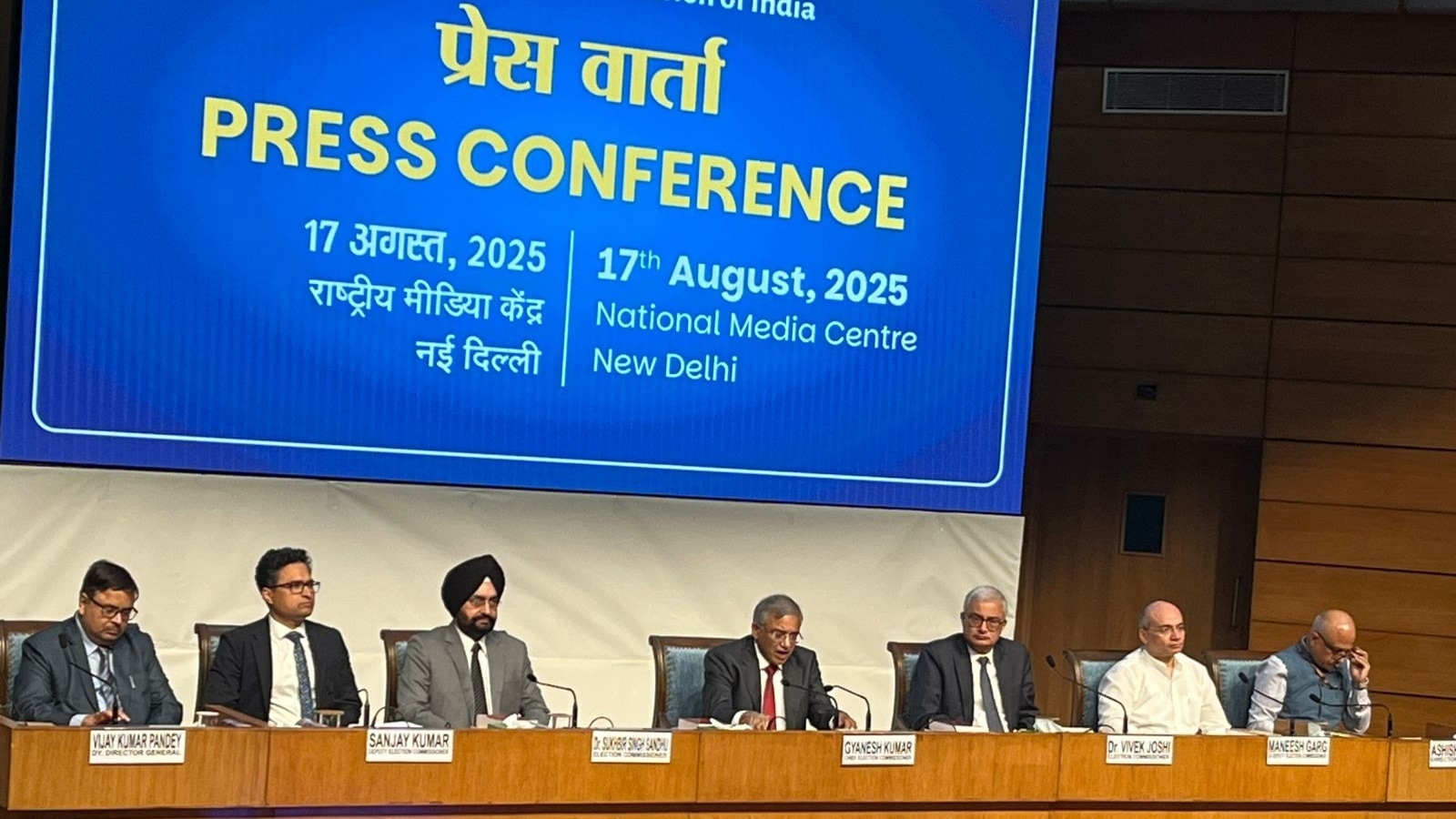
Free and fair elections are the lifeblood of a democracy, and the electoral roll is its very foundation. Without an accurate, inclusive and credible roll, the process risks being undermined at its very start. In a country as large and diverse as India, where the electorate exceeds 960 million, the preparation and continuous updating of electoral rolls is an extraordinary logistical and democratic exercise. It is through these rolls that the principle of 'one person, one vote' is given practical shape. The Election Commission of India (ECI), constitutionally mandated to conduct free and fair elections, has over the decades placed emphasis on the integrity of the electoral roll. The Supreme Court has repeatedly underscored this, holding that free and fair elections form part of the basic structure of the Constitution, and that accurate voter lists are integral to that process. Transparency has long been the ECI's guiding principle. From making draft rolls publicly available for claims and objections, to deploying technology for online search, to inviting political parties and civil society to participate in verification drives, the ECI has tried to keep the process open to scrutiny. For decades, this openness was a source of immense public trust. Surveys by the Centre for the Study of Developing Societies (CSDS) through the 1990s and 2000s consistently found trust levels in the ECI to be among the highest for any public institution, often exceeding 75-80 per cent. This trust was earned through visible impartiality, procedural fairness, and innovations that enhanced both access and credibility. One of the most remarkable exercises in electoral roll management was undertaken under the leadership of CEC N Gopalaswami in the 2007 Uttar Pradesh assembly elections. The ECI, then concerned about inflated rolls and the potential for bogus voting, introduced an innovative method to deal with the problem of 'SAD' voters — an acronym for Shifted, Absent, or Dead voters. Instead of deleting these names, which could have led to controversy or large-scale disenfranchisement, the ECI prepared a separate list of such voters for each polling station, based on door-to-door verification. These lists were handed over to the presiding officers, who were tasked to do a thorough check when such voters came and record how many of them actually turned up to vote. The result was telling: In most constituencies, only 2-3 per cent of these SAD voters appeared at the polling station. (This practice was followed up in other states, too, but the result was not the same. In Gujarat, about 24 per cent of the voters from the SAD list turned up.) With the list in the hands of the presiding officers, impersonation became impossible. The exercise virtually eliminated bogus voting and was hailed as a 'thundering success' — a practical demonstration of how field innovation, without disenfranchising anyone, could protect the purity of the poll. From 2011 onwards, the ECI began marking National Voters' Day on January 25. The idea was twofold: To celebrate the democratic spirit and to focus public attention on voter enrolment and participation, especially of the young. Each year, a new theme has reinforced the centrality of the voter: Greater Participation for a Stronger Democracy (2011 and 2012). Inclusive and Qualitative Participation (2013). Ethical Voting (2014). Easy Registration, Easy Correction (2015). Inclusive and Qualitative Participation (2016). Empowering Young and Future Voters (2017). Accessible Elections (2018). No Voter to be Left Behind (2019). Electoral Literacy and Making Our Voters Empowered, Vigilant, Safe and Informed (2020 and 2021). Making Elections Inclusive, Accessible and Participative (2022). Nothing Like Voting, I Vote for Sure (2023). Nothing Like Voting, I Vote for Sure — Every Voter Matters (2024, 2025). Running through these years is a clear institutional message: Every single voter counts, and no eligible citizen should be excluded for want of opportunity or access. The current Special Intensive Revision (SIR) in Bihar is ostensibly part of this tradition. Through the SIR, the ECI aims to capture new voters, correct errors, and remove ineligible names through a de novo process. Around 2003-4, the ECI had taken a decision to stop making voter rolls de novo as by then most state rolls had been digitised and electronic voter cards distributed. This practice was followed by successive Commissions. Even the present Commission conducted the 2024 general elections with a summary revision, which meant that the existent rolls were cross-checked by door-to-door visits and additions and deletions made. What was valid till 2024 has suddenly become wrong. Were the Commissions in the last two decades less wise? The trust the ECI once commanded almost unquestioningly is now under greater public scrutiny. Allegations of executive overreach, perceived inaction in the face of violations, and reduced transparency have prompted debates about whether the institution is as fiercely independent as before. While the procedural architecture for transparency — such as draft roll publication, booth-level officer verification, and stakeholder consultation — remains in place, the perception of impartiality is as important as its reality. Reinforcing this trust is as crucial as ensuring technical accuracy. In the current SIR, the Commission has released a granular breakdown of deletions: About 65 lakh names removed, including 22 lakh deceased voters, 36 lakh permanently shifted or untraceable individuals, and 7 lakh duplicates. This precision in identifying and removing inaccuracies is laudable. However, the number of new voters added after this clean-up has not been made public — leaving an incomplete picture of the revision's net effect. That is a serious omission, as the addition of bogus voters is a perennial complaint. The SC issued a landmark interim order on August 14, directing the ECI to publicly disclose the names and reasons for exclusion of approximately 65 lakh voters removed from Bihar's draft rolls. The names must be published within 48 hours, through multiple platforms — including district electoral websites, public notice boards, and newspapers, radio, and television. This directive aims to enhance transparency, prevent voter disenfranchisement and ensure accountability in electoral roll revisions — critical to preserving public trust ahead of the Bihar elections. The Court clarified it was not curtailing the ECI's authority to conduct revisions but underscored that such authority must be exercised transparently. It emphasised that citizens should not depend on intermediaries or political agents to know whether their names were removed. Public access is fundamental to democratic accountability. For an organisation that has built its reputation as one of the most respected election management bodies in the world, returning to its fullest, most uncompromising version of transparency is not just desirable — it is necessary for the preservation of democratic trust. If the ECI truly believes 'every vote matters', it must prove it by showing every voter it has added — not just every name it has removed, and every duplicate voter it has detected. The writer is former Chief Election Commissioner of India and author of An Undocumented Wonder — The Making of the Great Indian Election


News18
7 hours ago
- News18
Uttarakhand Minority Education Bill introduced in assembly
Agency: Gairsain, Aug 19 (PTI) The Uttarakhand government on Tuesday introduced the Uttarakhand Minority Education Bill 2025, which aims to extend minority status benefits to institutions run by the Sikh, Jain, Buddhist, Christian, and Parsi communities, in the state assembly. At present, the minority educational institution status is granted only to the Muslim community. Once the Uttarakhand Minority Education Bill 2025 is implemented, the Uttarakhand Madrasa Education Board Act, 2016, and the Uttarakhand Non-Government Arabic and Persian Madrasa Recognition Rules, 2019, will be repealed, effective July 1, 2026. When the Act comes into force, the study of Gurumukhi and Pali languages will also be possible in recognised minority educational institutions. This bill provides for the formation of an authority, making it mandatory for educational institutions established by all minority communities to obtain recognition from it. This authority will work to facilitate and promote educational excellence in these institutions so that the children of the minority community get quality education and their educational development can take place. Under the bill, the authority will grant recognition to a minority educational institution only if certain conditions are fulfilled by the applicant. If any condition is violated or the funds received from fees, donations, grants or any other funding source are found to be misused, the recognition of that institution can also be terminated. The authority will ensure that education is imparted in these institutions as per standards set by the Uttarakhand Board of School Education and the evaluation of students is fair and transparent. PTI DPT SKY SKY (This story has not been edited by News18 staff and is published from a syndicated news agency feed - PTI) view comments First Published: Disclaimer: Comments reflect users' views, not News18's. Please keep discussions respectful and constructive. Abusive, defamatory, or illegal comments will be removed. News18 may disable any comment at its discretion. By posting, you agree to our Terms of Use and Privacy Policy. Loading comments...
