



‘History Doesn't Favor the Bulls,' Says Top Investor About Palantir Stock
Elevate Your Investing Strategy:
Take advantage of TipRanks Premium at 50% off! Unlock powerful investing tools, advanced data, and expert analyst insights to help you invest with confidence.
In fact, the company recently crossed the $1 billion quarterly revenue milestone for the first time. While Palantir built its reputation on U.S. government security contracts, its latest results show momentum is spreading beyond that niche. U.S. commercial revenue jumped 93% year-over-year – clear evidence that businesses across the economy are finding enormous value in Palantir's expanding suite of AI tools.
And Palantir doesn't seem to be taking its foot off the gas pedal. The company raised its Q3 revenue guidance to $1.087 billion, which would represent 50% year-over-year revenue growth.
The biggest – and perhaps, only – knock against the company is its sky-high valuation. Seizing on this concern, top investor Julian Lin offers a word of caution.
'Despite stellar performance, I believe PLTR stock's valuation is in bubble territory, far exceeding historical tech bubbles,' explains the 5-star investor, who is among the top 1% of TipRanks' stock pros.
There's one particular historical example that Lin mentions, which could cause PLTR bulls to start sweating. That would be Cisco, which was trading at 30x sales before it came crashing down during the 2000 stock bubble. PLTR was recently trading as high as 100x sales, reminds the investor.
'History has proven time and time again that valuations always end up mattering,' emphasizes Lin.
As great as the company has been performing, Lin points out that PLTR's share price is already pricing in years of future growth. While this has arguably been the case for much of the past year, eventually the investor believes the bubble will pop.
This will especially be the case when some negative catalysts enter the picture, which could come in the form of higher inflation or AI-related job losses. This could cause a massive re-rating for PLTR, which Lin suggests could reach a downside of some 80%.
For that reason, the investor is getting out of dodge and is urging bulls to reconsider their commitment to PLTR.
'I just know that history does not shine well when valuations reach irrational exuberance. I reiterate my Strong Sell rating for the stock,' concludes Lin. (To watch Julian Lin's track record, click here)
How does Wall Street see Palantir? The consensus view is less dramatic but hardly bullish. With 13 Hold ratings, 5 Buys, and 2 Sells, PLTR currently carries a consensus Hold (i.e., Neutral) rating. The Street's average 12-month price target of $154.56 implies ~11% downside from current levels. (See PLTR stock forecast)
To find good ideas for stocks trading at attractive valuations, visit TipRanks' Best Stocks to Buy, a tool that unites all of TipRanks' equity insights.

Try Our AI Features
Explore what Daily8 AI can do for you:
Comments
No comments yet...
Related Articles
Yahoo
 3 minutes ago
- Yahoo
Why Rigetti Computing Stock Is Sinking Today
Key Points Q2 revenue was $1.8 million, down roughly 42% year over year; net loss neared $40 million. Soft jobs data and hotter-than-expected inflation data weighed on risk assets like quantum stocks. 10 stocks we like better than Rigetti Computing › Shares of Rigetti Computing (NASDAQ: RGTI) are sinking on Tuesday, down 8.7% as of 2:46 p.m. ET. The drop comes as the S&P 500 loses 0.7% and the Nasdaq Composite loses 1.5%. The quantum computing company's stock is continuing its slide after its recent earnings failed to impress investors and as macro concerns about the direction of the economy are leading investors to jump out of risky stocks. Rigetti Computing stock drops on weak Q2 and macro jitters Last week, Rigetti released its Q2 report, revealing that its sales and earnings were down significantly year over year. The company's $1.8 million in revenue was nearly 42% less than last year in the same period, and its net income dropped nearly 220% as the company lost nearly $40 million in the quarter. While the loss was exacerbated by some one-off accounting charges, the performance still showed how far the company is from justifying its current market cap of nearly $5 billion. Adding to the pain, recent economic data is putting pressure on riskier stocks like Rigetti. The latest jobs report shows the economy may be slowing, while at the same time, inflation numbers came in higher than expected. Investors should be cautious The company did share some promising operational updates and leaps in its technological development in its earnings release, but I believe we are likely many, many years, if not decades, away from viable quantum computing. Despite this, Rigetti and other quantum computing companies are reaching multibillion-dollar valuations already. I think there is a major disconnect here, and quantum investors may get burned if the economy does really take a dive. Should you buy stock in Rigetti Computing right now? Before you buy stock in Rigetti Computing, consider this: The Motley Fool Stock Advisor analyst team just identified what they believe are the for investors to buy now… and Rigetti Computing wasn't one of them. The 10 stocks that made the cut could produce monster returns in the coming years. Consider when Netflix made this list on December 17, 2004... if you invested $1,000 at the time of our recommendation, you'd have $671,466!* Or when Nvidia made this list on April 15, 2005... if you invested $1,000 at the time of our recommendation, you'd have $1,115,633!* Now, it's worth noting Stock Advisor's total average return is 1,076% — a market-crushing outperformance compared to 184% for the S&P 500. Don't miss out on the latest top 10 list, available when you join Stock Advisor. See the 10 stocks » *Stock Advisor returns as of August 18, 2025 Johnny Rice has no position in any of the stocks mentioned. The Motley Fool has no position in any of the stocks mentioned. The Motley Fool has a disclosure policy. Why Rigetti Computing Stock Is Sinking Today was originally published by The Motley Fool Sign in to access your portfolio

Bloomberg
5 minutes ago
- Bloomberg
AI Crucial to US in Cybersecurity Race Against China, Says Fmr. NatSec Official
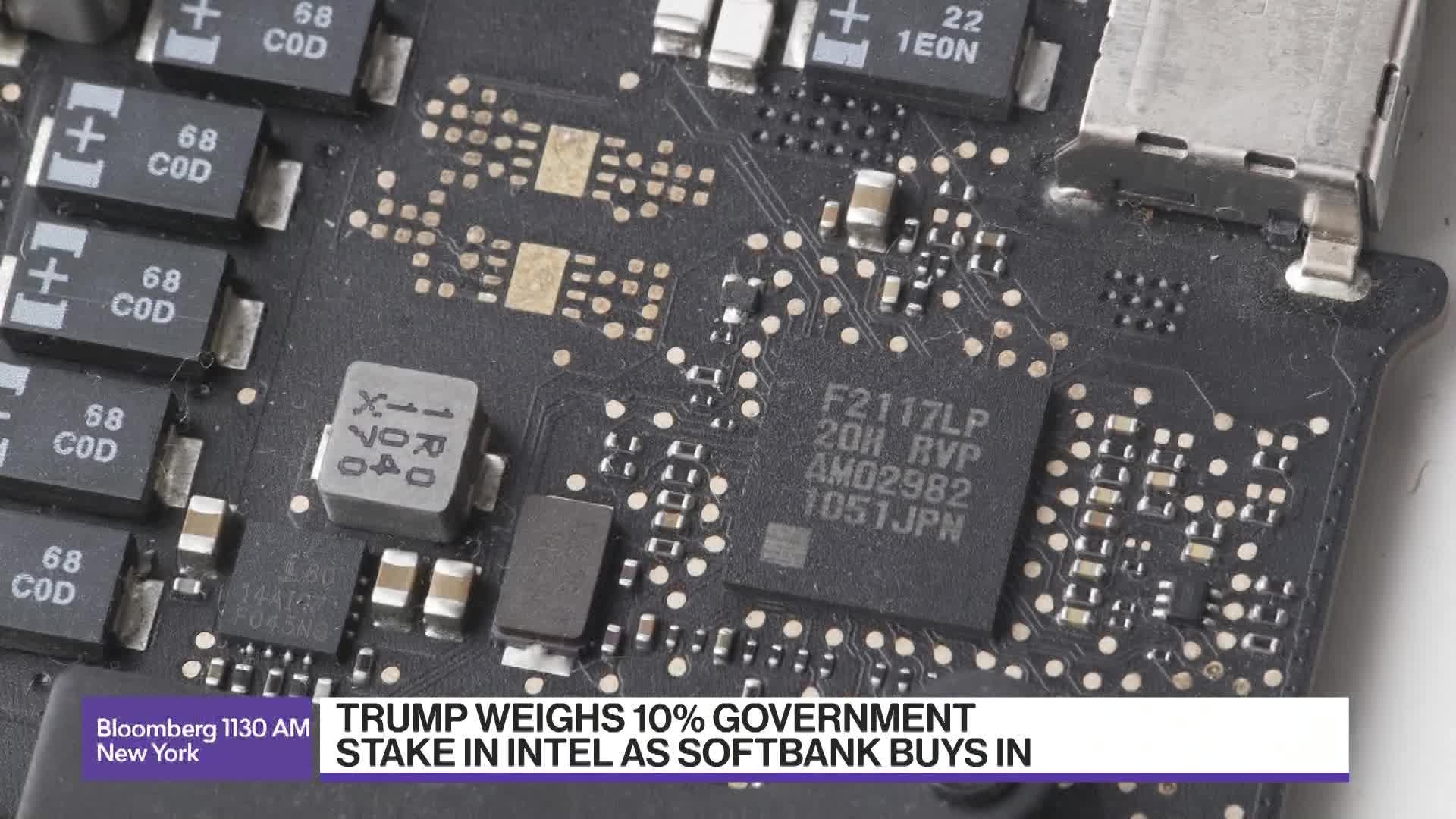
Anne Neuberger, former deputy National Security Advisor for Cyber and Emerging Technology in the Biden administration, breaks down the Trump administration's interest in buying a 10% stake in US chip company Intel and discusses why AI is crucial to the cybersecurity race against China. (Source: Bloomberg)
Yahoo
23 minutes ago
- Yahoo
1 in 6 workers pretend to use AI amid workplace pressures, survey finds
This story was originally published on HR Dive. To receive daily news and insights, subscribe to our free daily HR Dive newsletter. As more U.S. workplaces adopt artificial intelligence tools, 1 in 5 workers say they feel pressured to use it in situations they're unsure about — and 1 in 6 say they sometimes pretend to use AI, according to a recent survey from Overall, 75% of workers said they're expected to use AI at work, whether officially or unofficially. Although most workers said they agree with their leadership's approach to AI, others said they feel pressured and uncomfortable, and some said they pretend to use it rather than push back. 'Artificial intelligence (AI) is taking over the white collar workspace as a daily updates provide opportunities to optimize,' according to the report. 'However, potential does not always lead to smooth implementation.' In a survey of more than 1,000 full-time U.S. professionals, 59% said they use AI at least daily. While two-thirds said they feel energized by integrating AI into their workflow, 1 in 10 said AI has damaged their sense of self-worth at work. In general, 84% of workers said they feel more productive using AI, and 71% said they know how to use it efficiently. Most AI users reported less burnout, less work stress and better job satisfaction. Nearly a third said they feel less lonely, and a quarter said they collaborate more. In contrast, some workers said they struggle to keep up, with 1 in 4 feeling 'often' or 'always' overwhelmed with AI developments. A third also said that learning, using and checking AI takes as much time as their previous approach to work. Among those expected to use AI at work, 25% said they haven't received any training. Another quarter said they received formal training, and a third were given dedicated time at work to learn AI skills. For some U.S. employers, an AI development disconnect has emerged, where some workers pretend to understand the technology and others decline to prioritize AI learning and development opportunities. HR professionals can help by implementing programs that build AI fluency, tailoring initiatives to employees' skill levels and personalizing career paths, Deloitte AI leaders say. HR teams can also identify future-critical skills and create pathways for employees to transition into AI-augmented roles. Recommended Reading How companies are planning for AI disruption
