



Haryana YouTuber Jyoti Malhotra met Pakistani handler day before Operation Sindoor
CHANDIGARH: A day before India launched
Operation Sindoor
, a retaliatory strike following the April 22 terror attack in Pahalgam that killed 26 tourists, Haryana-based YouTuber Jyoti Malhotra met her Pakistani handler, identified as Danish, in Delhi
Operation Sindoor, conducted on May 7, was preceded by blackout drills across north India as part of a classified response to potential electronic surveillance threats.
Officials now confirm that Malhotra, arrested for espionage last week, was not only in the national capital on May 6, but also remained in touch with Pakistani officials over the next few days.
'She met Danish, the expelled staffer from
Pakistan High Commission
, and continued contact even during the blackout period,' a senior official told TOI. Investigators believe this timing was not coincidental, suggesting a larger espionage link to sabotage or monitor India's strategic readiness.
3 others also arrested for espionage; influencer under scanner for 'narrative work'
Malhotra, known for her YouTube channel Travel With Jo, is among four individuals arrested since May 13 by Haryana Police. The others include:
Nauman Elahi, a security guard from Panipat,
Devender Singh Dhillon, a Kaithal resident,
Arman, a youth from Nuh's Rajaka village who allegedly used his identity to issue mobile SIMs for Pak officers and shared details from a defence expo.
Police said all were acting at the behest of Pakistani handlers and passing on information related to vital installations.
Hisar SP Shashank Sawan said: 'In modern warfare, the enemy uses influencers and YouTubers to shape favourable narratives.
by Taboola
by Taboola
Sponsored Links
Sponsored Links
Promoted Links
Promoted Links
You May Like
Free P2,000 GCash eGift
UnionBank Credit Card
Apply Now
Undo
Malhotra's role appears to be part of this psychological front.'
Sources said her income didn't match her international travel patterns and suspect some trips may have been sponsored. "She's been on the radar for months, and now another YouTuber from Odisha is also under surveillance,' one officer added.
'Disproportionate income, Bali trip with Pak handler'
Investigations have revealed Malhotra visited Pakistan at least four times and was in a romantic relationship with Pakistani officials.
They also travelled together to Bali, police sources said. Devices recovered from her possession have been sent for cyber forensic analysis and a probe into financial transactions is ongoing.
Meanwhile, Arman, a Class XII dropout in his early 20s, was apprehended from Firozpur Jhirka on the night of May 15.
He maintained contact with Pakistani handlers via a terror conduit and supplied Indian SIMs for use by Pakistan's intelligence network.
All four arrested individuals are currently being interrogated by multiple security and intelligence agencies.
Hashtags

Try Our AI Features
Explore what Daily8 AI can do for you:
Comments
No comments yet...
Related Articles

Hans India
 16 minutes ago
- Hans India
'Stable, predictable, constructive ties': Modi, China's Wang Yi discuss steps to ease tensions
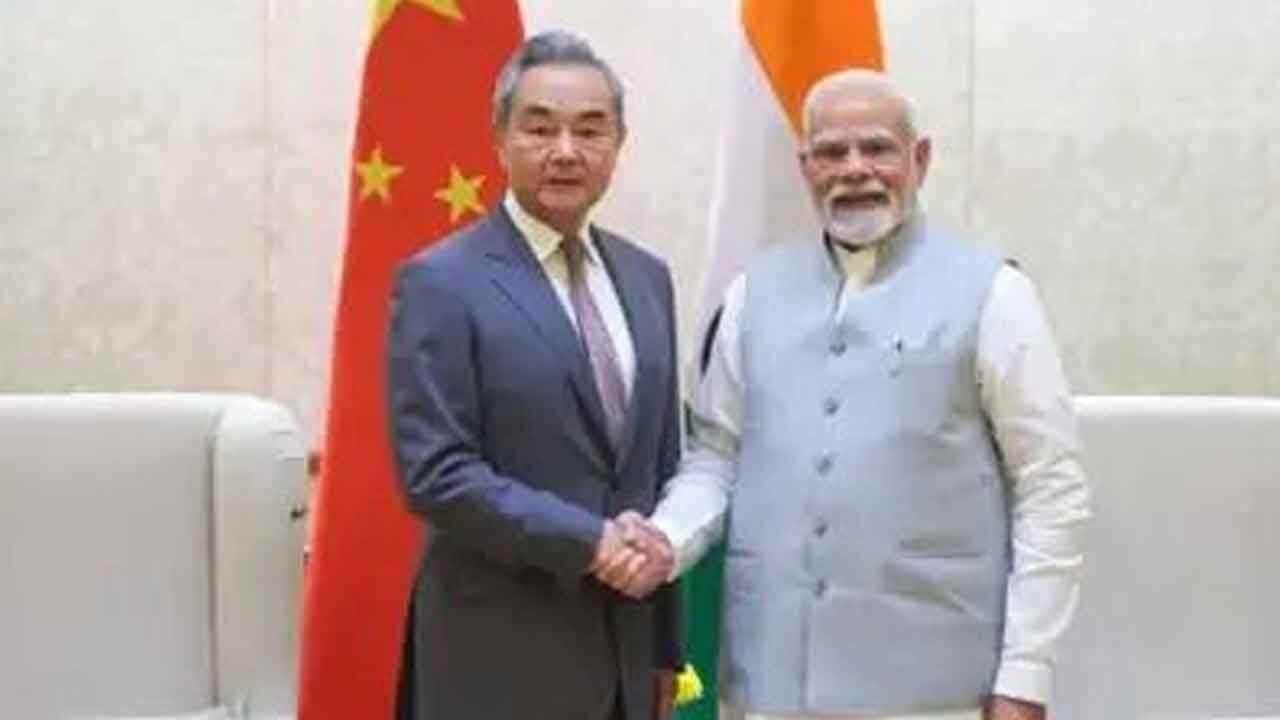
New Delhi: Prime Minister Narendra Modi on Tuesday met Chinese Foreign Minister Wang Yi at the latter's official residence, 7 Lok Kalyan Marg, in New Delhi, as India continues efforts to ease tensions in ties with China. The meeting took place against the backdrop of US President Donald Trump's recent move to impose tariffs, including a 50 per cent tariff on India. Modi stressed the need for peace and stability along the India-China border and reiterated India's commitment to a fair and mutually acceptable boundary resolution. The PM wrote on X after meeting Chinese FM Wang Yi: "Glad to meet Foreign Minister Wang Yi. Since my meeting with President Xi in Kazan last year, India-China relations have made steady progress guided by respect for each other's interests and sensitivities. I look forward to our next meeting in Tianjin on the sidelines of the SCO Summit. Stable, predictable, constructive ties between India and China will contribute significantly to regional as well as global peace and prosperity.' Renowned for his claims of mediating peace between rival nations, Trump may have inadvertently set the stage for an unexpected thaw in India-China ties. Despite Beijing's backing of Pakistan during Operation Sindoor after the Pahalgam terror attack, the recent easing of strains between New Delhi and Beijing is seen, in part, as a fallout of Trump's actions, though he has taken no credit. According to the ministry of external affairs (MEA), Wang Yi is in India at the invitation of National Security Advisor (NSA) Ajit Doval to take part in the 24th round of Special Representatives' (SR) Talks on the India-China boundary issue. During his two-day visit, Wang Yi also held bilateral discussions with External Affairs Minister Jaishankar. Sources indicated that China has promised to address three of India's concerns - rare earths, fertilisers, and tunnel-boring machines. During his public remarks, Jaishankar underlined that 'differences must not become disputes, nor competition conflict,' adding that the visit offered both sides an opportunity to review bilateral ties and exchange views on global and regional developments.


Indian Express
16 minutes ago
- Indian Express
Why China has constructed a rail line between restive Xinjiang and Tibet
Earlier this month, China established the Xinjiang-Xizang Railway Co Ltd, which state media described as a 'significant step in the development of one of China's most advanced transport projects'. The planned railway is important because it will connect two historically restive Chinese border regions adjoining each other — the Xinjiang Uyghur Autonomous Region in the northwest, and Tibet, officially Xizang Autonomous Region, in the south of the country. Both autonomous regions are large, have unique demographics, and harsh terrain and climatic conditions that make the construction of infrastructure projects challenging. Increasing access inside these regions, however, has been an important Chinese policy goal in recent decades. The proposed line will run close to the Line of Actual Control (LAC). The plan to connect Xinjiang with Tibet has been mentioned in Chinese official documents for years, and is part of China's policy to boost rail infrastructure in the region. China opened the high-elevation Qinghai-Tibet Railway in 2006, linking Tibet with the rest of the country by rail for the first time. The line, the highest in the world, is a remarkable feat of engineering — according to the government, about 85% of the route passes at an altitude of more than 4,000 metres, where the average annual temperature is below zero, and air oxygen content is only 50-60% of the standard in lowland areas. The Xinjiang-Xizang line will run 'from Hotan in northwest China's Xinjiang Uygur autonomous region to Shigatse and Lhasa in Xizang', and will be 'part of China's five planned railway corridors into Xizang', a report in China Daily said. Suyash Desai, a Non-Resident Fellow at the US-based Foreign Policy Research Institute, who studies China's defence, foreign, and nuclear policies, said that a larger connectivity loop is planned across these regions. 'The Hotan-Shigatse railway line will be one part of a route that goes around Tibet-Xinjiang, Southern and Central Xinjiang, and Golmud in Qinghai province,' Desai said. The railways constitute one layer of this connectivity loop; the other is an extensive road network. The new company has a registered capital of $13.22 billion, but the estimated cost of the project remains unknown. The project has multiple aims, from facilitating the movement of soldiers to harnessing untapped economic potential in these regions. 'China has been engaged in a lot of big-ticket projects for decades, but its minority regions still have the capacity to absorb additional infrastructure,' said Jabin Jacob, associate professor at the Department of International Relations and Governance Studies at Shiv Nadar University, Greater Noida. 'It is also about knitting together far-flung, politically unstable, economically weak provinces more strongly to the central authority, and is intended to generate easier population movement into these provinces', he said. Desai pointed out that the railways, which now extend to many far-flung regions, facilitate the large-scale mobilisation of troops and movement of defence equipment. This military objective is important in the desert-like parts of Xinjiang, where the conventional economic incentive for investment is not strong. 'When you bring development, the restiveness in these regions could go away,' Desai said. 'This has happened to an extent, with jobs bringing a noticeable element of prosperity in eastern Tibet in particular. Historically, these regions have lagged behind the more prosperous eastern coast of China,' he said. The minority Muslim Uyghurs and Buddhist Tibetans have long been subjected to an official policy of 'Sinicisation', or a centering of the cultural practices of the majority ethnic Han Chinese. The state has typically employed a carrot-and-stick approach towards these populations, which has ensured that no major protests or uprising-like incidents have occurred in more than a decade and a half, Desai said. Jacob said this relative calm suggests that 'draconian measures such as constant surveillance, destruction of religious sites and control of places of worship, have succeeded to a large extent'. 'Infrastructure development in minority regions is part of the effort to reorient their economic development towards centrally directed pathways, to improve control, and 'Sinicise' under pressure of both state control and Han migration into these regions,' he said. These infra projects picked up steady pace about two decades ago. 'China started looking towards its western region with a 'Go West' strategy in 2000. They identified 12 provinces for attention, including these two (Xinjiang and Tibet),' Desai said. Official data show that between 2000 and 2016, the government invested 6.35 trillion yuan ($914 billion) in 300 major projects, mostly in the infrastructure and energy sectors, in China's western region. As it emerged strongly as a global economic force, China started to take a more assertive approach all-round. 'Earlier, they largely believed in the philosophy of 'hide your capability and bide your time' propounded by [the architect of China's economic miracle] Deng Xiaoping,' Desai said. The assertiveness crystallised and became more conspicuous after Xi Jinping became general secretary of the Chinese Communist Party in 2012, he said. Among the reforms that were introduced in the People's Liberation Army (PLA) was a stronger focus on the western region. The new railway could pass through Aksai Chin. Though lagging behind China, India has made an infrastructure push of its own over the last several years, including after the 2020 Galwan clash. In 2023, Defence Minister Rajnath Singh inaugurated 90 border infrastructure projects, from a tunnel in Arunachal Pradesh to a military airfield in Ladakh.
&w=3840&q=100)

Business Standard
16 minutes ago
- Business Standard
India won't take first step to normalise ties, onus on Pakistan: Tharoor
India no longer has the appetite to take the first step in normalising ties with Pakistan after repeated betrayals, senior Congress leader Shashi Tharoor said on Tuesday, urging Islamabad to demonstrate sincerity by dismantling terror networks operating from its soil. He was speaking at the launch of the book "Whither India-Pakistan Relations Today?", an anthology edited by former ambassador Surendra Kumar. The Thiruvananthapuram MP said every Indian attempt at outreach -- from Jawaharlal Nehru's pact with Liaqat Ali Khan in 1950, to Atal Bihari Vajpayee's bus journey to Lahore in 1999, and Narendra Modi's Lahore visit in 2015 -- had been "betrayed" by hostility from across the border. "Given the record of Pakistani behaviour, the onus is on them. They're the ones who have to take the first steps to show some sincerity about dismantling terror infrastructure on their soil. "Why can't they be serious about shutting down these terror camps? Everyone knows where they are. The UN committee has a list of 52 names of individuals, organisations and places in Pakistan. It's not that Pakistan doesn't know they exist," Tharoor said. He said, "Shut them down, arrest some of these characters, show some serious intent." India would be more than willing to reciprocate once such action is taken, but won't take the first step now, the Congress leader said. Recalling the 2008 Mumbai terror attacks, Tharoor said India had provided "overwhelming evidence" of Pakistani involvement, including live intercepts and dossiers, yet "not one mastermind has been prosecuted". He noted that New Delhi showed "extraordinary restraint" after attacks, but subsequent provocations left India with little choice, leading to surgical strikes in 2016 and 'Operation Sindoor'. "In my book Pax Indica, which was published in 2012, I had warned that if there was ever another Mumbai-like attack of comparable impact, with clear evidence of Pakistani complicity, the restraint we had shown in 2008 might become impossible and all bets would be off. "And indeed, that is exactly what happened. No democratic government, least of all in India with its long record of betrayals by Pakistan, could sit idle while its neighbour assaults its civilians and innocent holidaymakers with impunity," he explained. Tharoor also stressed that "peace and tranquillity on the borders is indispensable to our national interest", and cited the reconciliation between France and Germany after World War II, as well as the United States' eventual ties with Vietnam, as examples of adversaries turning into partners. The discussion was also joined by former foreign secretary Kanwal Sibal, former Indian ambassador to Pakistan T C A Raghavan, ex-Army chief general Deepak Kapoor and academician Amitabh Mattoo.
