


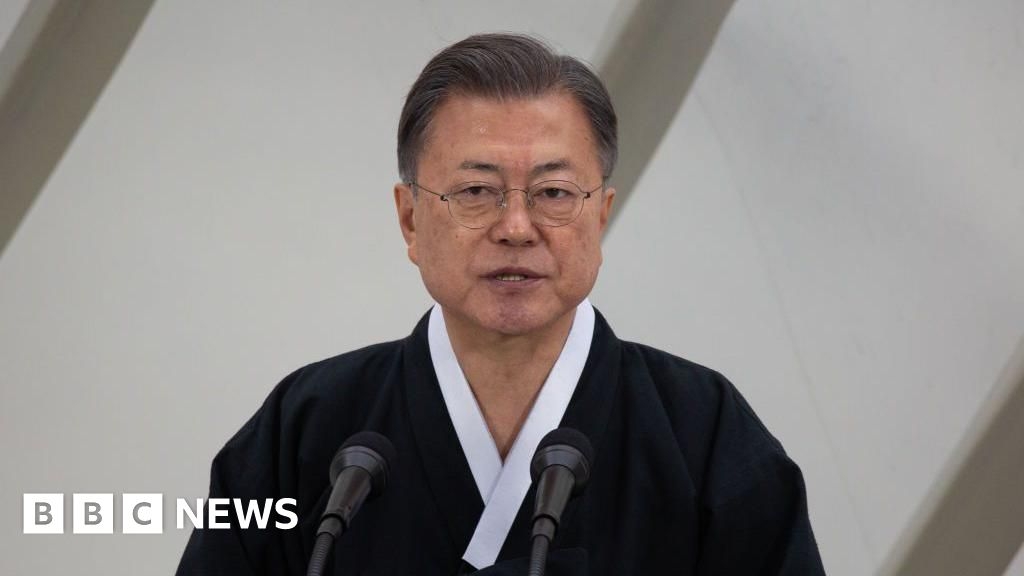
Former S Korea President Moon Jae-in indicted for bribery
Former President Yoon Suk Yeol, who was removed from office this month for his shock martial law declaration, is also facing criminal charges. Besides Moon, former lawmaker Lee Sang-jik has also been indicted, prosecutors say. He is being accused of bribery and breach of trust.In 2022, Lee was sentenced to six years in prison for embezzling company funds.The founder of budget carrier Eastar Jet, Lee was named the head of the Korea SMEs and Startups Agency in 2018 - the same year that Seo was appointed executive director of his airline's subsidiary Thai Eastar Jet.Between 2018 and 2020, Seo received around 217 million won ($150,000; £113,000) in salary and housing support - a sum that prosecutors say constitute bribes intended for Moon.According to prosecutors, Seo was appointed "despite any relevant experience or qualifications in the airline industry", said a Reuters report. He "frequently left his post for extended periods... and did not perform his duties in a manner befitting the position", it added. The residence of Moon Da-hye, the former president's daughter, was raided last September during investigations of the bribery allegations.Moon's indictment comes amid a series of prosecutions against officials in his administration. Earlier this month, Moon's former national security advisor and defence minister were indicted for allegedly leaking intelligence to activists.The country's prosecution service is often accused of being politicised – and when the government changes hands, it's common for rival politicians to be investigated.The current government is led by acting president and prime minister Han Duck-soo the People Power Party's. Moon's Democratic Party has condemned the prosection, calling it a "politically motivated move aimed at humiliating a former president".
Hashtags

Try Our AI Features
Explore what Daily8 AI can do for you:
Comments
No comments yet...
Related Articles


New Statesman
 a day ago
- New Statesman
Andy Burnham has become Labour's king over the water
Photo by Wiktor Szymanowicz/Getty For Labour, this has been an uneasy summer. Average support for the party has reached a new low of 21 per cent, a fall almost unprecedented for a one-year government. Reform, which has led every poll since May, is insurgent on the right; a new party is gestating on the left. Should one be needed, the Tories offer a preview of how quickly 'midterm blues' can become an existential crisis. In these grim times, MPs cast around for signs of life in the Labour family. Away from Westminster, their eyes are drawn to Manchester. In an era when incumbents are defined by their unpopularity, one figure stands apart from this trend: Andy Burnham. It's easy to dismiss the twice-defeated leadership candidate (and plenty still do). But after eight years running Greater Manchester, Burnham is the only senior Labour politician with a positive net approval rating (+7) and the public's preferred choice to succeed Keir Starmer as leader. Among party members, the group who would determine the outcome, his ratings are positively North Korean: a favourability rating of +78 (in a new LabourList poll). Burnham has done little to discourage speculation about his future. Back in June, as I reported at the time, he made what amounted to a leadership pitch at Compass's conference, offering a 'popular left programme' of economic and constitutional radicalism: the reversal of local authority cuts, higher wealth taxes and proportional representation. It's one that some MPs – plenty of them former Burnham critics – are increasingly attracted by. 'He's the only possible front-runner not tainted by being part of this government,' remarks one influential backbencher. 'Andy says he has changed. Personally, I believe him.' Another senior figure suggested: 'There are many more than 80 MPs who would nominate him.' Neal Lawson, the head of Compass, which is repositioning itself as the leader of Labour's soft left, comments: 'Burnham is proving himself to be popular in the party and is seen to have the character and politics to win the country. I meet a lot of people in Labour increasingly willing this to happen.' But is there a way? Speculation over Burnham's imminent return is an old Westminster sport and there's been plenty of it in recent weeks. The Manchester mayor's route back, Labour figures observe, could lie in a by-election in Gorton and Denton, the north-west seat currently held by his former campaign manager Andrew Gwynne, who lost the Labour whip over offensive WhatsApp messages (those close to Burnham dismiss the Gorton and Denton rumours as the 'usual summer silly season'). Starmer loyalists, however, suggest that a National Executive Committee broadly aligned to the leadership could bar the mayor's path. For now, Burnham fills the same political role that Boris Johnson did under David Cameron: an alternative leader who is popular among both party and country and who routinely dissents on matters of national policy. Just as Johnson held up London as a model for the UK, so Burnham does the same with Greater Manchester – the region which has enjoyed faster productivity growth than any other since 2004. Should Labour's woes continue to deepen, it's a pitch that will only receive more attention. Subscribe to The New Statesman today from only £8.99 per month Subscribe This piece first appeared in the Morning Call newsletter; receive it every morning by subscribing on Substack here [See also: What JD Vance was really doing in Britain this week] Related


The Independent
2 days ago
- The Independent
South Korean and US militaries begin annual summertime drills to cope with North Korean threats
South Korea and the United States began their annual large-scale joint military exercise on Monday to better cope with threats by nuclear-armed North Korea, which has warned the drills would deepen regional tensions and vowed to respond to 'any provocation' against its territory. The 11-day Ulchi Freedom Shield, the second of two large-scale exercises held annually in South Korea, after another set in March, will involve 21,000 soldiers, including 18,000 South Koreans, in computer-simulated command post operations and field training. The drills, which the allies describe as defensive, could trigger a response from North Korea, which has long portrayed the allies' exercises as invasion rehearsals and has often used them as a pretext for military demonstrations and weapons tests aimed at advancing its nuclear program. In a statement last week, North Korean Defense Minister No Kwang Chol said the drills show the allies' stance of 'military confrontation' with the North and declared that its forces would be ready to counteract 'any provocation going beyond the boundary line.' Ulchi Freedom Shield comes at a pivotal moment for South Korea's new liberal President Lee Jae Myung, who is preparing for an Aug. 25 summit with U.S. President Donald Trump in Washington. Trump has raised concerns in Seoul that he may upend the decades-old alliance by demanding higher payments for the American troop presence in South Korea and possibly reducing it as Washington shifts its focus more toward China. Tensions on the Korean Peninsula remain high as North Korea has brushed aside Lee's calls to resume diplomacy with its war-divided rival, with relations having soured in recent years as North Korean leader Kim Jong Un accelerated his weapons program and deepened alignment with Moscow following Russia's invasion of Ukraine. Seoul's previous conservative government responded to North Korean threats by expanding military exercises with the United States and seeking stronger U.S. assurances for nuclear deterrence, drawing an angry reaction from Kim, who last year renounced long-term reconciliation goals and rewrote the North's constitution to label the South a permanent enemy. In his latest message to Pyongyang on Friday, Lee, who took office in June, said he would seek to restore a 2018-inter-Korean military agreement designed to reduce border tensions and called for North Korea to respond to the South's efforts to rebuild trust and revive talks. The 2018 military agreement, reached during a brief period of diplomacy between South Korea's former liberal President Moon Jae-in and Kim, created buffer zones on land and sea and no-fly zones above the border to prevent clashes. But South Korea suspended the deal in 2024, citing tensions over North Korea's launches of trash-laden balloons toward the South, and moved to resume frontline military activities and propaganda campaigns. The step came after North Korea had already declared it would no longer abide by the agreement. When asked whether the Lee government's steps to restore the agreement would affect the allies' drills, the South's Defense Ministry said Monday that there are no immediate plans to suspend live-fire training near the Koreas' disputed maritime border. While the allies have postponed half of Ulchi Freedom Shield's originally planned 44 field training programs to September, U.S. military officials denied South Korean media speculation that the scaled-back drills were meant to make room for diplomacy with the North, citing heat concerns and flood damage to some training fields. Dating back to his first term, Trump has regularly called for South Korea to pay more for the 28,500 American troops stationed on its soil. Public comments by senior Trump administration officials, including Undersecretary of Defense Elbridge Colby, have suggested a push to restructure the alliance, which some experts say could potentially affect the size and role of U.S. forces in South Korea. Under this approach, South Korea would take a greater role in countering North Korean threats while U.S. forces focus more on China, possibly leaving Seoul to face reduced benefits but increased costs and risks, experts say. In a recent meeting with reporters, Gen. Xavier Brunson, commander of U.S. Forces Korea, stressed the need to 'modernize' the alliance to address the evolving security environment, including North Korea's nuclear ambitions, its deepening alignment with Russia, and what he called Chinese threats to a 'free and open Indo-Pacific.'


Reuters
2 days ago
- Reuters
South Korea's Lee orders partial phased implementation of existing North Korea pacts
SEOUL, Aug 18 (Reuters) - South Korean President Lee Jae Myung ordered on Monday the preparation of a partial step-by-step implementation of existing agreements with North Korea.
