



Edward too busy to marry
Matters relating to the question of the marriage of the Prince of Wales are discussed by Mr G. Ward Price, who is accompanying the Prince on his tour in South Africa in the capacity of official correspondent. "The eagerness for the future King's wedded welfare," says Mr Ward Price, "has aroused among some sections of the British public a certain impatience. Speculation and gossip follow naturally. Many explanations, most of them grotesquely ill-informed, have been put about for the fact that the Prince of Wales in the early thirties still remains a bachelor. Yet the simplest of them all is nearest to the truth. It is that the Prince has never yet had occasion to think about marrying. In a matter so important for himself and the nation he quite rightly does not intend to be hurried. Like many other busy and efficient men, the Prince believes in concentrating on one thing at a time, and his attitude toward marriage is that it can quite well wait until his Empire tours are over.
"If there were a Princess of Wales the dominions would naturally be most anxious that she should accompany the Prince on his visits. Were the Prince of Wales a married man he could not hope to see the Empire so thoroughly as he now sees it in his travels, and he does not intend to allow marriage to stand in the way of that. These long journeys are by no means undertaken on the spur of the moment. They have been planned a whole year, and sometimes more, ahead. Four months to Canada, seven months to Australia, seven months to India and Japan, seven months to South Africa and the Argentine — those are arrangements that have been filling up great spaces in the Prince's agenda book over since the war.
"In the case of any other young man whose immediate future was so encumbered with foreign travel it would seem not only natural, but praiseworthy, that he should postpone thoughts of matrimony until his time were more his own.
"It can be stated with confidence that the King and Queen agree with their son's attitude toward this question of his marriage. The days have gone past when the marriage of the Heir to the Throne was a matter to be settled in his youth by the monarch and his political advisers with small regard to the personal preferences of the young man whose domestic future was thus taken out of his own hands."
Cycling on one's mettle
To the editor: Sir, concerning the danger of loose metal on roads and streets in Dunedin and vicinity, anyone who has ridden a motor cycle or push bike over these treacherous surfaces has no doubt experienced an unpleasant thrill on running into such an antiquated method of repairing road surfaces. The machine becomes absolutely unmanageable, and the rider is lucky to escape a nasty spill, with always the danger of a following tramcar or other vehicle running over him. I think there ought to be a by-law administered by cyclists and motorists. The City Council and other responsible authorities for the state of the roads could then be charged under this by-law for "negligent control of the surface of the highways" and heavily fined, the fine to come out of councillors' pockets, and not from the public fund. I guarantee then there would be a little more care taken by the "experts" to see that maintenance metal was applied to the roads in a commonsense manner. — I am, etc, C.J.B. Ward — ODT, 4.7.1925
Hashtags

Try Our AI Features
Explore what Daily8 AI can do for you:
Comments
No comments yet...
Related Articles


Otago Daily Times
 8 hours ago
- Otago Daily Times
The (mis)management of Donald Trump
It is like one of those slapstick comedies from the early days of silent films: the Keystone Cops movies, perhaps, or Buster Keaton's various efforts. Lots of people rushing around, constant reversals of fortune and many pratfalls. Last Wednesday, on very short notice, the presidents and/or prime ministers of all the other major countries in the Nato alliance got together online to prep Donald Trump for his summit meeting with Russian President Vladimir Putin in Alaska on Saturday. He had to be coached about his newly adopted positions defending Ukraine's sovereignty and territorial integrity because everybody knows that Trump tends to echo the views of the last person who talked to him, especially in subjects he doesn't know about (which is most subjects). So French President Emmanuel Macron, British Prime Minister Keir Starmer, German Chancellor Friedrich Merz, Italian Prime Minister Giorgia Meloni, Nato Secretary-general Mark Rutte, and sundry other European Nato notables drilled Trump on what to say and what not. Ukraine's President Volodymyr Zelenskyy also got a few words in. Most importantly, they all said, Trump must insist Russia accept a ceasefire before peace negotiations started. Otherwise Putin could drag the negotiations out forever while continuing to conquer more Ukrainian territory. Trump was already quite cross about Moscow's foot-dragging on a ceasefire, so he seemed to take their advice seriously. Indeed, just before he stepped aboard Air Force One to fly to Alaska on Saturday he told reporters: "I want to see a ceasefire rapidly ... I'm not going to be happy if it's not today ... I want the killing to stop." But he was flying there to meet Putin — who would then become the last person he talked to on the subject. It's entirely possible that Putin doesn't have anything on Trump that's strong enough to blackmail him with. Lesser sexual and financial peccadilloes just slide off him like water off a duck's back. So why did "Teflon Don" applaud Putin getting off the plane in Anchorage, offer him a ride in the presidential limo, generally carry on like a bedazzled fanboy? He admires other dictators too, maybe because their absolute power intoxicates him (remember his courtship of North Korean's Kim Jong-un?), but his friendship with Putin is special. Nobody knows why. It was probably inevitable that Trump would do a U-turn as soon as he was in Putin's presence. All his promises of "severe consequences" (secondary tariffs on countries importing Russian oil) if Putin would not agree to a ceasefire went out the window. The 50-day deadline, the eight-day deadline, the tomorrow deadline — all forgotten in a moment. Flying home from Alaska, Trump wrote on Truth Social: "It was determined by all that the best way to end the horrific war between Russia and Ukraine is to go directly to a peace agreement." Who's "all"? Trump. Property tycoon Steve Witkoff and former Florida senator Marco Rubio (total six years of foreign affairs experience) v Putin, Russian foreign minister Sergei Lavrev, and foreign policy adviser Yuri Ushakov (total 133 years of foreign affairs experience). To be fair, Trump probably didn't understand this meant the Russians could go on fighting and bombing Ukraine until there was a peace settlement agreeable to Moscow — which will only be reached if and when Russian's maximal demands, amounting in practice to the subjugation of all Ukraine, have been accepted. He's not a detail man. Trump then summoned Zelenskyy to Washington to hear the bad news. Almost all the European Nato leaders who prepped him last Wednesday came along uninvited (although everybody will pretend otherwise) for a last-ditch effort to turn Trump around again. It might even work again. Even if it works this time, it's impossible to be always the last person Trump speaks to, and the effort to be that person soon degenerates into slapstick and pratfalls. The European Nato heads of government (and Canada's) will soon have to build a new Nato that does the old one's job of deterring Russia, but without the United States. They will, of course, carry on the pretence of the old Nato as long as possible, because although they have the money and the numbers to perform that task without American help there will be many shortfalls and gaps in the new alliance during a lengthy transition (three to five years). It will take a lot of hypocrisy and a massive campaign of perpetual flattery for the old Nato countries to keep Trump on side for that long while simultaneously keeping Ukraine out of Russia's hands. However, that is the task they have now set themselves, although some have yet to come fully to terms with the new strategic realities. • Gwynne Dyer is an independent London journalist.

The Spinoff
a day ago
- The Spinoff
A tired teacher explains why they're striking tomorrow
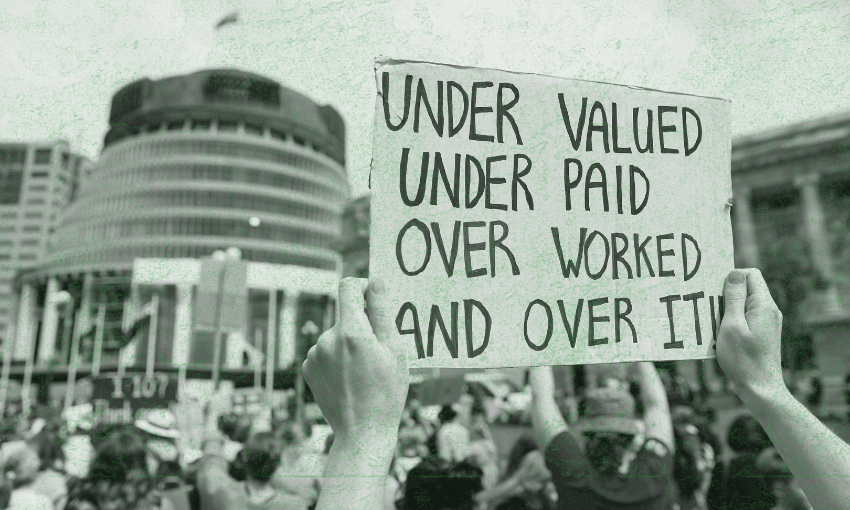
Teachers entered into negotiations with a set of very reasonable demands, but the government ignored our requests and crafted an offer seemingly purpose-built to make things worse, argues secondary teacher Connor Murphy. Last week, the government announced it was disappointed in teachers. This might have come as a surprise to some members of the public, as recent messaging from the government also praised teachers, with education minister Erica Stanford lauding their hard work every single day to 'inspire our young people and do the very best for them'. The reason for this disappointment? Teachers want money for their work. Public service minister Judith Collins mislabelled the upcoming teacher strikes as a 'political stunt', claiming they were premeditated and accusing teachers of attending negotiations in bad faith. So, let's review the recent offers and requests put forth by both sides to see how we've reached this point. Historically underpaid and undervalued Around 50 years ago, teacher salaries were comparable to those of backbench MPs. Now, teacher wages have declined to around half of what MPs earn. You might argue that this is an unfair comparison. After all, MPs will sit in parliament for an exhausting 93 days this year, while teachers are expected to teach students for a mere 170 full days throughout the year. So, it makes sense that teachers receive half as much for twice as many days of work. Oh, wait – no it doesn't. I won't contest that politicians have a more demanding job than teachers in many regards (although watching Gerry Brownlee try to preside over the House of Parliament does feel eerily similar to observing a beginning teacher losing control of a Year 11 class). But I think most people would find it difficult to argue that MPs work twice as hard as teachers do. I like to think of myself as pretty proud to be a Kiwi. I'm a second-generation immigrant with British and Australian parents, but New Zealand has always been home to me. I love our culture, our native flora and fauna, and the kindness of New Zealanders. Unfortunately, I find myself tempted to leave my home in pursuit of better living conditions. Just across the ditch, starting teachers receive $18,000 more per year in Victoria and $31,000 more per year in the Northern Territory than what they get in New Zealand. The call of cheaper groceries and higher wages beckons to me more and more each day. The prime minister says he has a solution. At the National Party conference earlier this month, Christopher Luxon insisted that New Zealand needed to create more jobs and increase wages if we hoped to stem the brain drain to Australia. I agree: to keep the best-quality teaching professionals in New Zealand, you must pay them competitively. If we continue to undervalue teachers, we will lose our best and brightest to other countries willing to pay teachers what they're worth. This is why teachers entered into these negotiations with the expectation of better pay and conditions. We deserve better, and if we don't get better, then our teacher staffing shortage will only worsen. The recent pay offer stings especially hard for teachers following the government intervention in our pay equity claims in May. Judith Collins has attempted to argue that secondary school teaching has historically been considered a masculine career, and so the pay equity claim wouldn't have led to anything. But it's worth pointing out that all New Zealand teachers have the same base salary scale. That means that primary school teachers and secondary school teachers receive the same salary for their level of experience. While secondary schools have a higher proportion of male teachers, primary schools have historically been staffed overwhelmingly by women, as has the overall profession since the unified base salary scale was introduced. The purpose of this pay equity claim was not to look at the salaries of secondary school teachers, but how teachers as a whole have been undervalued because of this systemic inequality. However, just before these claims could be acted on, ministers met in secret and undermined this correction for the sake of minimising government spending. This sent a clear message to teachers across Aotearoa: teachers are worth less to the government than even a single moment of bad public relations. Another example of how little teachers' time and energy are valued can be seen through the curriculum refresh and the recently announced overhaul of NCEA qualifications. I have worked at a couple of different schools during this curriculum refresh, and can say with near certainty that every teacher across New Zealand has dedicated at least 100 hours to it. Unfortunately, teaching isn't a job where you can pause your other duties to find time for something like this. Lessons still need to be planned, assessments need to be marked, and students still need to be taught. Pay them for their labour. During the last teacher pay negotiations in 2023, the Ministry of Education and the Post-Primary Teachers' Association were unable to reach an agreement for over a year. According to the arbitration panel that settled the dispute, 'the ministry refused to engage in productive discussions with teachers about most of our long-standing issues'. This culminated in multiple nationwide strikes, needlessly costing teachers time and money. Yet, the government feigned surprise and shock that teachers left negotiations this year. They labelled our strike as 'premeditated' and done in bad faith. I would instead label it the forgone conclusion from mistreating teachers at the beginning of negotiations, the same way we were mistreated two years ago. This wasn't premeditated, but it was something the government should have predicted from its offer. An insult disguised as an offer Judith Collins and Erica Stanford claimed in their announcement at the Beehive that the PPTA had only been negotiating with the government for six days (spread across nearly two months since June 17). According to these two ministers, the government made its initial offer, but received no counteroffer. This is probably true, but it ignores the fact that the PPTA had already submitted a list of proposed claims that teachers across the motu had signalled support for. Teachers did not walk away from a terrible first offer without warning or explaining what we wanted. We walked away from a terrible first offer that ignored every request we made. The PPTA requested an annual pay increase of 4%, which is, on average, less than we received during our 2023 negotiations. The government instead offered teachers a pay increase of 1%. For a new teacher, that would amount to an additional $11.79 a week. What's worse is that a 1% pay rise would fall below our current rate of inflation of 2.7%. In other words, this offer represents a pay cut instead of the much-needed pay rise the education sector needs. During negotiations, the government emphasised fiscal restraint. That's a hard pill to swallow when MPs' salaries are getting rolling rises of 10.5%, and ministers recently signed off on a pay rise of up to 80% for Crown board members. To some extent, I understand those pay increases. After all, we're living through an unprecedented cost-of-living crisis, and people need more money to make ends meet. I just wish the government acknowledged teachers as people, too. It's also difficult to accept that our ministers seem to be working on the assumption that experienced teachers are making $40,000 more than they actually are. In a press release responding to the strike announcement and subsequent radio interviews, Judith Collins said experienced teachers made over $140,000 each year. A teacher at the top of the pay scale is actually earning $103,000 and might be getting an additional $2,000 to $5,000 for extra duties like being in charge of a subject. Deputy principals might be close to $140,000 a year, but there aren't enough of those roles to pay even 10% of experienced teachers that much money. New Zealand schools are facing an increasing number of students with diverse needs and backgrounds who frequently require specialised pastoral care and learning support. The PPTA sought to protect these vulnerable ākonga by increasing pastoral care funding for schools, to ensure that students can learn in an environment where they feel safe and supported. The government disregarded this claim entirely, with no changes to pastoral care mentioned in its offer. The PPTA also requested funding for helping teachers upskill within schools in the form of a professional learning and development allowance and financial incentives for teachers who can demonstrate proficiency in key areas, like te reo Māori (such incentives already exist across the public sector, including the Ministry of Education). Instead, the government wants to restrict teachers' current ability to complete funded study awards or sabbaticals. The claim put forward by the government revokes all funding unless a teacher can publish research based on their studies, which means teachers cannot use this funding to improve their understanding of New Zealand's official languages unless they are already fluent. Teachers cannot take part in study days or overseas conferences to improve their practice. The government might argue it wants highly skilled and professional teachers, but it isn't willing to pay for them. One of the more glaring needs in New Zealand schools that the curriculum refresh has uncovered is the need for properly resourced curriculum advisers. We need good resources to deliver this evolving curriculum to students with confidence. Instead of reassuring teachers that the Ministry of Education is committed to helping teachers do the best job they can in planning for this new curriculum, the ministry refused to acknowledge this claim and left it out of their offer. Without adequate funding or resourcing, teachers will be overwhelmed by the impending changes to NCEA and the New Zealand curriculum. The government's obsession with saving money and cutting costs risks burning out teachers and worsening our teacher shortage. Where can we go from here? Despite rising tensions and concerns within education, teachers entered into these negotiations with a set of very reasonable demands. Instead of making a reasonable counteroffer, the government ignored our requests and crafted an offer seemingly purpose-built to make things worse. Some might even be inclined to argue that the government designed the offer as a premeditated political stunt to win points with a voter base that has historically disliked those in the public sector. Some might say that the government has initiated these negotiations in bad faith. Not me, though – I'll leave such conspiratorial accusations to be handed out by our MPs. Instead of trying to figure out who's morally right or wrong, I want the government to focus on crafting an actual offer. One that pays teachers well enough to draw in talented new professionals and helps our current staff develop the cultural and pastoral competency needed to ensure our ākonga learn and succeed.


NZ Herald
2 days ago
- NZ Herald
Europe leaders to go with Zelenskyy for Washington talks
Sir Keir Starmer has praised Donald Trump's offer of an Article 5-style security guarantee for Ukraine, as European leaders prepared to head to Washington for a crucial meeting with the US President and Volodymyr Zelenskyy. The British Prime Minister chaired a meeting with the Ukrainian President and members of the
