


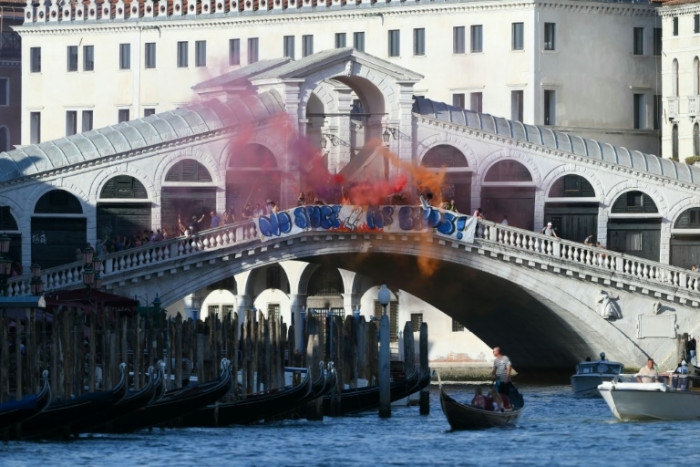
'Eat the rich': Venice protests shadow Bezos wedding
"Bezos, out of the lagoon", the demonstrators chanted as they wound through the city centre, some brandishing signs that read: "Eat the rich", "Rejected", and accusations that Venice's mayor is "corrupt".
The peaceful protest, held in sweltering heat, was led by the "No place for Bezos" group, which has campaigned for days against what it calls the couple's harmful economic and environmental footprint on the city.
"We are here against what Bezos represents, his model, the Amazon model, based on exploiting people and land," said Alice Bazzoli, 24, an activist with "No Space for Bezos" who has lived in Venice for five years, speaking to AFPTV.
Protesters later unfurled a large "No place for Bezos" banner and lit flares above the famous Rialto Bridge spanning the Grand Canal.
Matteo Battistuta, a 20-year-old student, said he wanted to send the message that "Venice is fighting back, it's not a dead city, it acts in its own interest before tourism's".
"We believe Venice can still be a place worth living in," he added.
Bezos, 61, and Sanchez, 55, exchanged vows during a ceremony Friday evening on the island of San Giorgio Maggiore, opposite St Mark's Square.
The ceremony capped off a week of yacht parties and VIP events, due to end with a lavish ball Saturday night -- as Venetians remain divided over the impact on the city's image.

Try Our AI Features
Explore what Daily8 AI can do for you:
Comments
No comments yet...
Related Articles

Bangkok Post
 5 days ago
- Bangkok Post
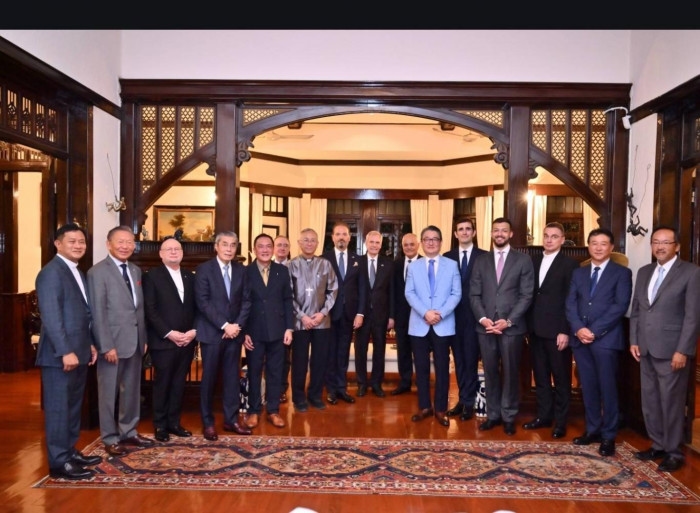
Italy Awards Top Honours to Khunying Patama and Dr Somsak
Italy has bestowed two of its highest national honours on two prominent Thai figures in recognition of their exceptional contributions to international relations, philanthropy, and the strengthening of cultural and economic ties between Italy and Thailand. The Italian Embassy in Bangkok recently hosted a distinguished reception to confer the honours on Khunying Patama Leeswadtrakul and Dr Somsak Leeswadtrakul. The event, attended by ambassadors, senior diplomats, business leaders, and prominent figures in Thai society, celebrated the couple's outstanding contributions to bilateral relations, philanthropy, and international cooperation. Khunying Patama, a member of the International Olympic Committee (IOC), President of the Badminton World Federation (BWF), Chairperson of Center for Morality Promotion (Public Organization), Chairperson of Cultural Promotion Fund, Department of Cultural Promotion, Ministry of Culture, Chair of the Board of the Thailand Philharmonic Orchestra (TPO), was awarded the title of Commendatore dell'Ordine al Merito della Repubblica Italiana (Commander of the Order of Merit of the Italian Republic – OMRI). Her husband, Dr Somsak, a leading business tycoon and philanthropist, received the title of Commendatore dell'Ordine della Stella d'Italia (Commander of the Order of the Star of Italy – OSI). The OMRI, Italy's highest-ranking civilian order, is bestowed upon individuals who have rendered outstanding service to the Republic in the fields of literature, the arts, economy, public service, and social, philanthropic, and humanitarian activities. The OSI, meanwhile, is granted to foreign nationals who have made significant contributions to promoting friendly relations and cooperation with Italy. Italian Ambassador to Thailand, H.E. Paolo Dionisi, presided over the reception. In his remarks, the ambassador praised both honourees for their lifelong commitment to excellence and cross-cultural dialogue. "You [Khunying Patama] have already left a tremendous legacy for Thailand and I'm amazed at how energetic and active you still are despite all the past successes you've reached," the ambassador noted. Beyond her support for both domestic and international sports, she has also been deeply involved in cultural, musical, and academic , as well as supporting numerous charitable causes both within Thailand and internationally. Her remarkable dedication is an inspiration to us all. he said, adding that her support was instrumental in Italy's successful bid to host the upcoming Milano-Cortina 2026 Winter Olympics. "It's hard for me to express in words how much I respect your work and your great life and work achievements, and I think that Thailand's blooming image and respectability abroad owe a lot to you and successful entrepreneurs like you," he said. "Like your husband, you managed to perfectly blend together both economic vision and political acumen, and you also recognised, in your decade-long career, the key value of people-to-people connections, which really transcend cultural differences and borders," he added. In recognising Dr Somsak, the ambassador noted his exceptional achievements in Thailand's steel industry and his steadfast support for Italian business interests, particularly his facilitation of projects by Italian industrial group Danieli. "You are a real steel magnate, having built an empire that spans the steel industry from downstream to upstream, and one of the largest steel industries in Southeast Asia. In addition, you founded businesses in construction, real estate, and property development," he said. The ambassador noted that although Dr Somsak maintains a low profile, he is generous in supporting various charitable causes, not only within the Catholic community in Thailand but also extending his aid to other religious groups, which were highlighted as testaments to his commitment to social progress. "You are a man of profound vision and skill, but also a living proof of the importance of cultivating both economic and social ties alike in international relations," said Ambassador Dionisi. "I think that Italy and Thailand's long and thriving history of friendship depends a lot on characters like you." In receiving their decorations, the couple reaffirmed their commitment to fostering international goodwill, cultural understanding, and sustainable development. In her response, Khunying Patama delivered a heartfelt address, expressing gratitude for the recognition and reaffirming her dedication to strengthening the enduring bond between Italy and Thailand. "Dr Somsak and I are profoundly humbled and grateful to receive these prestigious decorations," she said. "We are deeply moved that these honours have been presented by you, Ambassador Paolo, whose exceptional leadership and genuine love for Thailand have greatly enriched our bilateral relations." She highlighted the power of sport in fostering peace and understanding across cultures, tracing her own passion for sport diplomacy to her early education at St. Francis Xavier Convent School. As Chair of the IOC Culture and Heritage Commission, she pledged continued support for initiatives tied to Milano Cortina 2026, which she described as a celebration of Italy's "beauty, spirit, and rich Olympic tradition." "We humbly dedicate this recognition to our family, our colleagues, and to all who share a belief in using sport to build a better, more united future," Khunying Patama concluded.
Bangkok Post
10-08-2025
- Bangkok Post
The hidden power of strategic adaptability
Across boardrooms in Thailand and Southeast Asia, one question is rising above the noise: How do we stay relevant in a world that keeps shifting under our feet? In my work with leaders and organisations across the region, I have seen that what used to set high performers apart — efficiency, expertise, even innovation — is no longer enough. The edge today belongs to something deeper, less visible, but more powerful: Strategic adaptability. This is not about simply reacting or being flexible. It is about evolving deliberately, continuously and with clarity of purpose — faster than the environment around us. It is the ability to transform without losing your centre. Just look at the signals. Amazon moved beyond retail to become a global tech infrastructure leader. LVMH modernised luxury while protecting its soul. Thai banks now operate more like digital ecosystems than traditional lenders. These are not random pivots. They reflect a new leadership capability — adaptive strategy in action. So how do we build this into our leadership and culture? 1. Shift from static plans to scenario thinking In today's world, fixed strategies expire quickly. The most resilient companies prepare for multiple futures. They ask bold 'what if' questions: What if our supply chain changes overnight? What if talent spreads across borders? What if the next generation demands meaning over structure? This mindset shift allows us to stay sharp without being shaken. 2. Grow leaders who can lead through uncertainty I often say: confidence is important, but what matters more today is clarity amid complexity. Leaders must act without perfect data, hold tension without shutting down and still create momentum. This is not just a leadership skill, it is an emotional capability — and one that must be intentionally developed. 3. Build cultures that learn faster than they fail The best teams are not the ones that avoid mistakes. They are the ones that learn faster. They reflect, course-correct and stay open. They reward curiosity, not just outcomes. They build trust by being real. If your culture resists reflection or hides behind silence, you are already slowing down. 4. Design around customers, not control Many Thai organisations are still structured for internal control rather than external relevance. But in today's world, value is created with customers, not just delivered to them. The most successful companies organise for speed, feedback and impact. They move with their market — not after it. Adaptability is not soft. It is strategic. It is what allows us to respond with intention instead of fear. In a region as dynamic as ours, it is not enough to keep up — we must lead the pace of change. The real question is not, 'What is the plan?' It is, 'What are we capable of becoming before the world forces us to change?' This is the mindset I believe we need to cultivate — within our teams, our organisations and ourselves. or visit her LinkedIn profile.

Bangkok Post
05-08-2025
- Bangkok Post
Australian govt internet network signs for Amazon satellite service
SYDNEY - The Australian government-owned internet network hired Amazon's untested startup satellite service to provide connectivity to people who cannot access its terrestrial network rather than Elon Musk's Starlink. From next year, low-Earth orbit satellites owned by Amazon's Project Kuiper will start replacing two Australian government-owned satellites due for decommissioning in 2032, NBN Co and Amazon said in a joint statement on Tuesday. The deal, for which financial terms were not disclosed, is designed to give high-speed internet to some 300,000 homes and businesses that NBN's terrestrial network does not reach. The thousands of low-Earth orbit satellites are connected to each other through optical links and communicate with antennas and other connection points on the ground. The deal represents a missed opportunity for Starlink, by far the world's biggest provider of such network services and which already has more than 250,000 customers in Australia, according to industry data. Australia's two biggest telecoms providers sell Starlink residential connection dishes and some government entities, including the Australian Electoral Commission, also have contracts with the company. Starlink, a unit of Musk's SpaceX rocket company, now has 8,000 fast-orbiting satellites since it began launching them in 2019, while Amazon's service has just 78 since its first launch in April. NBN and Amazon said Project Kuiper would ultimately have more than 3,200. NBN said the decision followed a rigorous procurement process, but did not say why it had chosen the Amazon service. Starlink was not immediately available for comment. "It is true that Amazon Kuiper has not launched services yet in Australia or globally, but they are reportedly pumping in about $15 billion into that programme," said Gavin Williams, chief development officer for regional and remote services at NBN. "We have every confidence that we've got a partner in Kuiper that will do what they say they're going to do," he added in an interview. Asked if Musk's ownership of Starlink played a part in the decision, Williams said only that NBN supplied critical infrastructure with regulatory and legal obligations and "technical, operational, and commercial imperatives that fall into that consideration were contemplated and ventilated through the procurement process."
