



Gardeners asked to put one food out for birds that doesn't cost the earth
For many people the idea of providing food for birds can be intimidating as they may think it requires expensive, specialist mixtures from garden centres or DIY shops. They may also see it as a pastime reserved for those with extra cash to spend on feeding local wildlife.
But the RSPCA assures us that anyone can contribute to bird feeding without spending a fortune on specialist food. All you need are some common, budget-friendly kitchen staples. The North Wales Live Whatsapp community for top stories and breaking news is live now - here's how to sign up.
Besides rice, potatoes and cheese, cooked pasta can be served up on bird tables. But it's vital to remember that the pasta must be cooked, never raw, as uncooked pasta could pose a risk to birds, so ensure it's properly boiled beforehand.
This is because raw pasta is hard for birds to digest. In some instances, it can cause bloating, discomfort, or even internal damage if it expands after being ingested. Many bird species are facing threats due to habitat loss, dwindling food sources like the decline in insect populations, as well as climate change and pollution, reports the Express.
That's why we're being asked to lend a hand by supplying food for our avian neighbours, which will also help them in nourishing young fledglings this month.
Fledglings are young birds that have just departed their nests. Their tender years mean they're still learning how to hunt for food, and they need plenty of nourishment to develop properly.
Experts at the RSPCA recommend putting out fruit, seeds, unsalted chopped peanuts and food scraps for garden birds. The guidance states: "Birds love to eat: fruit - apples, pears and soft fruits; Suitable seeds and grains - like nyjer, millet, oats, and sunflower seeds; Peanuts - must be unsalted, fresh and that they don't contain aflatoxin (a poison caused by fungus mould).
"Young chicks might choke on whole peanuts, so always put them in feeders with a smaller mesh; Food scraps - cooked pasta, rice and boiled potatoes or cheese and uncooked and unsalted bacon rind."
The recommendations stress clearing away any remaining food each evening and keeping feeding areas clean at all times. This advice follows the RSPB's temporary removal of flat bird tables from their outlets whilst investigating potential disease spread risks associated with exposed food left on flat surfaces.
The organisation now promotes regular cleaning of feeding stations and nesting boxes, along with swift removal of any uneaten provisions

Try Our AI Features
Explore what Daily8 AI can do for you:
Comments
No comments yet...
Related Articles


Daily Mirror
 25 minutes ago
- Daily Mirror
Shower screens will be shining when using one natural item that cleaners love
One cleaning specialist has shared a natural alternative to white vinegar for fighting limescale and it's particularly effective on shower screens and glass shower screens Whilst numerous household cleaning challenges can be tackled using white vinegar, it doesn't always deliver the finest outcomes. For those struggling with shower screen limescale, a cleaning expert has suggested a natural alternative she favours, which plenty of people attest to. Posting on the Mrs Hinch Cleaning Tips Facebook group, Michelle Davis sought "best cleaning product recommendations to attack the shower screen", which prompted almost 100 replies. Professional cleaner Anna Crucitti responded: "Hello, I'm a deep clean specialist. I'd spray a strong limescale remover (a citric acid solution is my choice), let it sit for 10 to 15 minutes, then rinse well. I prefer citric acid to white vinegar as it's powerful on the glass but not on the chromed areas." Another member backed this approach, reports the Express. Marsha Leach commented: "Citric acid, cut in half with water. Spray the glass. Leave it even overnight if needed. Wet the scrub daddy and use it to clean the glass. Rinse. Game-changer. The screen will be limescale-free and gleaming." Sophie, a cleaning expert from the Sustainable Lazy blog, has revealed the ideal homemade citric acid spray for tackling limescale and soap residue. She noted that "citric acid is effective" for eliminating limescale, soap residue, rust and tea and coffee marks. Limescale has alkaline properties, meaning "it can be dissolved by an acid", like citric acid. Sophie said: "If your limescale has built up, it can become stubborn to remove. The easiest solution is to combine citric acid with hot water and leave it to soak. If it's particularly bad, it may need more than one attempt." To create a citric acid solution, you should mix one tablespoon of citric acid per 250ml of water. You can scale this recipe up based on your bottle size - for instance, if your container holds 750ml, you'd need three tablespoons of citric acid. On this occasion, Sophie chose to use 470ml of boiling water, adding two tablespoons of citric acid to the mix. The heated water assists in dissolving the citric acid granules. After it has cooled down, transfer your citric acid mixture into a clean spray bottle and spritz onto your shower door. Allow it to work for several minutes before cleaning the screen with a cloth. After you've tackled the limescale accumulation, using your homemade citric acid solution regularly on shower doors and other problem spots "will prevent the limescale from getting bad again".
Daily Mirror
25 minutes ago
- Daily Mirror
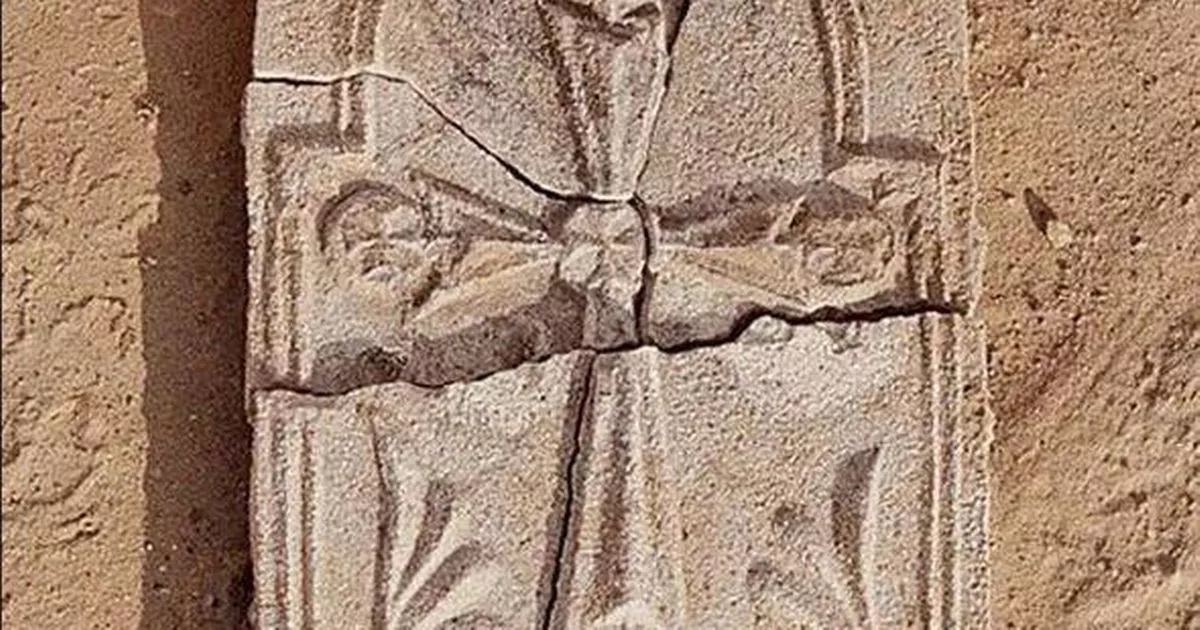
Mysterious cross depicting Christ's crucifixion rewrites the origins of Christianity
The 1,400-year-old plaque, found among the ruins of a church in Abu Dhabi, shows a depiction of a cross with a stepped pyramid evoking Golgotha - where Christians believe Jesus was crucified A 1,400 year old plaque showing a cross is transforming experts' knowledge of Christianity's eastward reach. Researchers excavating Abu Dhabi's Sir Bani Yas Island discovered the relic, which displays a stepped pyramid reminiscent of Golgotha - the site where Christians believe Jesus was crucified - with foliage emerging from its foundation, according to the Daily Mail. The artefact was unearthed amongst the remains of a church and monastery, suggesting a Christian settlement that prospered on the island throughout the seventh and eighth centuries, while recent reports show how a previously unexplored 'Area X' begins to give up its religious secrets. Early Christians Christianity during this era is commonly linked with the Levant, Mesopotamia and sections of Europe, making proof of a flourishing community on a southeastern Arabian Gulf island both surprising and historically important, , reports the Express. Simultaneously, the area was experiencing dramatic religious transformation as Islam was emerging and expanding swiftly throughout Arabia, whilst ancient pagan customs persisted and Christianity was believed to be declining. Nevertheless, the existence of a thriving Christian settlement here contradicts that belief. Christianity flourished Maria Gajewska, chief archaeologist at the location, explained: "Every element of the cross incorporates regional motifs. "It tells us that Christianity in this region was not only present but flourished, adapting visually to its local context. We had settlements of Christians that were not just existing but were clearly thriving." Mohamed Khalifa Al Mubarak, chairman of the Department of Culture and Tourism, hailed the discovery as "a powerful testament to the UAE's profound and enduring values of coexistence and cultural openness," adding that the find underscores a history of peaceful religious diversity in the region. This season's excavations also unearthed pottery, glass artefacts and a small seagreen bottle that may have contained oil or rosewater. The cross itself measures about 10.6 inches long, 6.7 inches wide and roughly 0.8 inches thick. Archaeologists speculate it could have been an object of veneration, mounted on a wall with worshippers kneeling before it. Hager Al Menhali, an Emirati archaeologist at the department, told The National: "The plaster was resting face down and something about it caught my attention." She noted a "distinct fingerprint on the back," suggesting it was left by the person who crafted the stucco plaque. Future studies will involve radiocarbon dating and further exploration of the courtyard houses, which could eventually be incorporated into a broader visitor trail. "These discoveries deepen our connection to the past and inspire future generations to embrace the spirit of unity and mutual respect that has long defined our community," Al Mubarak said. Findings from the dig suggested that senior monks may have resided in the courtyard buildings, making their way to the church for worship or utilising the spaces for spiritual retreats. The well-constructed structures, built from limestone and coral with water cisterns, indicate a comfortable lifestyle rather than a purely hermitic existence. The Christian community was part of the Church of the East, a denomination that extended from the Middle East to China. The Sir Bani Yas find provides a rare insight into how Christianity not only endured but flourished eastward, connecting Arabian Gulf communities to the broader narrative of the faith's expansion towards India and Asia. Sir Bani Yas Signs of a church and monastery on Sir Bani Yas, dating to the seventh and eighth centuries, were first unearthed in the early 1990s. A further monastery, probably connected to the same church, was found on an island in Umm Al Quwain in 2022. Comparable sites have also been located in Kuwait, Iran and Saudi Arabia. Archaeologists continue to examine why the Sir Bani Yas settlement went into decline. The church is thought to have been fracturing before Islam's emergence, plagued by internal divisions as competing branches pursued independence. However, historical evidence indicates that early Christian and Islamic communities in the area coexisted peacefully and engaged in trade. To date, no external event has been pinpointed as the reason for the site's desertion. Intriguingly, archaeologists have noted that the buildings seem remarkably tidy, with scant evidence of collapse or debris. This implies that the inhabitants may have departed voluntarily, intending to return, rather than being driven away by catastrophe or strife.

North Wales Live
8 hours ago
- North Wales Live
Gardeners asked to put one food out for birds that doesn't cost the earth
Brits are being urged to scatter pasta on their bird tables, in an effort to support our feathered friends during the crucial fledgling season. And it may be cheaper than you think. For many people the idea of providing food for birds can be intimidating as they may think it requires expensive, specialist mixtures from garden centres or DIY shops. They may also see it as a pastime reserved for those with extra cash to spend on feeding local wildlife. But the RSPCA assures us that anyone can contribute to bird feeding without spending a fortune on specialist food. All you need are some common, budget-friendly kitchen staples. The North Wales Live Whatsapp community for top stories and breaking news is live now - here's how to sign up. Besides rice, potatoes and cheese, cooked pasta can be served up on bird tables. But it's vital to remember that the pasta must be cooked, never raw, as uncooked pasta could pose a risk to birds, so ensure it's properly boiled beforehand. This is because raw pasta is hard for birds to digest. In some instances, it can cause bloating, discomfort, or even internal damage if it expands after being ingested. Many bird species are facing threats due to habitat loss, dwindling food sources like the decline in insect populations, as well as climate change and pollution, reports the Express. That's why we're being asked to lend a hand by supplying food for our avian neighbours, which will also help them in nourishing young fledglings this month. Fledglings are young birds that have just departed their nests. Their tender years mean they're still learning how to hunt for food, and they need plenty of nourishment to develop properly. Experts at the RSPCA recommend putting out fruit, seeds, unsalted chopped peanuts and food scraps for garden birds. The guidance states: "Birds love to eat: fruit - apples, pears and soft fruits; Suitable seeds and grains - like nyjer, millet, oats, and sunflower seeds; Peanuts - must be unsalted, fresh and that they don't contain aflatoxin (a poison caused by fungus mould). "Young chicks might choke on whole peanuts, so always put them in feeders with a smaller mesh; Food scraps - cooked pasta, rice and boiled potatoes or cheese and uncooked and unsalted bacon rind." The recommendations stress clearing away any remaining food each evening and keeping feeding areas clean at all times. This advice follows the RSPB's temporary removal of flat bird tables from their outlets whilst investigating potential disease spread risks associated with exposed food left on flat surfaces. The organisation now promotes regular cleaning of feeding stations and nesting boxes, along with swift removal of any uneaten provisions
