


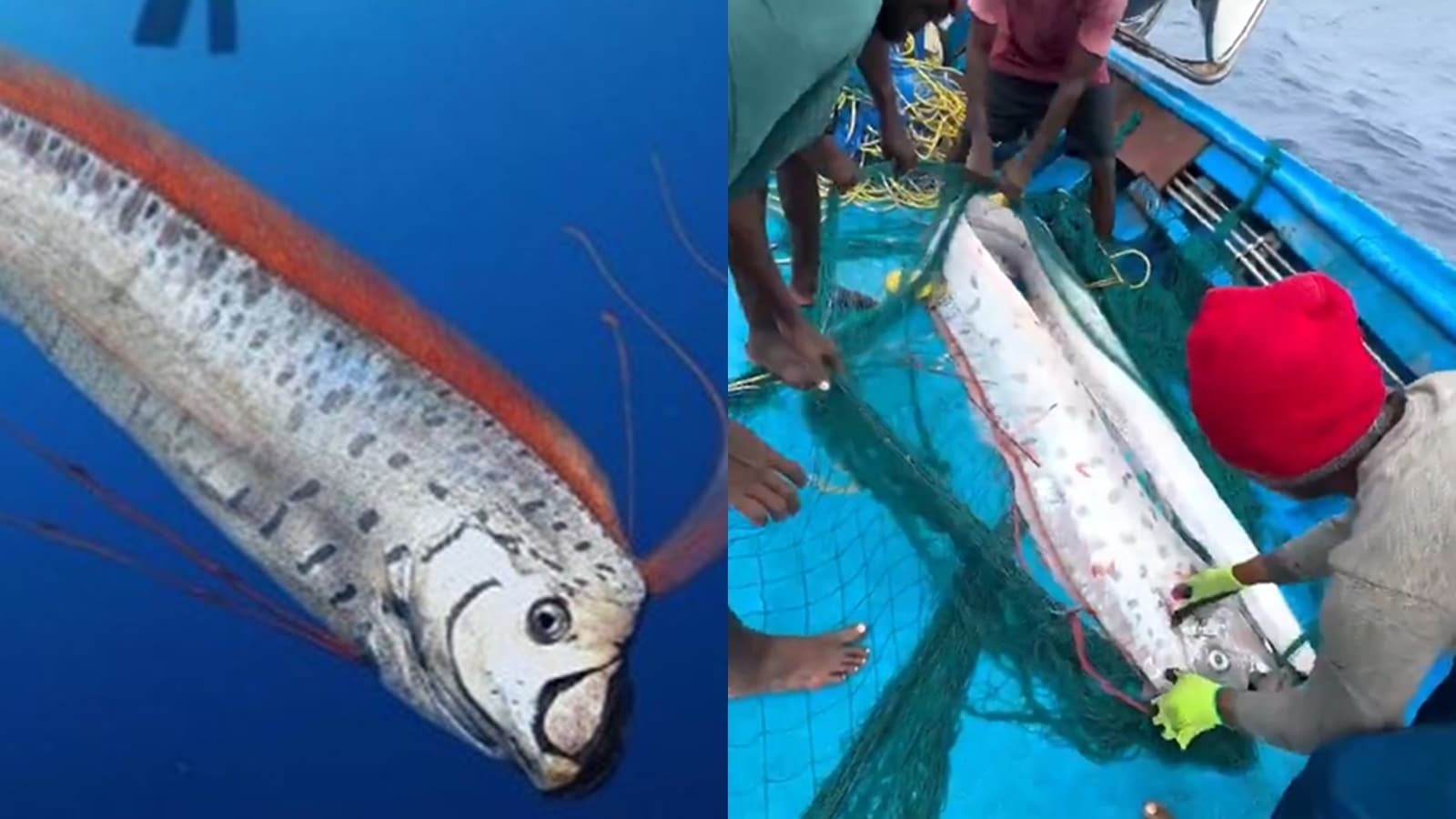
Rare oarfish aka ‘doomsday fish' caught in Tamil Nadu sparks rumours about an impending calamity; should you be worried?
The unusual deep-sea creature, which, according to a viral video shared on X, required seven men to lift, has reignited age-old debates about whether these mysterious marine giants can truly predict natural disasters.
However, before delving into the folklore surrounding this enigmatic fish, it's crucial to address what modern science tells us. A 2019 study published in the Bulletin of the Seismological Society of America analysed decades of data and found no statistically significant link between sightings of deep-sea fish, such as oarfish, and earthquakes in Japan, effectively debunking the scientific basis for their so-called 'doomsday' reputation.
The study analysed data collected between November 1928 and March 2011, focusing on instances where deep-sea fish were spotted 10 to 30 days before earthquakes struck within a 50 to 100 kilometer radius of the sightings. Researchers found only one event that could have been plausibly correlated, out of 336 fish sightings and 221 earthquakes in Japan. 'As a result, one can hardly confirm the association between the two phenomena,' the authors write in the BSSA paper.
The creature captured in Tamil Nadu is a giant oarfish (Regalecus glesne), the world's longest bony fish, which can reach lengths of up to 36 feet (11 meters). These remarkable creatures typically inhabit the mesopelagic zone, dwelling 660 to 3,300 feet beneath the ocean's surface, where sunlight barely penetrates.
The silvery, ribbon-like fish with its distinctive red crest-like dorsal fin is rarely seen by humans due to its deep-water habitat. They are thin and slow due to their lack of muscles and generally swim vertically in the ocean. When oarfish do surface, it's typically because they are sick, disoriented, dying, or occasionally breeding—not because they're fleeing from impending seismic activity, according to Ocean Conservancy, a nonprofit environmental advocacy group based in the United States.
The rarely seen oarfish, which usually are in deep-sea, which is also known as 'Doomsday' fish is caught in the net in TamilNadu pic.twitter.com/8N4TTNyDec
— Aryan (@chinchat09) June 16, 2025
The 'doomsday fish' reputation stems from ancient Japanese folklore, where oarfish are called 'ryugu no tsukai,' meaning 'messenger from the sea god's palace.' This belief gained international attention following several notable coincidences, particularly the 2010 incident when multiple dead oarfish washed ashore in Japan months before the devastating 2011 Tohoku earthquake and tsunami that led to the Fukushima nuclear disaster.
More recently, these coincidences have continued to fuel superstitions. In August 2024, a 12-foot oarfish was discovered near San Diego just two days before an earthquake struck Los Angeles, adding to the mystique surrounding these deep-sea dwellers.
The Tamil Nadu sighting is part of a concerning trend of increased oarfish appearances worldwide. In recent months, these rare creatures have been spotted in various locations, including Mexico, Tasmania, and California.
This uptick in sightings has led to increased speculation about environmental factors, with some experts suggesting that climate change, ocean warming, or changes in deep-sea ecosystems might be driving these creatures to shallower waters.
Hashtags

Try Our AI Features
Explore what Daily8 AI can do for you:
Comments
No comments yet...
Related Articles


The Hindu
 6 hours ago
- The Hindu
A tribute to M.S. Swaminathan, ‘the man who fed India'
The Viksit Bharat aspiration, which has gained considerable momentum, will require a significant development of scientific capability, and some of this, especially in the new digital economy, will have to be aatmanirbhar. There is much to learn in this context from the most successful experiment in atmanirbharata in the past, which was the achievement of food self-sufficiency in the 1960s. M.S. Swaminathan was the man who did it and he was a living hero to all of us. This is the centenary year of his birth and it has seen the publication of a new biography, M.S. Swaminathan: the Man who Fed India, by Priyambada Jayakumar. Ms. Jayakumar had the benefit of detailed discussions with him on both the personal and professional side of his life and she has produced a book which is a great read. However, in this article, I will focus on some lessons from his experience which have relevance for the future. The planting of a seed of an idea Scientific advancement was at the core of the Green Revolution and the book brings out that such advances are not achieved by dedicated scientists working in isolation in a lab. They involve collaboration with other scientists and a cross-fertilisation of ideas. It was known that wheat productivity could be increased through application of fertilizers and other inputs, but the problem was that the higher weight of grains caused the plant to bend and lodge if the stalk was not strong enough. Swaminathan was trying to use radiation to develop a genetic mutation that would have a stronger stalk, but this approach was not getting anywhere. In 1958, a Japanese scientist visiting Delhi told Swaminathan that a dwarf wheat variety developed in Japan, and which had a shorter, stronger stalk, could hold the higher weight of grain without bending. Swaminathan found that the new variety had been taken to the United States where a seed breeder was working on it. The breeder told Swaminathan that they were developing a winter variety, which would not be suitable for India, but Norman Borlaug in Mexico was developing a different variety that might work. As it happened, Swaminathan had met Borlaug earlier at a seminar in the U.S. He was able to persuade him to send a small quantity of his Mexican seeds to India. These seeds did well and Swaminathan wanted to invite Borlaug to come to India to discuss ways of adapting these varieties to Indian conditions. The proposal to invite Borlaug was promptly approved by the Director of the Indian Agricultural Research Institute (IARI) in 1960 but it took more than two years to get the bureaucratic approvals needed to send the invitation and Borlaug arrived only by March 1963. Swaminathan often quoted Pandit Nehru's phrase, 'everything can wait but not agriculture', but the bureaucracy was clearly unaware of it. It is interesting to speculate on what would have been the benefits if the Green Revolution had come two years earlier. The important lesson is that for science to flourish, our scientists must be much better connected to relevant scientists abroad and become familiar with cutting-edge work in their field. This means they should travel more freely to attend conferences abroad and build personal contacts, all of which means bureaucratic control must be drastically reduced. The next step was to subject the seeds to trials on the fields of actual farmers. Swaminathan could not get the Ministry to fund the effort. Fortunately, Lal Bahadur Shastri, who became Prime Minister in 1964, wanted to give higher priority to agriculture and for this purpose appointed C. Subramaniam as Minister of Agriculture. This made a critical difference. Subramaniam called about 20 agricultural scientists for a meeting to hear their views on how to increase food production. When Swaminathan was asked to speak, he frankly told the Minister that he had identified the new seeds that would solve the problem, but the Ministry was unable to fund the necessary trials. Subramaniam promptly called for the file and ensured that the funds were provided. It is a pity that we have no record of what the other scientists said in the meeting, and in particular whether the more senior scientists (Swaminathan was then only 39) had a different view. The politician needs to listen to the scientist This yields the second important lesson. In dealing with complex technical issues, the political leadership must hear the scientists/technical people involved directly instead of relying on the generalist bureaucracy to convey their views. Swaminathan greatly admired Pandit Nehru's commitment to science, but the book brings out that he soon realised that this 'had few takers even in his own government, ministries and the bureaucracy'. On page 48 the author puts it bluntly: 'Most ministers barely supported, understood, or believed in research and development…. this was also true of the Agriculture Minister in 1958.. (who ) would order scientists like Swaminathan to go into the field and 'sort out the problems' without really understanding the ground realities.' One of the reasons China has done so well on the economic and technical front is that Ministers are usually technically qualified people, often engineers with a track record of successful management. Subramaniam exemplified that type of political leader: he was a physics graduate and had a good knowledge of science. If we want to achieve Viksit Bharat, and explore new and increasingly complex areas of science, we will need many more such Ministers in the years ahead, not only at the Centre but also in the States. The field trials were a great success and the next step was to roll out the Green Revolution across the country. This required importing 18,000 tonnes of seed — the largest seed shipment in history — costing ₹5 crore in foreign exchange. There were objections from many fronts. The Finance Ministry was not happy releasing that much foreign exchange. The Planning Commission opposed the proposal on the grounds that it did not believe that the new seeds would do better than what we already had. The Left also opposed the move because the seeds were developed under a grant from a U.S. institution (the Rockefeller Foundation). Shastri was understandably concerned about these conflicting views. Fortunately, Swaminathan persuaded him to visit the IARI to see for himself how the new wheat was doing. Shastri was convinced and the import of new seeds was duly approved. Tragically, Shastri passed away in January 1966 but Indira Gandhi, who took over as the next Prime Minister, also gave Swaminathan full backing. The lesson is that when dealing with new and untried ideas, there will always be conflicting opinions even among so-called experts. It is important that all the different points of view are appropriately aired and considered. However, this process may not always result in a consensus. In such a situation, a decision has to be taken at the highest level. Once taken, the thing to do is to back the effort fully. But it must also be subjected to truly independent monitoring, with course corrections. In the case of the Green Revolution, the results were amply evident within a few years. We reaped a bounteous wheat harvest in 1968 and we were able to start phasing out PL 480 imports. Over time, new problems arose. The excessive dependence on water and also fertilizer use led to environmental problems. Swaminathan himself, having left the government by then, warned about the corrections needed to make the Green Revolution environmentally sustainable. It is a pity that we are yet to implement these corrections. The issues India needs to look at Looking ahead, we know that climate change will have a severely negative effect on agricultural productivity. Once again, science will be critical and much will depend upon the performance of our research institutions. India was ahead of China in agricultural research in the late 1960s, but today, China has eight agricultural research institutions in the world's top 10 and India does not have any in the top 200. One reason is inadequate funding: we spend only 0.43% of our agricultural GDP on research and development, whereas the percentage in China is twice our level. But there is also the issue of the quality. Do our agricultural research institutions have the institutional autonomy and governance structure that they need to recruit and promote meritorious scientists? And can we ensure that our top agricultural scientists have the kind of access to political decision makers that Swaminathan had? Filling these gaps is the best way of really honouring M.S. Swaminathan. And the lessons are relevant for other areas of scientific development also. Montek S. Ahluwalia is Distinguished Fellow, Centre for Social and Economic Progress


Indian Express
a day ago
- Indian Express
Academia margins to NCERT row: French-born scholar's tryst with India's past
'I enjoy (historical) controversies in a kind of perverse way, perhaps,' Michel Danino, 69, said during his lecture at Azim Premji University in October last year. Arguing that 'historical controversies' are inherent part of the discipline, he said: 'We should not shun controversies, we should desire them. We should make use of them to go deeper into issues.' Danino, who heads the panel on the NCERT social science textbooks, is no stranger to row. He has delved into subjects, that have generated heat in academic and political circles for decades, which include questions related to the Aryan invasion — in his writings and lectures he rejects it — and the Sarasvati river, which he terms the 'life-giving river' of the 'Indus-Sarasvati civilisation' or the Harappan civilisation. While the new NCERT books have brought him into the limelight again, the French-born Danino, who was awarded the Padma Shri in 2017, was once, in his words, 'on the margins of academia'. In France, he studied maths, physics and engineering. While he enjoyed science, he felt it didn't have 'answers to major issues'. In the early 1970s, he got interested in Indian spirituality, Sri Aurobindo, and the 'Mother' (Mirra Alfassa, who established Auroville in Pondicherry). 'It was in the air — there was information going around (on Sri Aurobindo and Auroville). There was a famous short movie on French TV by a well-known filmmaker. Auroville started in 1968, and people were already working there. It attracted me because of Sri Aurobindo's vision of human unity — it would be possible only with a very substantial transformation of human nature. I landed in Auroville in 1977,' said Danino. Deciding to spend his life in India, Danino started translating, editing and publishing texts related to Aurobindo and the 'Mother'. He was drawn to Aurobindo's ideas on Indian civilisation and its ancient past. 'In his writings, he (Aurobindo) brought up what used to be called the 'genius of Indian civilisation'. He was convinced going back to those roots could help us meet today's and tomorrow's challenges much better. This led me to further exploration of Indian civilisation.' His 'cursory readings' became systematic, and he began to take part in conferences, and present, publish papers. He gave three series of lectures at IIT Kanpur. Danino was then scholar-in-residence at IIT Kanpur. The lectures caught IIT Gandhinagar's founding director Professor Sudhir Jain's attention. Danino began as guest professor at IIT Gandhinagar in 2011, helped set up Archaeological Sciences Centre at the institute, coordinated an Indian Knowledge Systems discipline, and offered courses like 'Perspectives on Indian Civilisation'. Now, referring to his NCERT panel, Danino said it was mandated to develop the social science textbooks within the framework of the National Education Policy 2020 and the National Curriculum Framework for School Education 2023. On new textbooks, he said: 'In some of our workshops, I said we'll get brickbats when the textbooks are out. I declared my objective was to get equal brickbats from both sides of the spectrum so that we will know we have done a good job. And ironically, that's almost what's happening.' Danino said since the new curriculum involves having a single social science book instead of separate ones for subjects like history, geography, and political science, 'we have limited space'. 'We try to focus on what is important that we would like our students to remember, if possible, all their life.' Danino said: 'The least genuine criticism is we are writing under the gaze of ideological movements like RSS, etc. This is completely false. We never felt any undue influence. People are not willing to believe that because it's a convenient argument to dismiss the whole effort without seriously looking at it. We have not said that the textbooks are perfect. How can they be perfect? It's the first attempt and done in a short time. They have to be revised and looked at afresh from year to year.'


Time of India
a day ago
- Time of India
6 students from Odisha leave for Japan to participate in science prog
Bhubaneswar: Six meritorious students from different districts of Odisha were selected to participate in the prestigious SAKURA Science High School Programme (SSHP) in Japan, scheduled from Aug 16 to 23. They will be accompanied by a guide teacher, representing the state on an international platform of scientific learning and cultural exchange. Organised by the Japan Science and Technology Agency (JST), SSHP is designed to nurture young talent in science and technology by facilitating short-term visits to Japan's leading universities, research institutes and high-tech industries. The programme also includes cultural exchange activities, helping students gain a deeper understanding of Japanese society, while sharing their own culture. By engaging in interactive sessions with Japanese students and scientists, the participants will be exposed to cutting-edge innovations and scientific practices, which organisers hope will inspire them to pursue advanced studies and contribute to future international collaborations. For these six Odisha students, the week-long programme is expected to be a transformative experience—broadening their horizons, sharpening their academic aspirations and fostering a spirit of global scientific partnership. The delegation departed from Bhubaneswar on Thursday for New Delhi from where they will fly to Japan. The selected students were identified as Sai Soham Pradhan from Iconic OAV, Andharua, Khurda, Sreyashree Panigrahi from BJB Higher Secondary School, Bhubaneswar, Samikhya Rani Mali from Govt SSD Higher Secondary School, Nabarangpur, Chandra Sekhar Behera from Khallikote Higher Secondary School, Ganjam, Sipra Satapathy from Ravenshaw Higher Secondary School, Cuttack and Punya Pulokita Pati from OAV, Tarando, Kendrapara. Niharika Sahu, a teacher from BJB Higher Secondary School, will guide the team. Stay updated with the latest local news from your city on Times of India (TOI). Check upcoming bank holidays , public holidays , and current gold rates and silver prices in your area.
