


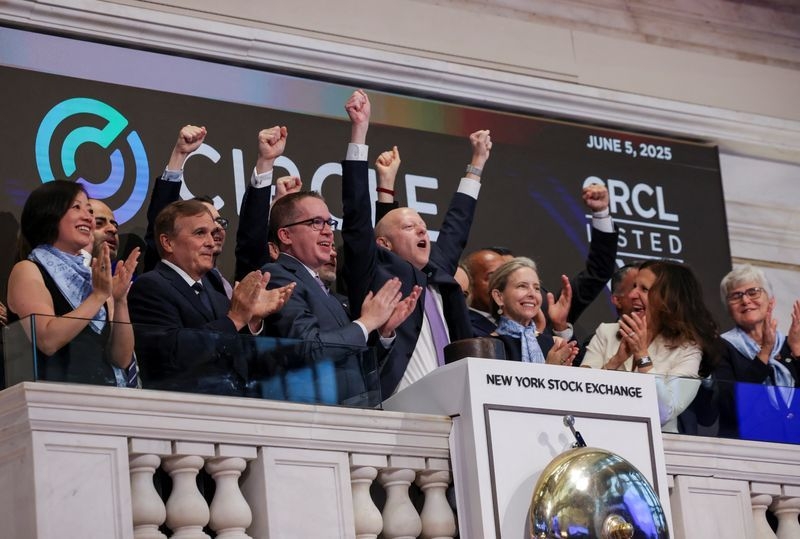
Circle shares set to surge in NYSE debut, lifting hopes for IPO market recovery
(Reuters) -Circle Internet's shares were set for a strong debut on the New York Stock Exchange on Thursday, a move expected to boost an IPO market that has struggled to regain momentum.
The stock was last indicated to trade between $60 and $61 at debut compared with its IPO price of $31.
The successful flotation is likely to encourage other crypto IPO hopefuls eyeing public markets. Surging interest in digital assets amid rising token prices and supportive regulatory developments are expected to spur more listings from the industry.
The outlook for the digital asset industry has also brightened with the Trump administration adopting a lighter regulatory touch and moving to establish a crypto-friendly environment.
In recent months, a growing number of companies have also added cryptocurrencies to their balance sheets to capitalize on rising token prices.
Circle's flotation is the biggest crypto listing since Coinbase's 2021 debut and the first major IPO by a stablecoin issuer. It had earlier attempted to go public through $9 billion blank-check deal, but the deal fell apart in 2022.
MAINSTREAM ADOPTION
Circle's IPO is also a landmark moment for the stablecoin market, which has been a hot topic since the Trump administration took office.
The passage of the pending stablecoin bill could further accelerate the adoption of the digital tokens and make it more mainstream.
Apart from being used to trade cryptocurrencies, stablecoins are increasingly being used as a form of digital payment.
Wall Street expects stablecoins to become one of the biggest themes within finance in the coming years and the next multi-trillion dollar market opportunity.
Founded in 2013 by Jeremy Allaire and Sean Neville, Circle issues the dollar-denominated USDC, the world's second-largest stablecoin by market cap after Tether. Besides USDC, Circle also issues the euro-denominated stablecoin EURC.
Allaire, 53, has led Circle since its inception. He previously served as the co-founder and CEO of streaming technology company Brightcove.
(Reporting by Arasu Kannagi Basil in Bengaluru; Editing by Anil D'Silva, Shilpi Majumdar and Shounak Dasgupta)
Hashtags

Try Our AI Features
Explore what Daily8 AI can do for you:
Comments
No comments yet...
Related Articles


The Star
 21 minutes ago
- The Star
Japan's exports fall more than expected in July on US tariff pressures
Export vehicles are parked at Daikoku Pier in Yokohama, near Tokyo, Tuesday, April 8, 2025. (AP Photo/Hiro Komae) TOKYO: Japan's exports dropped for a third straight month in July, government data showed on Wednesday, as U.S. tariffs continued to weigh on manufacturers, raising concerns about the outlook for the country's export-reliant economy. The outcome follows unexpectedly strong growth in gross domestic product (GDP) in the April-June quarter, separate data showed last week, fuelled by surprisingly resilient exports and capital expenditure. Total exports from the world's fourth-largest economy dropped 2.6% year-on-year in July in value terms, more than a median market forecast for a 2.1% decrease and following a 0.5% drop in June. Exports to the United States in July fell 10.1% from a year earlier, while those to China were down 3.5%, the data showed. Imports in July dropped 7.5% from a year earlier, compared with market forecasts for a 10.4% fall. As a result, Japan ran a deficit of 117.5 billion yen ($795.4 million) in July, compared with a forecast of a 196.2 billion yen surplus. The United States imposed 25% tariffs on automobiles and auto parts in April and threatened 25% levies on most of Japan's other goods. It later struck a trade deal on July 23 that lowered tariffs to 15% in exchange for a U.S.-bound $550 billion Japanese investment package. The agreed tariff rate on automobiles, Japan's largest export sector, is still far higher than the original 2.5%, exerting pressure on major automakers and parts suppliers. Japanese automakers have mostly absorbed additional tariff costs by cutting prices to protect shipment volumes. But economists expect them to eventually pass on costs to U.S. consumers, which could hamper their sales in the U.S. market. ($1 = 147.7200 yen) - Reuters
The Star
an hour ago
- The Star
Finance industry bodies call for changes to crypto rules for banks
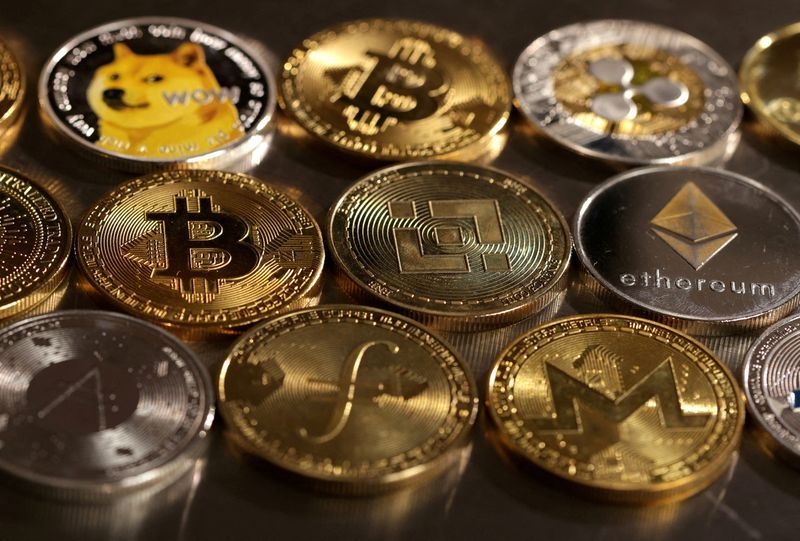
FILE PHOTO: Representations of cryptocurrencies are seen in this illustration created on August 10, 2022. REUTERS/Dado Ruvic/Illustration/File Photo (Reuters) -A group of finance industry bodies is calling for a rethink on looming regulatory standards that they say will make it difficult for banks to participate in crypto markets. The Basel Committee on Banking Supervision, which comprises regulators and central banks from the world's main financial centres, agreed a set of standards in 2022 for how banks should manage and disclose risks around their exposure to crypto assets. In an open letter to the committee, various finance industry groups said that the crypto market has changed since 2022, making the proposed standards too conservative. While the crypto market remains a small part of the overall financial system, it has grown rapidly in recent years, with cryptocurrency prices reaching record highs. It has also become increasingly connected to mainstream financial markets. Banks are trying to tap into a shift in the regulatory environment in the U.S., where President Donald Trump has taken a pro-crypto approach. U.S. regulators this year made it easier for banks to engage in crypto-related activities. "The Cryptoasset Standard's restrictive qualification standards, combined with otherwise punitive market and credit risk capital treatments, effectively make it uneconomical for banks to meaningfully participate in the cryptoasset market," the letter said. The letter called for the committee to "temporarily pause" implementation of the new standards, seek new information and consider making changes. Signatories included the Global Financial Markets Association, the Institute of International Finance and the International Swaps and Derivatives Association - which lobby for the mainstream financial sector - as well as crypto industry groups. The Basel Committee has no enforcement powers, but its members agree to apply its standards to international banks in their jurisdictions. The standards around crypto are due to come into effect in January 2026. The Bank for International Settlements, where the Basel Committee is based, did not immediately respond to a request for comment. A series of collapses at major crypto companies in 2022 left millions of investors out of pocket and revealed widespread misconduct in the industry, prompting calls for regulation. (Reporting by Elizabeth HowcroftEditing by David Goodman)

The Star
8 hours ago
- The Star
India plans to ban online games played with money, citing addiction risks
FILE PHOTO: The words "India online gaming regulations" are displayed in front of an Indian flag in this Illustration taken September 14, 2022. REUTERS/Dado Ruvic/Illustration/File Photo NEW DELHI (Reuters) -India's government plans to ban online games played with money, a proposed bill showed on Tuesday, in what would be a heavy blow for an industry that has attracted billions of dollars of foreign investment. Citing psychological and financial harm it says can be caused by such games, the Promotion and Regulation of Online Gaming Bill 2025 says that no person "shall offer, aid, abet, induce or otherwise indulge or engage in" the offering of online money games and such services. The 13-page bill, which has not yet been made public but has been reviewed by Reuters, describes an online money game as one played by a user by depositing money in expectation of winning monetary and other enrichment. The Indian market for such gaming is set to be worth $3.6 billion by 2029, venture capital firm Lumikai says. Endorsements by top Indian cricketers and other marketing efforts have boosted appeal and investor interest of real money gaming apps such as the popular fantasy cricket games operated by startups Dream11 and Mobile Premier League. Dream11 commands a valuation of $8 billion while Mobile Premier League is valued at $2.5 billion, PitchBook data shows. The Indian government has long been concerned about how such games are addictive. India's IT ministry, which has drafted the bill, did not immediately respond to a request for comment. MPL and Dream11 declined to comment. In fantasy cricket games on Dream11, users create their teams by paying as little as 8 rupees (10 U.S. cents), with a total prize pool of 1.2 million Indian rupees ($14,000). The apps become more popular during the Indian Premier League season, one of the world's most popular cricket tournaments. The bill states that anyone who offers such money games could face a jail term of up to three years and a fine. "Such games often use manipulative design features, addictive algorithms ... while promoting compulsive behaviour leading to financial ruin," the bill said. (Reporting by Aftab Ahmed and Aditya KalraEditing by David Goodman)
