



The Recent Price Increases For Games Are Likely Coming From Publishers
While this may initially appear to be the fault of Microsoft or Nintendo, it's far more likely that this is coming from publishers to make up for their recent losses.
In that, the massive and ongoing layoffs across gaming, with Electronic Arts announcing another 300 layoffs, of which a chunk were from a new Titanfall game, show that publishers are still in a very difficult position financially.
This is because around a decade ago, publishers sought external funding for massive AAA games. With many of those games finally released and having spectacularly failed in terms of sales, publishers now have to pay that money back.
That's what is driving this ceaseless need for layoffs; publishers need the money to pay back their investors.
So when game prices take a noticeable hike, it's clear that publishers are behind this. For instance, the main reason Microsoft gave was that the increased prices are needed to pay for the 'rising costs of game development'.
With most developers running on a skeleton crew following all these layoffs, it's clear these 'costs' are likely money needed to pay off disgruntled investors who were duped by publishers who promised a AAA pot of gold at the end of a gaming rainbow.
Now, part of this increase has been attributed to gaming not keeping pace with inflation. However, I am sceptical that this is the root cause of what we are seeing. Yes, game prices have fallen behind inflation, but this isn't a new thing, and having it rectified alongside industry-wide layoffs is dubious at best.
The point here is that getting angry at Nintendo and Microsoft is not going to help, simply because they aren't the ones who need this price increase in the first place.
Platform holders take a 30% cut, on average, on every game sold on their system, so these price increases wouldn't help them as much as they would each of the respective publishers, who are now deeply in the red.
In short, if you want to be constructive in your feedback to the industry, complain to publishers over these game price increases, as that is where this is coming from.
Follow me on X, Facebook and YouTube. I also manage Mecha Damashii and am currently featured in the Giant Robots exhibition currently touring Japan.
Hashtags

Try Our AI Features
Explore what Daily8 AI can do for you:
Comments
No comments yet...
Related Articles

Geek Wire
 an hour ago
- Geek Wire
Protesters set up temporary encampment at Microsoft to pressure company on Israel contracts
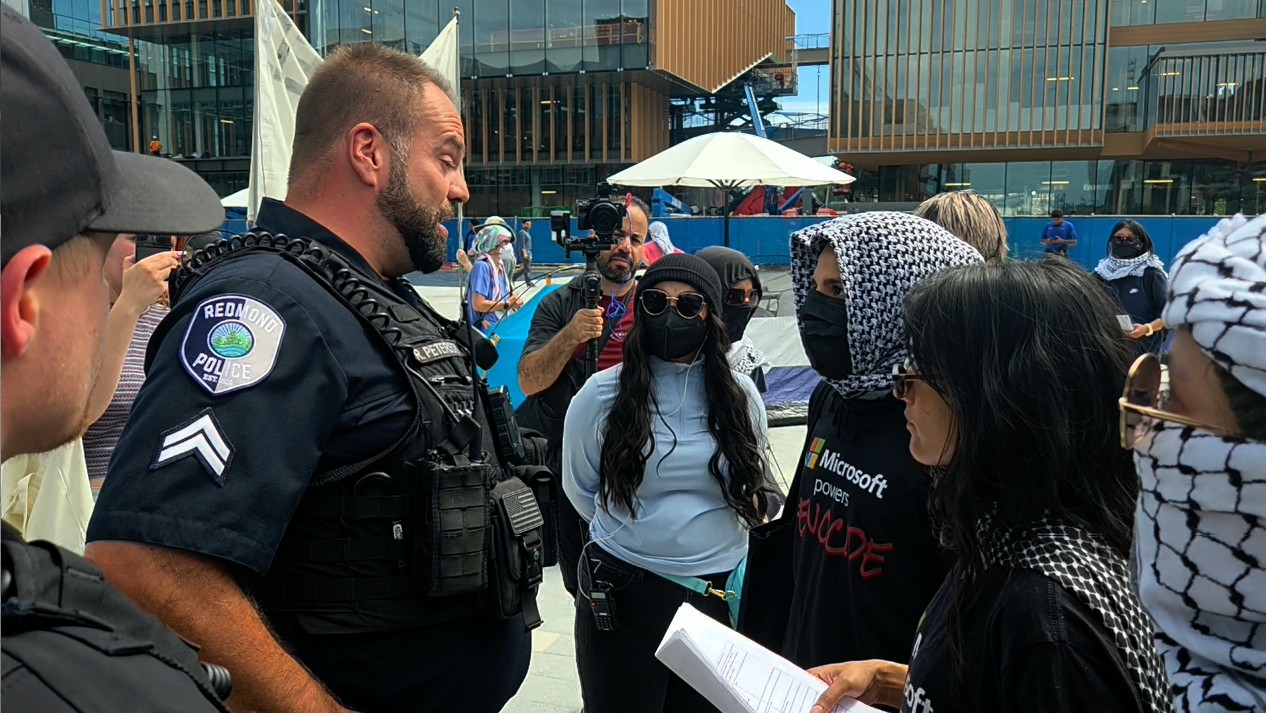
Redmond police explain to members of No Azure for Apartheid that they will be subject to arrest for trespassing if they don't leave the Microsoft campus Tuesday afternoon. (GeekWire Photo / Todd Bishop) Protesters took over part of Microsoft's Redmond, Wash., campus for more than an hour Tuesday — escalating their efforts to pressure the company to stop providing technology to the Israeli government and military. Members of the No Azure for Apartheid group, which includes current and former Microsoft employees, allege that the company's technology is being used in the surveillance, starvation and killing of Palestinians in Gaza. Microsoft has said it complies with its human rights commitments, and that its contracts with Israel's Ministry of Defense are standard commercial agreements, governed by its terms of service and AI Code of Conduct. The protesters created what they called a 'Liberated Zone' in the plaza of the company's East Campus, in front of the Microsoft sign, pitching tents and setting up a 'negotiations table' with a banner that read, 'Microsoft Execs, Come to the Table.' The space was filled with shrouds symbolizing the dead in Gaza, and a large plate reading, 'Stop Starving Gaza.' 'Regardless of your beliefs, regardless of whether or not your work today actually supports Israel, know that Microsoft's money does include blood money,' said one of the speakers at the protest, Julius Shan, a software engineer who said he has worked at Microsoft for nearly five years. A smattering of Microsoft employees looked on from the periphery as security guards and police arrived. One employee who was watching nearby said he empathized with the message but not the approach. 'This isn't going to change anything,' said the employee, who did not give his name. 'It's just going to annoy the people that are here.' The 'Liberated Zone' was in place for more than an hour on Microsoft's Redmond campus. Initially, the protesters appeared to be preparing for an extended encampment, reminiscent of student-led protests at universities during the 2023-24 academic year. In a press release shortly after the action began, the group said it was renaming the plaza 'The Martyred Palestinian Children's Plaza,' and offered interviews at the 'Anas Al-Sharif Media Tent,' named after a Palestinian journalist killed in Gaza last week. However, the group took down the encampment and moved to a nearby public sidewalk after City of Redmond Police told them they were trespassing on private property and would be subject to arrest. Microsoft has not issued a public statement about the latest protest. The company has said in past statements that it does not permit its technology to be used for unlawful surveillance or human rights abuses. Earlier this year, Microsoft said internal and external reviews found no violations. However, the company acknowledged its limited visibility into how its technology is deployed on private or on-premises systems Microsoft announced on Aug.15 that it is launching a formal review into allegations that its Azure cloud services were used by the Israeli military for mass surveillance of Palestinians. The company said it hired the law firm Covington & Burling LLP to lead the review, and pledged to make the findings of the review public once the process is complete. That move came after reports earlier this month in The Guardian, +972 Magazine, and Local Call cited sources alleging that the Israeli Defense Forces stored data from widespread phone monitoring of civilians in Gaza and the West Bank on Microsoft servers. Protesters walk past a security robot as they leave the Microsoft campus. (GeekWire Photo / Todd Bishop) At the time of the initial report by the Guardian, the company explained that its work with an Israeli intelligence unit focused on cybersecurity and that it was not aware of any civilian surveillance. The encampment Tuesday was part of a broader escalation by the group, which has spent much of the past year staging protests inside and outside company events, including Microsoft's 50th anniversary event in Redmond earlier this year, where protesters interrupted executives inside the event. Earlier this month, the group staged a loud protest outside the home of Teresa Hutson, corporate vice president of Microsoft's Trusted Technology Group — pouring red paint on the sidewalk symbolizing blood, and accusing her of being complicit in killing children in Gaza, according to video clips from the protest. The group's latest action comes amid reports of a growing humanitarian crisis in Gaza, and increasing concerns about famine. Hamas has agreed to a proposed 60-day cease-fire with phased hostage releases. Israeli officials today demanded the release of all hostages and said they were not interested in partial deals, according to the BBC.
Yahoo
an hour ago
- Yahoo
'Call of Duty', 'Black Myth' wow Gamescom trade show
A twisted futuristic version of "Call of Duty", Batman in Lego form and the "Resident Evil" series' ghoulish monsters had gamers salivating Tuesday as the vast Gamescom trade show opened in Cologne. A two-hour showcase of upcoming releases, including "Call of Duty: Black Ops 7" slated for November 14, belied an industry that has been weathering a rough patch with tens of thousands of job cuts. The first-person shooter has enlisted American actor Milo Ventimiglia (known for TV series "Heroes" and "This Is Us") as its protagonist in a near-future conflict against psychedelic backdrops evoking the movie "Inception". More than 5,300 packed one of the giant halls of western German city Cologne's convention centre Tuesday, a record opening night according to organisers. The event showed off footage from titles like "Requiem" -- the next instalment in the long-running "Resident Evil" horror series -- and rambunctious space adventure "The Outer Worlds 2". Set for a 2026 release, a new "Lego Batman" will take fans back to "iconic moments and deep-cut references from decades of Batman TV shows, comics and games" in humourous plastic brick form, director Jonathan Smith told the audience. And there was a surprise reveal for "Black Myth: Zhong Kui" -- a follow up to Chinese 2024 smash hit "Wukong". Gaming's influence on the broader culture was also on show, as the stars of hit game-to-TV adaptation "Fallout" introduced the Amazon Prime series' second season with a December 17 release. - Hands-on testing - While last year's Gamescom drew 335,000 visitors, organisers hope 2025 can recover to pre-Covid levels of around 370,000 between Wednesday and Sunday. The show brings together industry professionals and lovers of the medium, with around 1,500 exhibitors laying on large stands -- many offering the opportunity to try out the latest, or even unreleased, titles. Nintendo is back after staying away last year, surfing on the success of its record-breaking Switch 2 console launch in June. And Microsoft's Xbox division will be showing off its own portable console, slated for release towards the end of the year. But Japanese PlayStation maker Sony has elected to stay away in 2025. Fans' interest on opening night was especially piqued by horror titles, as "Resident Evil" battles for the horror crown with a new episode for the "Silent Hill" saga. Organisers also spotlighted "Hollow Knight: Silksong" -- the sequel to a beloved indie platformer finally on the doorstep after an eight-year wait. With budgets far lower than multiple-hundred-million behemoths like "Call of Duty", such games "prove something important: small teams with big ideas can change the industry," the event's master of ceremonies, Canadian TV presenter Geoff Keighley, said Tuesday. The impact indie games can have on fans was clear from the small clusters and individuals wearing the red beret and striped shirt sported by characters in French indie hit "Clair Obscur: Expedition 33". "It's a little bit of a community, so when you see each other... you say hi, and everyone is smiling," Cologne-based fan Vera Sperber, 36, told AFP. The hall's bright lights, lasers and crowd noise were on hold for a moment as Lorien Testard, who crafted the entrancing music for "Expedition 33", gave a live performance with singer Alice Duport-Percier. - 'Not pretty' - Exhibitors may be less ecstatic than fans at this year's show as the industry endures an extended rough patch. "The sector hasn't had an easy time of it in the last two years, there was a lot of consolidation, job cuts, some studios closed, some projects were ended prematurely," Felix Falk, managing director of Germany's GAME industry association that co-organises Gamescom, told AFP. "That's not unusual for the highly dynamic games industry but it's nevertheless not pretty when it happens," he added. Tracking website Game Industry Layoffs has tallied almost 30,000 job cuts since early 2023, with more than 4,000 this year alone. But revenue in the global games market should hold steady at just under $190 billion this year, data firm Newzoo has forecast. kf-tgb/rmb
Yahoo
3 hours ago
- Yahoo
Elon Musk's teen prodigy Kairan Quazi is ditching SpaceX for billionaire Ken Griffin's Citadel Securities
At just 16 years old, Kairan Quazi has already gained accolades most engineers spend decades accumulating. He graduated from college, helped design software for SpaceX Starlink satellites, and turned down offers from Silicon Valley's buzzy AI labs. Now, the prodigy is taking his next leap—not in Silicon Valley, but on Wall Street, where he's joining Citadel Securities, a liquidity provider, as a quant developer. A defiant attitude Quazi's path has been unconventional from the start. At 9, he left third grade for community college, went on to intern at Intel Labs at 10, and transferred to Santa Clara University at 11, eventually becoming the youngest graduate in its 172-year history. In 2023, he made headlines when Elon Musk's SpaceX hired him at just 14 years old. A 'rare company,' Quazi said at the time, that didn't use his age as an 'arbitrary and outdated proxy for maturity and ability.' The same year, he sparred with Microsoft-owned LinkedIn after it locked him out of the platform for being under 16, blasting the decision as 'illogical, primitive nonsense.' In fact, Quazi has never been shy about critiquing the traditional system that held him back. Once LinkedIn allowed him back on to their platform, Quazi posted a comment slamming the conventional school system. The 16-year-old argued that 'tests are not used to measure mastery, but the ability to regurgitate' and that the modern 'school factory' rewards fear and prestige-chasing over learning. 'Age, privilege, and unconscious (sometimes even conscious) biases are used to gatekeep opportunities,' he wrote, adding that philosophers like Seneca the Younger and Roman emperor Marcus Aurelius might have seen today's education system as dangerous. Two years later, Quazi is channeling that same defiance into a different arena. He turned down offers from top AI startups and tech firms to join Citadel Securities this week in New York, citing the firm's culture of meritocracy and instant feedback. 'Quant finance offers a pretty rare combination: the complexity and intellectual challenge that AI research also provides, but with a much faster pace,' he told Business Insider. At Citadel Securities he said, he'll be able to see the results of his work in 'days, not months or years.' A win-win Citadel Securities—sister company to the well-known Citadel—for its part, has every reason to trumpet the win. The firm, which handles roughly 35% of U.S. retail stock trades and generated nearly $10 billion in revenue in 2024, is locked in a talent war with the likes of OpenAI, Anthropic, and xAI. Recruiting a prodigy who was once deemed too young for LinkedIn—but now works at the intersection of engineering and quantitative problem-solving—is a symbolic coup for Ken Griffin's trading powerhouse. For Quazi, the move also closes a personal loop. His mother worked in mergers and acquisitions as an investment banker, giving him early exposure to finance. And on campus, he saw how coveted quant jobs had become for math and computer-science students. 'It's one of the most prestigious industries you could go into as a computer scientist or mathematician,' he told Business Insider. Now, he's living that reality in New York City. Quazi has moved into an apartment just a 10-minute walk from Citadel Securities' Park Avenue office. 'New York has a very special place in my heart,' he said, noting that his mom grew up in Astoria, Queens. Unlike his time at SpaceX, where his mother had to drive him to work in Redmond, Wash., Quazi's commute is now his own: first on foot, and soon, by subway. 'I felt ready to take on new challenges and expand my skill set into a different high-performance environment,' he said. 'Citadel Securities offered a similarly ambitious culture, but also a completely new domain, which is very exciting for me.' Jackie Scharnick, Citadel's communications director, said Quazi would pass on an interview with Fortune so he could 'focus on his second day of work.' This story was originally featured on Error in retrieving data Sign in to access your portfolio Error in retrieving data Error in retrieving data Error in retrieving data Error in retrieving data
