



Five key takeaways from Zelensky's talks with Donald Trump at the White House
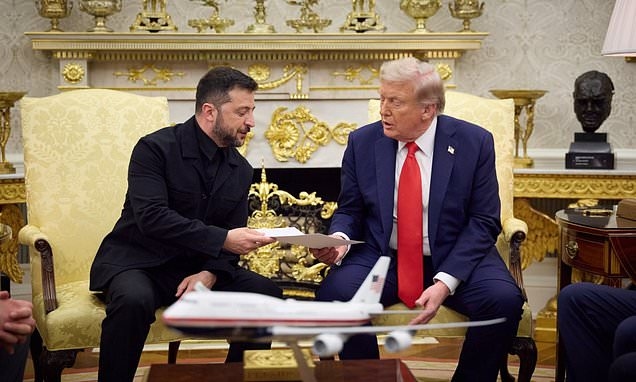
US president Donald Trump welcomed Ukrainian president Volodymyr Zelensky and several European allies to the White House yesterday.
Following Trump and Russian president Vladimir Putin's summit in Alaska on Friday, in which no ceasefire was reached, the 'coalition of the willing' rallied around Ukraine and strengthened their calls for a solution.
UK prime minister Keir Starmer joined Trump and Mr Zelensky alongside several other European leaders – and Sir Keir said 'real progress' had been made during the summit held yesterday afternoon.
He described the talks as 'good and constructive', adding: 'There was a real sense of unity between the European leaders that were there, and president Trump and president Zelensky.'
Trump also described the talks as 'very good', saying on his Truth Social platform that 'everyone is happy about the possibility of PEACE for Russia/Ukraine'.
And president Zelensky said the talks were 'the best' so far, adding: 'We are very happy with the president that all the leaders are here and security in Ukraine depends on the United States and on you and on those leaders who are with us in our hearts.'
But what did the talks actually achieve?
During the meeting, Trump promised the US would be involved in providing security guarantees for Ukraine.
Trump reiterated ahead of the meeting that he is still totally against Ukraine joining Nato – but Putin is reportedly open to allowing the US to provide Ukraine with Nato-like 'robust security guarantees'.
Speaking at the weekend, US envoy Steve Witkoff said: 'We were able to win the following concession: that the United States could offer article five-like protection, which is one of the real reasons why Ukraine wants to be in Nato.'
Nato's Article Five is the principle that an attack on one member is considered an attack on them all – and Russia has long opposed Ukraine being accepted into Nato.
The US president added: 'I think that the European nations are going to take a lot of the burden. We're going to help them, and we're going to make it very secure.'
Trump told the meeting that he had spoken directly with Putin to start planning a meeting between him and Mr Zelensky.
In fact, according to an EU diplomat, Trump interrupted the meeting to call the Russian president, Sky News reports.
Sir Keir said after the meeting: 'The other material outcome was the agreement that there will now be a bilateral agreement between president Putin and president Zelensky, followed by a trilateral which will then add in president Trump.
'That is a recognition of the principle that on some of these issues, whether it's territory or the exchange of prisoners, or the very serious issue of the return of children, that is something where Ukraine must be at the table.
'These were the two outcomes that were the most important coming out of today. They're positive outcomes, there was a real sense of unity. We've made real progress today.'
Speaking to Fox News after the Alaska summit, Trump suggested it could be 'up to Zelensky' to make peace with Russia.
If Trump is able to set up a meeting between Putin and Mr Zelensky, it would be only the second time the two leaders have met face-to-face.
They last met in 2019 at the Élysée Palace in Paris to try and negotiate a solution after Russia annexed Crimea illegally in 2014 and Russian-backed separatists started to take control of parts of Ukraine's Donetsk and Luhansk regions.
Trump also said that 'if everything works out well today' he would organise a meeting between himself, Putin, and Mr Zelensky.
Mr Zelensky was reportedly using the meeting to push for a trilateral meeting between himself, Trump and Putin after he was excluded from the Alaska summit.
From the perspective of Mr Zelensky and other European leaders, the priority for yesterday's talks seemed to be that further negotiations and talks about Ukraine's future must include Ukraine's input.
French president Emmanuel Macron said while a trilateral meeting is important, he also wanted a 'quadrilateral' summit to take place afterwards.
It wasn't clear whether he wanted the fourth party in the meeting to be France, Nato, the EU, or the 'coalition of the willing' as a whole.
Following Friday's Alaska summit, where the prospect of a ceasefire was not discussed, Trump said there doesn't need to be a ceasefire in Ukraine, as a peace deal could be worked out while the two countries are still at war.
He commented: 'I don't think you need a ceasefire. You know, if you look at the six deals that I settled this year, they were all at war, I didn't do any ceasefires.
'I know that it might be good to have, but I can also understand, strategically, why one country or the other wouldn't want it.
'You have a ceasefire and they rebuild and rebuild and rebuild and maybe they don't want that.'
German chancellor Friedrich Merz seemed to oppose this, telling media in the White House: 'I can't imagine that the next meeting would take place without a ceasefire, so let's work on that and let's try to put pressure on Russia.'
Trump later pushed back, saying: 'So if we can do the ceasefire, great, and, if we don't do a ceasefire… many other points were given to us, many, many points were given to us, great points.'
Trump repeatedly said before this meeting that a discussion about territory exchanges needed to be discussed.
He said any exchanges would need to 'take into consideration the current line of contact', adding: 'That means the war zone, the war lines that are now, pretty obvious, very sad, actually, to look at them and negotiating positions.'
It's understood that during the Alaska summit on Friday Putin demanded Ukraine hand over its Donetsk and Luhansk regions as a condition for ending the war – a move which Trump reportedly endorsed privately.
In exchange, Russia would reportedly give up other Ukrainian territories held by its troops. More Trending
However Mr Zelensky has repeated that he is not able to give up any of his country's territory – including Crimea, which was illegally annexed by Russia in 2014.
Speaking in April about the possibility of ceding land, he simply said: 'There is nothing to talk about here. This is against our constitution.'
Article two of Ukraine's constitution states that its sovereignty 'extends throughout its entire territory' which 'within its present border is indivisible and inviolable'.
For any change to the country's borders to happen, the Ukrainian parliament must authorise a national referendum for its citizens to vote on.
Get in touch with our news team by emailing us at webnews@metro.co.uk.
For more stories like this, check our news page.
MORE: Fact check: Donald Trump boasts he's ended 'six wars in six months' but has he?
MORE: Zelensky tells Trump 'it's the best I had' after turning up in black suit with no tie
MORE: Russian troops troll Zelensky by flying US flag on mission into Ukraine

Try Our AI Features
Explore what Daily8 AI can do for you:
Comments
No comments yet...
Related Articles


The Independent
 11 minutes ago
- The Independent
MTG's boyfriend says he took Zelensky's Oval Office suit zinger in good cheer: ‘It was a funny joke'
Marjorie Taylor Greene 's boyfriend, Real America's Voice correspondent Brian Glenn, laughed off Volodymyr Zelensky's zinger about him wearing the same suit during Monday's press conference in the Oval Office as he did during February's now-infamous showdown between the Ukrainian leader and President Donald Trump. Axios reported that The White House inquired about Zelensky's attire before the much-anticipated second meeting between the leaders, after Vice President JD Vance in particular voiced frustrations over his 'look and attitude' the first time around. The Ukrainian President wore his usual military-style attire during the disastrous February meeting, which Glenn mocked at the time. Zelensky again wore an all black ensemble for his return to the West Wing - but this time with a suit jacket - something noted by the reporter. 'You look fabulous in that suit,' Glenn told Zelensky. 'You look good.' 'I said the same thing,' Trump chimed in, noting that Glenn 'attacked' Zelensky for his attire 'last time.' 'I apologize to you, you look wonderful,' added Glenn. 'You are in the same suit. I changed, you are not,' Zelensky said to laughter in the Oval Office. During Glenn's subsequent appearance on LBC, he said, 'I apologized to him, and then he threw a little zinger back at me…I actually loved it.' Glenn noted that he wasn't 'technically' wearing the same suit as he had been in February, adding, 'I think it was a funny joke, I took it really well…I really did.' 'I think it loosened up that moment in the Oval Office, and, you know what, from that point on, I remember making eye contact with President Zelensky multiple times, and it was kind of like a gentleman's nod, kind of like, 'okay, we're good,'' said Glenn. The rightwing correspondent added that he believes the Ukrainian leader has forgiven him. Glenn, who's dating firebrand Republican Rep. Greene, ripped Zelensky for wearing a black sweater with the Ukrainian trident during February's heated Oval Office meeting with Trump. 'Why don't you wear a suit? You are at the highest level in this country's office, and you refuse to wear a suit. Do you own a suit?' Glenn asked. "I will wear [a suit] after this war finishes. Maybe something like yours, maybe something better," Zelensky said at the time.

Daily Mail
11 minutes ago
- Daily Mail
Opinion: Signals that prove Trump forced a historic reckoning
No one knows if there will be a peace deal between Ukraine and Russia. But this much is emphatically and impressively true: Donald Trump has already done something extraordinary — he has created a moment in which all parties can see two stark alternatives with sudden clarity. They can compromise and make a deal, or they can face the continuation of a grinding war with an uncertain duration and outcome. That sense of crossroads was on display at the White House on Monday in a tableau that was at once theatrical and substantive. Trump has managed, at least for now, to coax the United States, Europe, and Ukraine into a common position. That united front presents Vladimir Putin with what he has long tried to avoid: Western cohesion in the face of his aggression. The day unfolded with all the trappings of political theater. There was the banter about President Volodymyr Zelensky 's choice of wardrobe — a jacket that suggested a nod to formality rather than the olive drab sweatshirt that has become his wartime uniform. There was also a moment of personal warmth, when Zelensky handed Trump a letter from his wife to Melania Trump, written about the plight of children in the war zone. These gestures may appear minor, but in diplomacy such small signals help reinforce the larger message: unity, solidarity, and an insistence on treating each other as friends rather than supplicants or tetchy combatants. For Zelensky, a former actor who once made his living playing roles, Monday was a performance that mattered. He carried his lines with precision and his tone with care. The last time he visited Washington the chemistry soured and tensions spilled into public view. This time, the body language told a different story. Smiles, nods and a sense of easy rapport radiated from the Oval Office outward. Compared with Putin's frosty reception during his stop in Alaska on Friday — a visit the Kremlin had hoped would project strength — Monday's White House welcome stood as a vivid counterpoint. The most consequential takeaway from the day was the absence of daylight between Washington and its European allies. For years, Putin has relied on fissures within the transatlantic alliance, exploiting differences over energy, trade or the use of force. Yet on Monday, the alignment was clear: the US, Europe and Ukraine are working together to shape a peace plan. This is precisely the scenario Putin has sought to prevent, and brings the world to the essential questions now hovering over these fragile negotiations. Will Putin accept a combined European and American framework that offers Ukraine the security guarantees it needs to risk peace? And will Ukraine, whose soldiers have retaken and held swathes of territory at immense cost, truly be willing to cede land now under its control in exchange for ending the bloodshed? Neither question yields an obvious answer. For Putin, compromise has always been a synonym for weakness. For Ukraine, yielding territory risks validating aggression and betraying those who have died defending it. Yet the very posing of these questions, out loud and on equal terms, marks a shift in the conversation. The possibility of peace, however brutal, is now at least conceivable. If the answer to either or both questions is 'no,' then the burden will shift back to Trump. What will he do? Will he enforce punishing new sanctions designed to cripple the Russian economy? Will he authorize Ukraine to use American-supplied weapons to strike deeper into Russian territory? Will he risk escalation to demonstrate resolve? The options ahead are perilous, but they are his to shape. What is striking is how Trump — long painted as skeptical of NATO, dismissive of Europe and oddly solicitous of Putin — now finds himself in the role of transatlantic unifier. By engineering a moment when the allies stand shoulder to shoulder, he has created the conditions for a test: either Putin comes to the table, or he faces the combined weight of American and European pressure. This is not a neat choice between war and peace. It is instead what might be called a 'brutal peace.' Any deal will be painful, incomplete, and fraught with moral compromise. But it will still be peace. If Trump cannot deliver Putin to the table, then he must bring him to heel by other means. Either way, the calculus has changed. Diplomacy often depends on timing. Wars grind on until one side collapses or until leaders perceive that further bloodshed is more dangerous than negotiation. What Trump has done, at least for now, is force that moment of reckoning. He has made all sides look squarely at the costs of continuing the war versus the costs of ending it. It is too soon to know whether history will mark this week as a turning point. But it is fair to say that Trump, a man once derided as an opponent of Europe and a skeptic of alliances, has demonstrated a capacity to bring allies together in common cause against a murderous dictator. That alone is remarkable. It may yet be remembered as the moment when urgency became opportunity.


Channel 4
41 minutes ago
- Channel 4
‘There's a feeling of depression in Russian cities'
In Russia, the universally pro-Kremlin media have tried to downplay Volodymyr Zelenskyy's meeting with Donald Trump and European leaders – declaring that 'everyone looked gloomier than a thundercloud'. While an op-ed in the state news agency RIA Novosti warned that if future overtures didn't go well, there would be no more 'truly generous compromises', even threatening western Ukraine with the headline 'we'll have to go as far as Lviv'. We were joined by Andrei Soldatov who's one of Russia's leading investigative journalists who fled the country in 2020 and is now on Russia's most wanted list. His latest book is Our Dear Friends in Moscow – the Inside story of a broken generation.
