



Budget 2025: Nicola Willis' focus on the Opposition shows she's feeling the pressure
It was an unusual decision by Willis to lead off the general debate yesterday with a speech on the Labour Party and whether it will have a core Crown debt ceiling of 50% of GDP, as advised by Treasury. There were discrepancies between what leader Chris Hipkins said this week – no decision – and what finance spokeswoman Barbara Edmonds said last week – she supported the ceiling. It was hardly the issue of the day, one day before her much-anticipated second Budget.
When she was at the Budget printers in Petone in the morning, Willis explicitly told media she was not focusing on the Opposition, then promptly went back into town and drafted a speech about them. The attack on the eve of her own Budget shows she will use anything that promotes her own sense of discipline. It also suggests she may be nervous about polling since the pay equity changes were passed under urgency.
It wasn't just Labour in her sights. She ended her speech with a flourish against the big-spending Greens' alternative Budget: 'Just spare a thought also for Chlöe Swarbrick: she wants to save a planet that she doesn't even live on,' Willis said. The BS Budget or the BA Budget?
Labour's Kieran McAnulty immediately responded to Nicola Willis' speech and her preferred nickname for the Budget as the 'No BS Budget': 'A confident finance Minister doesn't talk about her opposite; she talks about herself and what they've achieved and they didn't mention that once and New Zealanders know exactly why: because they have done bugger all, because they've buggered up the Budget.' C-bombs in the House – the sequel
Andrea Vance, who used the c-word in the Sunday Star Times in describing the actions of women ministers over pay equity law changes, won the political journalist of the year award at last week's Voyager Media Awards for work in 2024.
The other finalists were my Herald colleague Jamie Ensor and RNZ's Guyon Espiner. The Herald on Sunday won weekly newspaper of the year and the overall newspaper of the year.
I was intrigued to see how Hansard, the record of Parliament, would handle the c-word after Act's Workplace Minister Brooke van Velden used it in Parliament last week in a bid to convey her outrage at Andrea Vance's column.
Curiously, Hansard spelled out the full word in reporting van Velden's words, but put square brackets between the second letter and the last letter, like this: c[***] (asterisks ours).
After making an inquiry to the Office of the Clerk as to why the brackets were there, I was told the reason is that van Velden's quote was not an exact quote from the Vance article; van Velden uttered the word, whereas the article used the letter c and three dots. Hansard handles all quotes the same way. If an MP claims to be quoting but it is not an exact quote, it gets the square bracket treatment. Justice delayed
The Government normally has control of what happens in Parliament, but not this week. The debate on the Privileges Committee report recommending the suspension of three Te Pāti Māori MPs had to be held as the first item of business following the tabling of the report last Thursday, which meant it had to be held on Tuesday after Question Time.
There was no way the debate could be delayed at the discretion of the Speaker, the Leader of the House or even by agreement among parties. The only way the debate could be adjourned was after the debate had begun, which is what Chris Bishop, as Leader of the House, moved after speeches by Privileges Committee chair Judith Collins and Labour leader Chris Hipkins.
It was a closely guarded secret until Bishop's ambush, though why it was so secret is not evident. There is little sense of collegiality in the parliamentary complex at present. But Labour was not nimble enough, and having spent a couple of days calling for a delay in the debate so Te Pāti Māori leaders could take part in the Budget debate on Thursday, it got a minute's notice to think about the delay motion and vote against it.
Hipkins thought that while the delay might let the MPs speak in the Budget, it might prevent them from voting on the Budget. It turns out they will be able to do both, although that is no guarantee they will.
The whole episode has been frustrating, and that is clear in the comprehensive comment piece by political editor Thomas Coughlan. More crime and punishment
Winston Peters was thrown out of the House on Tuesday for the first time this term for a completely daft question to his benchmate, the Prime Minister. Peters had not read the room properly and did not pick up on the fact that Speaker Gerry Brownlee was at breaking point in his attempts to tighten the leash at Question Time, ahead of what he thought was going to be a fraught debate following it. Deputy PM Winston Peters leaves the House on Tuesday. Photo / Adam Pearce
Luxon had been answering questions from Te Pāti Māori co-leader Debbie Ngarewa Packer about his interview the previous day with Newstalk ZB's Mike Hosking. Hosking had used the term 'Māorification' in a question around Stop/Go signs being in te reo (Taihoa/Haere). Ngārewa Packer questioned him about what he thought it meant and why he had not pushed back on the question, to which Peters made the following contribution: '...on the issue of 'Māorification', would it be 'Māorification' if every Thursday I went down and got myself a suntan?'
Brownlee, having issued a warning two minutes earlier that he was not in a mood to be trifled with, told Peters to leave the House, although he let him back in at the end of Question Time. If you're going to get thrown out of the House, Winston, it is better for it to be on a point of principle, or at least something clever. Hanging judges
Perhaps Peters' equilibrium had been disturbed. Earlier in the day, while making a KiwiRail Budget announcement at Wellington Railway Station, Peters had been heckled by a staff member of Tonkin + Taylor on his way to work, including the term 'You f***ing moron.' The heckler was wearing his work lanyard and the company has contracts with KiwiRail.
Peters yesterday showed no sympathy for the staffer, whose conduct is being reviewed by his company and whose actions are being defended by the Free Speech Union.
Perhaps following the example of the hanging judges on the Privileges Committee, the heckler could get a three-week suspension with no pay – and maybe some discount if he showed some contrition to Peters. By the way...
• Winston Peters puts on his Foreign Minister's hat tomorrow and leaves for a trip taking in Adelaide, the home city of his Australian counterpart, Penny Wong, Sri Lanka, Nepal and India. It will be the first visit ever by a New Zealand Foreign Minister to Nepal and coincides with the 72nd anniversary of the summit of Everest by Tenzing Norgay and Sir Edmund Hillary.
• Parliament is set to go into urgency after the Budget today and is expected to stretch into a Saturday sitting. We know this because the cafeteria staff have been asked to open at 8am on Saturday. Quote unquote
'It is not a Budget filled with rainbows and unicorns. It is a reality Budget that will deliver genuine hope for the future.' – Finance Minister Nicola Willis at the Petone printers yesterday. Micro quiz
What year was the so-called Mother of All Budgets presented? (Answer below.) Brickbat ACC Minister Scott Simpson. Photo / Hagen Hopkins
Goes to ACC Minister Scott Simpson, who said in response to a question from Labour's Camilla Belich about a particular ACC programme that has been stopped: 'ACC is an independent Crown entity, and I, as Minister, stand at arm's length from operational decisions.' You don't hear the ministers of Health, Housing or Transport say that about Health NZ, Kāinga Ora or Waka Kotahi. Bouquet Eric Crampton, chief economist of the NZ Initiative.
Goes to Eric Crampton, the chief economist of the NZ Initiative think-tank, who refused to accept Treasury's invitation to today's Budget lock-up unless it lifted itsban on Council of Trade Unions economist Craig Renney– which it did. This week's top stories
OPINION - Budget 2025: KiwiSaver changes, tax write-offs and other 'surprises' – Jenée Tibshraeny on what to watch out for in today's Budget.
Budget 2025 – debt debate: In the final days before the Budget, Finance Minister Nicola Willis has been turning up the heat on Labour for its flip-flopping on debtthat .
Budget 2025 preview: The Government needs to find billions of dollars for the numbers to add up in today's Budget. Derek Cheng outlines what we know so far.
Budget 2025 – health spending: Prime Minister Christopher Luxon and Health Minister Simeon Brown have announced that $164 million will be spent on urgent care across the country.
Peters heckling: The employer of a man who heckled NZ First leader Winston Peters during a press conference has drawn criticism after apologising for his behaviour and saying the company had launched an investigation.
MPs' punishment: The Government has passed a surprise motion to delay the debate on the punishment of three Te Pāti Māori MPs for participating in last year's controversial haka in the House.
OPINION – MPs' punishment: MPs' failure to compromise on the punishments meted out to three Te Pāti Māori MPs after last year's haka in the House bodes ill for Parliament, writes Thomas Coughlan.
MPs' property: The latest disclosures of politicians' financial interests have been released by Parliament, revealing how MPs' property portfolios looked at the start of the year.
Regulatory Standards Bill: Implementing the Regulatory Standards Bill will cost a minimum of $20 million per annum across 20 years, government officials estimate.
Digital Services Tax: The Government has binned a tax worth an estimated $100 million each year after threats of retaliation from US President Donald Trump.
Greens' budget: Labour leader Chris Hipkins has called the Green Party's alternative budget 'unrealistic', but says he agrees with some elements.
ANALYSIS – think-tank 101: What is a political think-tank and who are the key players in New Zealand? Audrey Young explains.
ANALYSIS – social sector shakeup: 'We need a different model' - Andy Coster talks to Audrey Young about his new role in reshaping social sector funding.
Stay with us for comprehensive coverage of today's Budget, including live coverage from 2pm, with interviews with major players, in-depth analysis and commentary. Parliament will go into urgency later today to debate Budget-related legislation. Parliament will be in recess next week.
Quiz answer: 1991, by Ruth Richardson
For more political news and views, listen to On the Tiles, the Herald's politics podcast.
Hashtags

Try Our AI Features
Explore what Daily8 AI can do for you:
Comments
No comments yet...
Related Articles


Techday NZ
 3 minutes ago
- Techday NZ
Agentic AI is Australia's unrealised productivity lever
As ongoing Productivity Commission reports show, Australia's flat productivity is a persistent national challenge, so much so that the Labour government is hosting a three day industry roundtable focused on restarting our economic engine. If productivity is corrected, the Productivity Commission estimated that it would leave the average Australian worker $14,000 better off by 2035. However, simply working harder isn't the answer. The latest ABS Labour Force data highlights that Australians are working ever more hours. We collectively clocked 2 billion hours in July 2025, which is a 2.1% annual increase. Yet, our national productivity stagnates. Instead, we should be working smarter. As the Economic Reform Roundtable convenes in parliament, it's positive to see the Treasurer put more emphasis on AI as a key lever to solving Australia's productivity deficit - estimating AI could add more than $116 billion to the economy over the next decade. But the national conversation is still catching up to reality. While policy debates dwell on generative AI, the frontier has already evolved to agentic AI: systems that plan, action, and collaborate with humans across workflows. The risk isn't moving too fast; it's moving too slow and falling behind the global status quo. With Microsoft's Work Trend Index 2025 showing that 81% of business leaders globally expect AI agents to be part of their strategy in the next 12–18 months, it's crucial for Australian industry and government to recognise agentic AI as a critical asset in not only course-correcting our productivity, but moving us ahead economically too. However, like any transformational technology, the fundamental challenge is skills; agentic AI requires new skills and a rethink to how we approach work. Fortunately, there's already a lot the white collar workforce can learn from how the software development world has reinvented itself with agentic AI. Software development's blueprint for agentic AI success The software development industry provides a powerful blueprint for agentic AI adoption, particularly for a market like Australia that suffers a perpetual tech skills shortage which puts consistent pressure on developers to deliver more and more. AI coding agents are opening up doors for human developers to have their own agent-driven team, all working in parallel to amplify their work. Technical teams are now able to assign tasks that would typically detract from deeper, more complex work, allowing developers to focus on high-value coding tasks that have the most impact. We've seen a profound impact on the use of GitHub Copilot's agentic capabilities, with many now using the tool in their day-to-day work. Australian industry leaders like Commonwealth Bank, EY, and MYOBhave embraced AI-assisted software development, leading to surging productivity gains. More broadly, between 60-75% of developers report feeling more fulfilled and less frustrated when using GitHub Copilot - a metric businesses shouldn't take for granted when striving to maximise productivity. By taking on repetitive, time-consuming tasks asynchronously, AI agents free developers to focus on what matters: solving problems, delivering value, and building products at scale. What once took days now takes hours, turning release cycles from marathons into sprints, offering up a surefire way to reshape the productivity puzzle. What can businesses learn from this? Employees who are empowered with AI,integrating it deeply into their workflow, emerge with greater ambition, sharper technical fluency, and higher job satisfaction. The evidence shows that developers aren't writing less code; they're orchestrating more complex, system‑level work, and this should provide an exciting example for businesses to follow. It will take a lot of 'unlearning' at the senior manager level (and a lot of trust in employees) but a 'reimagining of work' across a business' workforce will open creative and innovative doors that have probably not been conceived of yet. For this opportunity to be harnessed across Australia's economy however, we need to instill these skills in future generations; 'managing AI' should be a fundamental skill every citizen learns. AI education is the key to empowering an innovative society We can't expect graduates to thrive in an AI-driven economy if they haven't learned with AI. It's the equivalent of trying to prepare the future workforce to work with computers, apps, and other modern digital means, and then handing them a pencil. Australia has taken an important first step with the Australian Framework for Generative AI in Schools, recently endorsed by education ministers in June 2025. But a framework centered on GenAI alone is already being outpaced by the next frontier with agentic AI. Students should be given the opportunity to learn about AI as a dedicated subject in school curriculums. They should be taught to brief, supervise, and evaluate autonomous systems: the very skills that will be critical to their future jobs on day one. Never before has technology been so ubiquitous and instrumental in the future of the economy - leaving it out of early learning would not only do a disservice to students, it's also not conducive to a competitive economy. This isn't a theoretical risk either. Australia is already struggling to attract and retain AI talent. We lean heavily on skilled migration for advanced roles; we punch above our weight in research output but capture only a sliver of AI patents, a clear sign of a commercialisation gap. Too many talented graduates, including those who've helped build world-class systems, are taking their skills offshore. The fix is straightforward: create clear, supported pathways from classroom to career so students can learn, build, live, and work in Australia. As we await tangible policy following the Economic Reform Roundtable, it's imperative that both government and industry understand one thing: productivity is intrinsically linked to economic growth - and AI sits at the heart of this. If Australia wants to compete, the choice is simple: reinforce agentic AI as a productivity lever and reinvest in the human capability that unlocks it. While the Roundtable can set the direction, what remains is the will to link policy with practice so investment and education moves together toward reversing the trend of declining national productivity, and making our economy world-leading with AI.


NZ Herald
33 minutes ago
- NZ Herald
Western Bay teachers strike over 1% pay rise offer
'And we can't do that with the Government's latest pay offer.' Sam Oldman at the Western Bay of Plenty PPTA strike in Tauranga. Photo / Ayla Yeoman Oldham said the Government had been 'completely unreasonable' with its offer of a 1% increase per year for three years. 'We can't work with that.' Oldham said a more appropriate offer would be 4% each year for three years. Oldham said large numbers of teachers were leaving to teach in Australia, where they could get paid tens of thousands of dollars more, often with cheaper costs of living. The Western Bay of Plenty Post Primary Teachers' Association (PPTA) strike against the 1% pay rise offer from the Government. Photo / Ayla Yeoman 'We want to be competitive with Australia and other jobs in New Zealand.' Oldham said he wanted to stay in New Zealand because he loved living here and his family and children were here. 'I grew up here and I don't want to have to leave my country in order to get a decent quality of living. 'I actually want to stay here and build a great public education system that my kids can go through.' Oldham said the strike was also protesting the cancellation of 33 pay equity claims in controversial legislation passed by the Government under urgency in May. Another Mount Maunganui College teacher, Lance Talstra, said he did not want to live in Australia. He was a Kiwi 'born and bred'. Lance Talstra at the Western Bay of Plenty PPTA strike in Tauranga. Photo / Ayla Yeoman 'The pay is not in line with inflation, so effectively it's a pay cut. 'But, in addition to being a 1% pay rise, we're also being asked to do a lot more in terms of new curriculum,' he said, referring to the recent announcement that NCEA would be abolished. Talstra said the changes to the curriculum meant a significant amount of time investment for the same amount of pay, 'which is clearly unfair'. He said he would like an offer that lined up with inflation. 'There are a lot of people who are doing it tough at the moment. I'd like to be doing better myself.' Members of the Post Primary Teachers' Association marched from Red Square in Tauranga's city centre. Photo / Ayla Yeoman Another striker, who did not want to be named, said they were striking for investing in teachers for a better education system that would benefit the students. 'I'm here for the students because, my working conditions, that's what they have to learn in,' they said. 'It affects their ability to learn.' The march ended at a picket line at the Cameron Rd and Elizabeth St intersection. Photo / Ayla Yeoman Labour MP Jan Tinetti, who is a former principal of Merivale School, attended the protest and said the offer was 'absolutely appalling'. She said she took leave from parliament today to join the strike because she felt so strongly about the importance of the teachers. Labour MP Jan Tinetti at the Western Bay of Plenty PPTA strike in Tauranga. Photo / Ayla Yeoman 'Our teachers are under a lot of stress at the moment. They are the people who impact on our future like no other profession does. 'They are the key to our future.' Education Minister Erica Stanford asked the PPTA in an announcement yesterday to return to the table in good faith. 'You can't negotiate when you're sitting at the table by yourself, and that's what we've found over the last little while.' She said the government and the union had just had another round of negotiations, and they had recently seen some 'good faith moves' from the PPTA, but would not go into further detail. 'All I can say is there have been some more good faith moves on behalf of the PPTA, which is really good to see.'

The Spinoff
an hour ago
- The Spinoff
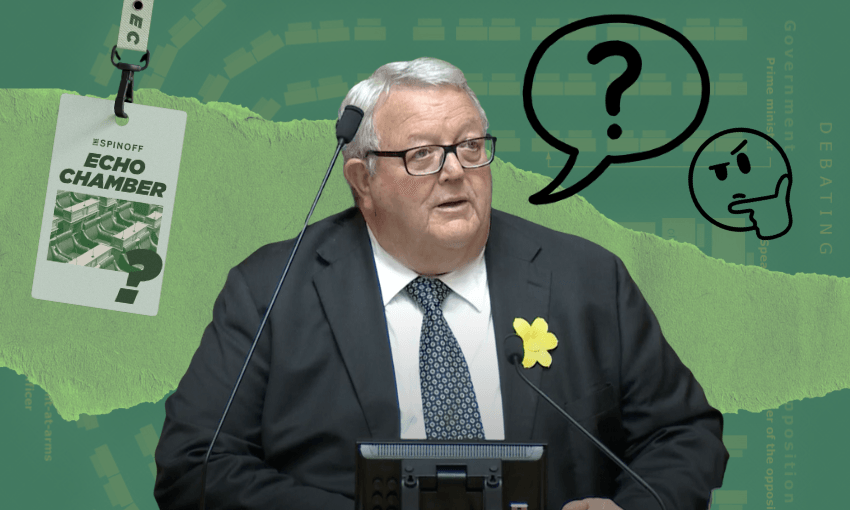
Echo Chamber: Wait, who's keeping track of the rules around here?
Welcome to the House of Representatives, where the standing orders one week aren't the same the next week. Echo Chamber is The Spinoff's dispatch from the press gallery, recapping sessions in the House. Columns are written by politics reporter Lyric Waiwiri-Smith and Wellington editor Joel MacManus. Do you ever get tired of people beating the same old drum? Some are worn down from so much use that what once were crashing bangs are now dull thuds. In the House of Representatives, for example, the cost-of-living drum once beat loudly and now sounds more like a low hum. But most thrashed is the standing orders drum, whose cymbals are so coated in patina it's hard to know what the writing underneath says – so you might as well just make it up as you go along. For Tuesday's question time session, Labour leader Chris Hipkins and prime minister Christopher Luxon beat their same old drum ('does he stand by all his government's statements and actions?', 'yes') and landed on the same old notes that the government swears are still in tune. But when Hipkins tried to press Luxon on why the average Hohepa should cough up nearly $100 to see their doctor while tobacco companies have enjoyed a massive tax cut, he pressed someone else's buttons instead. 'Point of order.' Winston Peters rose to his feet. No one should be able to come into this House and base a question on a supposed $300m tax cut – 'and it was $200m', he clarified – which came from a reduction in the sales of cigarettes and tobacco, and amount it to what he's saying. 'And they've done it for the umpteenth time.' Finance minister Nicola Willis, perhaps in audition mode for the role of future prime minister, egged the show on: 'Give him some advice! Surely you get it?' And the voice of Labour MP Megan Woods cooed back, 'ooohh, Nicola!' The speaker and the Chrises moved on, but Peters couldn't let go of the tobacco conversation. While Chippy now wanted to talk about tax breaks for tech companies, Peters wanted to clear up the record for the misunderstood tobacconists bravely and boldly trying to operate in an increasingly pro-health world. 'Point of order, Mr Speaker,' he began. 'We have sat here for month after month while those members have repeated that lie in the House.' He carried on, but there was something flapping around in his periphery, the arms of Greens co-leader Chlöe Swarbrick trying to get the speaker's attention. 'Seriously?' Swarbrick – back from a week-long ban from the House for encouraging her fellow MPs across the aisle to look into the benefits of growth in the vertebrae – cried out. Longtime fans of parliament's standing orders may remember the fact that 'reflecting on a member's character' – in this case, implying or straight up saying they're lying/are a liar – is a punishable enough offence to get kicked out of the House, like when Labour's Willie Jackson was ejected from the chambers last year for calling David Seymour a 'liar'. Hipkins rose for a point of order. Mr Speaker, just last week you named and ejected a member for saying they were struggling to find members with a backbone – 'how is accusing members of lying any different?' Well, Brownlee replied, 'it is quite different in my head' – because one of those comments was directed 'very personally at members of parliament', and the other was a question about repeating a lie. Interesting point – no two days are ever truly the same in this building, so why should the way the rules are applied be the same every day? 'Wait on, what I'd say to you is,' Brownlee began, and quickly corrected himself. 'Oh, I don't like that saying. The member knows there is a remedy by way of the standing orders to have that corrected.' Raising a privilege complaint would be 'pushing it too far', Brownlee told Hipkins, and all the while, Peters grinned away in his seat. Trying to turn the tide back into the left bloc's favour, Hipkins channelled his inner gen Z to let the nation know he's still cool and with the kids, unlike that other Chris across the aisle. 'When he says that the economy and the country are turning the corner, while food prices continue to skyrocket, unemployment continues to go up,' Hipkins began, 'why won't he simply admit that his government is all 'delulu' and no 'solulu'?' 'Sorry, could he repeat the question?' Luxon asked. 'I didn't understand it.' No, we don't need that repeated, Brownlee decided – we'll move on. It didn't take long for Peters to resume the defensive position, after Labour's finance spokesperson Barbara Edmonds questioned Willis over the dead-in-the-water iRex ferry project, which cost $671m and returned no new ferries. Peters was keen to rectify another 'lie' – actually, the previous Labour government had already spent $471m on the project before we even came to power, he told the House. Peters sought leave from Brownlee to 'table an article' – which was actually commentary to the select committee – from February 2024, when KiwiRail confirmed the price tag from the Labour side. Brownlee let him, but not correcting Peters' use of 'article' came back to bite him when Labour's Kieran McAnulty stood up, and asked to 'table a document which shows Christopher Luxon is the least popular prime minister in 30 years'. 'Check yourself before you wreck yourself,' Peters called. What ensued was a small back and forth, where Brownlee conceded he had made a rare misstep, but now it was time to get on with it. 'You can disrupt the House all you like, I'm not changing my mind,' Brownlee told McAnulty. 'Stop trifling in my direction.'
