


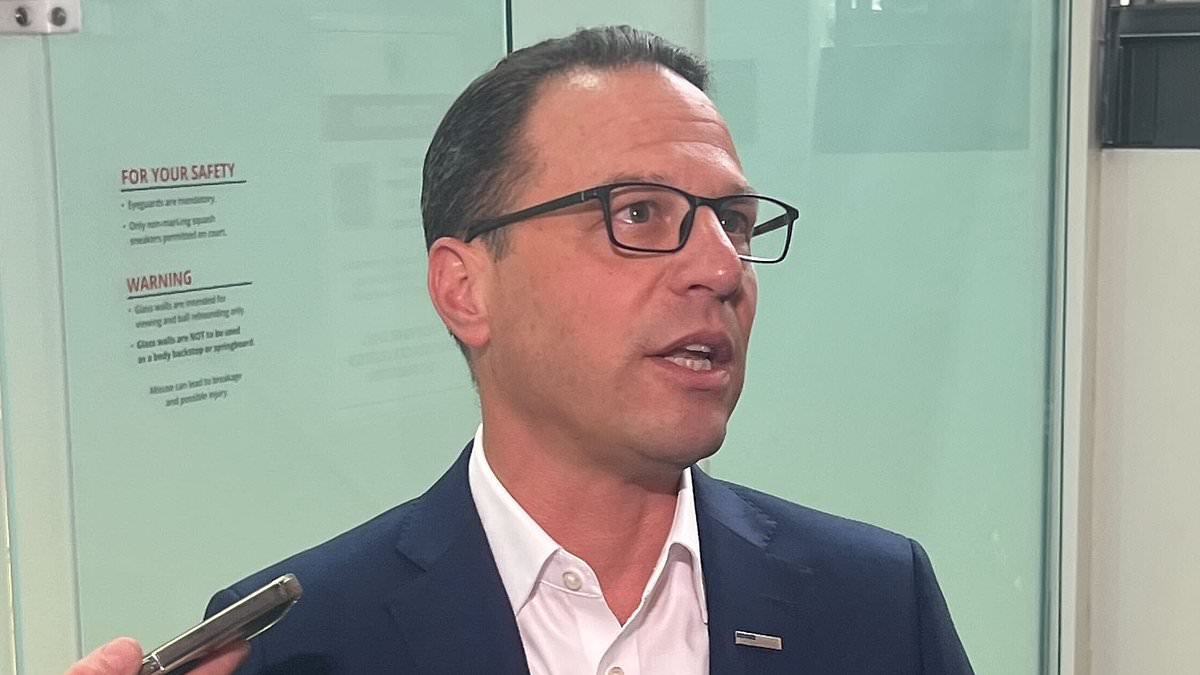
Rising Democratic star takes swipe at JD Vance as sparks fly ahead of potential 2028 matchup
Shapiro, a popular Democrat who's among the top names floated as a viable future White House hopeful, was in Pittsburgh attending the Pennsylvania Energy and Innovation Summit, headlined by President Donald Trump.
Vance is headed to Pennsylvania Wednesday to tout the 'big, beautiful bill,' which Trump signed into law on the Fourth of July.
The vice president is also considered a top pick for the 2028 GOP nomination.
Shapiro told the Daily Mail in a gaggle with reporters that he's been very clear about the so-called 'big, beautiful bill.'
'I think it's going to hurt Pennsylvania,' he said. 'I think it's a bill that's going to take us back. I'm also just deeply concerned about the $3.4 trillion that they're adding to the debt.'
Vance will travel to West Pittson in the commonwealth's northeast Luzerne County, where he's expected to hold a rally-like event at a manufacturing facility.
'For someone who's preached a long time about the deficit, this takes us the wrong way,' Shapiro said of Vance and his backing of BBB. 'So I don't know what the vice president's going to say, but I think it's hypocrisy given what his record is and what this bill actually does.'
The Pennsylvania Democrat also noted how Vance 'professes to care about the middle class and working class' and the 'big, beautiful bill' includes cuts to programs including Medicaid.
Shapiro was more diplomatic earlier when he was seated alongside Pennsylvania's Republican Sen. Dave McCormick, who put together the Tuesday's summit, held on the campus of Carnegie Mellon University.
The governor and McCormick were commended by Penn State President Dr. Neeli Bendapudi for working in a bipartisan manner and asked if they had 'any pointers on how you build that culture?'
'We've got profound differences,' Shapiro said. 'We're honest about differing on the bill that was just passed, the reconciliation bill that was just passed last week, but we also understand how critically important it is to grow our economy in Pennsylvania, this unique moment we are in right now.'
'And the senator knows I bring certain tools to the conversation that he doesn't bring, and I know he brings certain tools to the conversation that I don't bring,' the Democrat continued. 'And if actually work together, one plus one starts to equal three instead of two.'
Shapiro said that he and McCormick, who beat longtime Pennsylvania Democratic Sen. Bob Casey in last year's election, are honest about their differences.
'We try and do so in a private way and in a respectful way. I think we need to find more ways to disagree respectfully in this country, like candidly,' Shapiro continued. 'And I think, you know, hopefully this can be a model for others.'
Another speaker at the conference, former Texas Gov. Rick Perry, who served as Trump's energy secretary during the president's first term, was also willing to deliver a compliment across the aisle.
Perry, who was being interviewed by journalist and author Salena Zito, first took aim at another possible 2028 Democratic hopeful - California Gov. Gavin Newsom.
'Gavin Newsom came to see me when he was lieutenant governor, trying to have a conversation about, "How are you getting all of our businesses out of California to come to Texas?"' Perry recalled.
'And I told him ... this isn't rocket science, I said, this is really pretty easy. Don't over-tax, don't over-regulate, don't over-litigate and have a skilled workforce, which basically transfers into accountable public schools,' Perry continued. 'Those are the four things I said, then get out of the way.'
'Now thinking Gavin wasn't listening too good,' Perry said to laughs.
The former Texas governor said he was just kidding.
'No you're not,' Zito shot back.
'But my point is, Gov. Shapiro understands that,' Perry said.
Hashtags

Try Our AI Features
Explore what Daily8 AI can do for you:
Comments
No comments yet...
Related Articles


The Guardian
 25 minutes ago
- The Guardian
White House launches official TikTok account after Trump vowed ban in 2020
The White House launched an official TikTok account on Tuesday, as Donald Trump continues to permit the Chinese-owned platform to operate in the US despite a law requiring its sale. 'America we are BACK! What's up TikTok?' read a caption on the account's first post, a 27-second clip, on the popular video sharing app. The account had about 4,500 followers an hour after posting the video. Trump's personal account on TikTok meanwhile has 110.1 million followers, though his last post was on 5 November 2024 – election day. Trump has a soft spot for the popular app, crediting it with helping him gain support among young voters when he defeated Kamala Harris, his Democratic opponent, in the November 2024 presidential election. 'The Trump administration is committed to communicating the historic successes President Trump has delivered to the American people with as many audiences and platforms as possible,' Karoline Leavitt, the White House press secretary, said as the account went live. A federal law requiring TikTok's sale or ban on national security grounds was due to take effect the day before Trump's inauguration on 20 January. But the Republican, whose 2024 election campaign relied heavily on social media and who has said he is fond of TikTok, put the ban on pause. TikTok is a tremendously popular social media app with 170 million users in the US. ByteDance, TikTok's parent company, said in April that it had been in discussion with the US government regarding a solution for the app. It added that any agreement 'will be subject to approval under Chinese law'. In mid-June Trump for the third time extended the deadline for the popular video-sharing app by another 90 days to find a non-Chinese buyer or be banned in the United States. That extension is due to expire in mid-September. The idea of banning TikTok originated with Trump in 2020, who said the Chinese-owned app posed a danger to national security. It quickly became a bipartisan issue and Congress overwhelmingly voted to ban the app last year, which faced a legal challenge but was ultimately affirmed by the supreme court. The original deadline for the TikTok ban was on 19 January. Trump switched his stance on TikTok after joining the app while campaigning for president last year, amassing nearly 15 million followers and hosting the TikTok CEO, Shou Zi Chew, at Trump's Mar-a-Lago estate in Florida. Chew also attended Trump's inauguration. While Trump had long supported a ban or divestment, he reversed his position and vowed to defend the platform – which boasts almost 2 billion global users – after coming to believe it helped him win young voters' support in the November election. Trump's official account on X, formerly Twitter, has 108.5 million followers – though his favored social media outlet is Truth Social, which he owns, where he has 10.6 million followers. The official White House accounts on X and Instagram have 2.4 million and 9.3 million followers, respectively. Dara Kerr contributed reporting


Telegraph
25 minutes ago
- Telegraph
White House joins TikTok with video of Trump saying ‘I am your voice'
The White House has joined TikTok even though the social media platform is due to be banned in the US in under a month. Donald Trump's administration on Tuesday set up a verified account on the Chinese-owned video-sharing app on Tuesday, with the caption: 'Welcome to the Golden Age of America.' TikTok is controversial in the US amid accusations by the FBI and others, which the company fiercely denies, that it could be used by Beijing to harvest data and sow division among Americans. Mr Trump attempted to outlaw the platform in his first term in office, but reversed course before the 2024 election and pledged to halt a federal ban going into effect that had been passed in Congress. The White House posted its first, and so far only, TikTok video on Tuesday evening, accompanied by the caption: 'America we are BACK! What's up TikTok?' The 27-second clip quotes Mr Trump's acceptance speech to the Republican National Convention (RNC ) last year, when he officially became the party's candidate for president ahead of his election win in November. 'Every day, I wake up determined to deliver a better life for the people all across this nation,' the president says. 'I am your voice.' The video, which switches from black and white to colour at the climax of Mr Trump's speech, shows the Republican meeting workers and members of the military, addressing the RNC, and striding down a red carpet on the way to a podium. @whitehouse America we are BACK! What's up TikTok? ♬ original sound - The White House Congress passed legislation to ban TikTok last year, with Republicans overwhelmingly defying Mr Trump's plea to vote against the bill over national security concerns. The app briefly went dark in January, but on his first day back in the White House the same month, the president signed an executive order to delay the ban until April 4 while the administration searched for a buyer. Mr Trump subsequently signed another extension to the delay two months ago, which moves the deadline back until Sept 17. The order instructs the justice department not to enforce the ban until January. The president has previously credited his presence on TikTok to helping him win over the young voters who swung dramatically towards him in November's election, paving the way for a victory that saw him win all seven swing states. 'I have a warm spot in my heart for TikTok,' Mr Trump said in December, roughly a month before he returned to office.

The Guardian
25 minutes ago
- The Guardian
Voices arguing that climate action is a waste of time are getting louder. Here's why they are wrong
There is something of a reality check under way on the response to the climate crisis. It's no secret that countries and corporations are far from living up to the goals set by international leaders at the landmark 2015 Paris agreement. Unless there is a significant course correction, the ramifications will be far-reaching and often destructive. The second coming of Donald Trump and growing global instability has made a top-down injection of urgency at the pace needed harder to imagine. Optimism is harder to come by. But that doesn't mean nothing is happening. It's worth pointing this out because a narrative has started to take hold that renewable energy and other clean solutions have made little to no headway in displacing fossil fuels, and therefore are pointless. Fuelled by Tony Blair and the former US government adviser Daniel Yergin, and embraced by the fossil fuel industry and its lapdogs in the commentariat, it is used to attack zero emissions targets as a fool's dream. In Australia, it is part of the backdrop as the Albanese government is lobbied over whether to set an ambitious emissions reduction target for 2035. The reality, though, is more complicated. Here are some things worth considering if you hear climate action is pointless. One line that has gained some traction this year is that the proportion of global energy supply from fossil fuels has barely moved over the past 35 years. The claim – bubbling away in the The Australian, on Sky News and on social media – goes that dirty fuels provided 85% of energy in 1990, and still provide 80% today. So much for progress, right? But the Bloomberg New Energy Finance founder and self-declared conservative Michael Liebreich points out that this ignores an important factor. The percentages referred to by fossil fuel advocates refer to primary energy – that is, raw coal, crude oil, gas, wood, sun or wind. They do not refer to secondary energy – energy that has been converted into a usable form, such as electricity or refined petroleum. Given secondary energy is what humans use, it is the more relevant measure. And the process of processing raw fossil fuels into usable energy is, in many cases, not particular efficient. More energy is lost in generating at a remote coal-fired power plant and transmitting it to a home than if solar, wind or hydro was used. Petrol cars require much more energy to travel a kilometre than an electric vehicle does. If we acknowledge this and consider secondary energy alone, the amount of energy provided by fossil fuels is not 80%, but 68%. This is obviously still too high. But it won't stay at this level. Despite all the talk of new coal plants still being built, they are playing in the margins. The International Energy Agency (IEA) forecasts that solar and wind will meet more than 90% of the global increase in electricity demand this year. Global generation from solar and wind energy is expected to increase by about 25%, from 4,000 terawatt-hours to more than 5,000. Next year it is expected to jump another 20%, past 6,000TWh. The IEA projects that global renewable energy output – including solar, wind and hydro – will surpass coal output in either 2025 or 2026. For the first time in a century, the share of electricity coming from coal will have fallen to less than 33%. Solar and wind will together be nearly 20% – up from 4% a decade ago. A key question is if this growth in renewable energy will eventually reduce global fossil fuel use – as is necessary – or mostly just meet growing energy demand. Liebreich argues compellingly that fossil fuel use is set to fall. Using a simple model, he suggests it is likely to start falling in the 2040s and could be squeezed out of the system by about 2065. That is not near fast enough to deliver the trajectory scientists say is needed to limit global heating since pre-industrialisation to 1.5C. But it is a well argued rejection of claims that a global transition isn't possible. Sign up to Clear Air Australia Adam Morton brings you incisive analysis about the politics and impact of the climate crisis after newsletter promotion With a population of 1.4 billion and having taken on a huge proportion of the world's manufacturing, China is easily the world's biggest direct national climate polluter, pumping out three times as much CO2 as the second-placed US. Its story is mixed, as always. But the data show it is changing. An analysis for Carbon Brief by China experts Qi Qin and Lauri Myllyvirta found that coal's share of the country's power generation fell from 73% in 2016 to 51% in June this year. This happened as it continued to build new coal plants for a simple reason – it doesn't run them at anything like capacity. A significant moment came earlier this year when China's national emissions fell for the first time, dropping 1% in the first quarter compared with a year earlier. Beijing needs to do much more if it is to meet its commitment under the Paris deal. Its next five-year plan for economic development, due this year, will be crucial. According to Our World in Data, global sales of internal combustion engine cars – which run solely on petrol or diesel – peaked in 2016 at 80.47m. Electric and plug-in hybrid car sales in that year were just 780,000. Last year, sales of dirty cars were 62.05m, a 23% fall. Electric and plug-in hybrid car sales had increased to 17.5m. Put another way, nearly a decade ago only one in every 100 cars sold across the globe was electric. Now it is more than one in five. Elon Musk's extraordinary self-own in damaging Tesla's reputation may dent the pace of growth but it won't stop it. China has little time or need for Teslas and is home to more than 60% of global EV sales. None of this is to understate the scale of the problem. This column has reported before on the big step-up in global heating since June 2023. Averaged across the globe, every day in 2024 was at least 1.25C hotter than preindustrial levels, and three-quarters were 1.5C hotter. Extreme weather events are becoming more damaging. Feedback loops (melting permaforst and huge wildfires) are releasing large additional amounts of CO2, accelerating the problem. Governments have barely started to acknowledge the expected increase in economic, societal and environmental costs that will hit productivity – the current focus of the Australian political class – and so much else. It's hard to overstate how much there is to be done. But don't believe self-interested arguments that action is impossible, or will be for nothing.
