



Trump proposes Zelenskyy-Putin summit after White House meeting
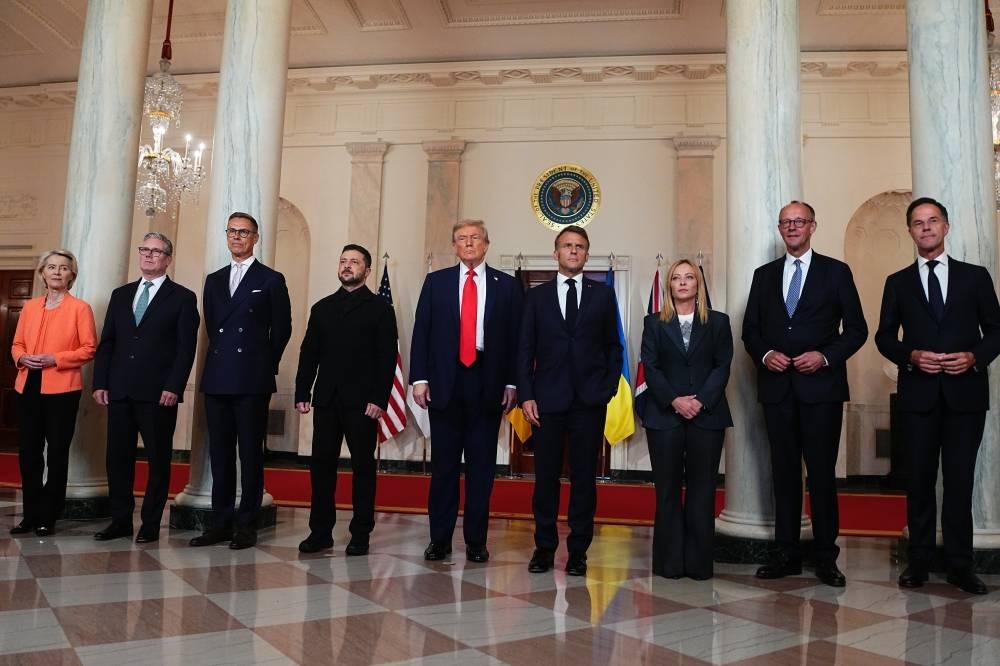
Ukraine's President and European leaders met with US President Donald Trump at the White House, discussing security guarantees and potential Ukrainian land concessions. Trump announced plans for a Putin–Zelenskyy summit in a last-ditch effort to end the war.
Video Duration 02 minutes 59 seconds 02:59
Video Duration 03 minutes 16 seconds 03:16
Video Duration 02 minutes 05 seconds 02:05
Video Duration 01 minutes 15 seconds 01:15
Video Duration 00 minutes 55 seconds 00:55
Video Duration 01 minutes 02 seconds 01:02
Video Duration 00 minutes 54 seconds 00:54
Hashtags

Try Our AI Features
Explore what Daily8 AI can do for you:
Comments
No comments yet...
Related Articles


Al Jazeera
 13 minutes ago
- Al Jazeera
Russia-Ukraine war: List of key events, day 1,273
Here is how things stand on Wednesday, August 20: Fighting Russian authorities have returned the remains of 1,000 Ukrainian soldiers, Ukraine's Coordination Headquarters for the Treatment of Prisoners of War said on Monday, according to The Kyiv Independent news outlet. Russia's state-run TASS news agency confirmed that Russia returned the bodies of 1,000 soldiers, adding that Ukraine returned the bodies of 19 Russian soldiers. Separately, TASS reported that about 1,370 Ukrainian soldiers were killed in a single day, citing the Russian Ministry of Defence. Al Jazeera could not verify this claim independently. Russian forces dropped 250kg (550 lbs) bombs on the city of Kostiantynivka in Ukraine's Donetsk region, Serhii Horbunov, the head of the Kostiantynivka City Military Administration, wrote on Facebook on Monday. At least two people were injured, and apartments and an education building were damaged, Horbunov said. A Russian drone attack on an ambulance injured two emergency workers in the Kupiansk district of Ukraine's Kharkiv region, regional police said in a post on Telegram. TASS reports that a Ukrainian drone attack caused a power outage in Ukraine's Zaporizhia region, according to the governor of Russian-occupied Zaporizhia, Yevgeny Balitsky. The attack did not affect the operation of the Zaporizhzhia nuclear power station, TASS later reported. Local officials in the front-line city of Kamianka-Dniprovska in Russian-occupied Zaporizhia reported 'massive' shelling from Ukrainian forces, causing at least six explosions and damaging a hospital, according to a TASS report that did not mention casualties. The brother of Vitaly Milonov, a representative in Russia's State Duma, the lower house in parliament, died after being injured 'as a result of military action' in Ukraine's Luhansk region, TASS said. The lawmaker's brother was serving as a volunteer in Russian army intelligence when he was injured, TASS reports. Ukrainian Prime Minister Yulia Svyrydenko wrote in a post on the Telegram messaging app that 52,000 people have been evacuated from Ukraine's Donetsk and Dnipropetrovsk regions in recent months due to fighting. Peace talks Russian President Vladimir Putin and Ukrainian President Volodymyr Zelenskyy 'are in the process of setting it up', Trump said in relation to a proposed bilateral meeting between the two leaders. Trump made the comment in a radio show a day after he met with Zelenskyy and several European leaders at the White House. Switzerland would be ready to host Putin for peace talks, despite an existing arrest warrant for his arrest from the International Criminal Court, the country's foreign minister, Ignazio Cassis, said. Trump provided details to Fox News on the nature of potential US involvement in security guarantees for Ukraine, saying that US support would probably be 'by air', whereas European countries 'are willing to put people on the ground'. White House Press Secretary Karoline Leavitt confirmed US air support was 'an option and a possibility', but, like Trump, did not provide details. 'The president has definitively stated US boots will not be on the ground in Ukraine, but we can certainly help in the coordination and perhaps provide other means of security guarantees to our European allies,' Leavitt told a news briefing. Turkish President Recep Tayyip Erdogan and NATO Secretary-General Mark Rutte discussed security guarantees for Ukraine in a phone call on Tuesday, the Turkish presidency said in a statement. European Council President Antonio Costa said that the process to make Ukraine a member of the European Union needs to advance, and Europe has to be part of future peace negotiations alongside Ukraine, Russia and the United States. US Treasury Secretary Scott Bessent told CNBC that India was profiteering on its purchases of Russian oil. 'This… Indian arbitrage – buying cheap Russian oil, reselling it as product has just sprung during the war – which is unacceptable,' Bessent said. Putin discussed his recent meeting with Trump in Alaska on a call with Saudi Arabia's Crown Prince Mohammed bin Salman, the Kremlin said.

Qatar Tribune
3 hours ago
- Qatar Tribune
Resistance isn't a real strategy for the Democrats
Clive Crook Nearly nine months after Donald Trump's reelection, Democrats still can't make sense of it. Only the faintest glimmers of a reset are visible. The only thing that might pass for a strategy seems to be the hope that, given time, voters will finally come to their senses: It's the people who need to think again, not the politicians who are asking for their support. Given Trump's recklessness, this approach isn't in fact doomed to fail — yet his opponents need to do better. How, exactly? What should a Democratic reset look like? Let's move quickly past what's obvious, or ought to be. First, address the voters whose minds you want to change — people who voted for Trump — with respect. They don't like being called idiots and bigots. Acknowledge the elements of validity in Trump's account of what needs to change. Insist that support for Trump is a mistake, but neither groundless nor intelligible only as a consequence of racism or stupidity. Second, renounce — don't just decline to discuss — the provably unpopular woke nonsense that party extremists have set as an ideological litmus test. Sex is a social construct. Color-blindness is racist. Speech is violence. Equality is a fraud. Capitalism is evil. Immigrants can't be 'illegal.' The country's true founding was in 1619. And so forth. Democrats should stand for compassion and fairness, but not for an encompassing theory of systemic oppression that most Americans don't recognize and rightly view as unhinged. So much for the easy part. Equally important, though, is framing a popular and workable policy agenda — and this is less straightforward. Democrats stand for nothing if not redistribution, regulation of market excesses, equal opportunity and support for the less fortunate. But these noble and desirable purposes all involve trade-offs, which Democrats often prefer to ignore. That's a mistake. Voters need to be persuaded that such policies won't do more harm than good and that reformers understand the drawbacks. The party needs to line up with policies that express its values while reassuring voters it knows what it's doing. Woke is the opposite of reassuring, but anti-woke isn't enough to project competence. The themes I'd recommend are opportunity and security — as opposed to 'justice' or 'equity,' which imply (deliberately or otherwise) fundamental failures of market-based economies and a desire for root-and-branch transformation. Persuadable Trump voters, the target audience, don't despise the rich or long for a progressive utopia. They want pragmatic, intelligible interventions that engage with their economic goals and anxieties. The most promising ideas address both at once. Dislocation caused by trade and innovation is a main cause of economic insecurity. Historically, innovation has been by far the more disruptive of the two — and the advent of AI could be especially so. Trying to stop such disruptions would be folly, but when jobs are lost, the U.S. should do more to cushion the victims and help them find new, better ways to make a living. The US has only ever flicked at this, with half-hearted programs such as Trade Adjustment Assistance, too narrowly purposed and seriously underfunded. A bigger and more comprehensive program, delivering income support during the transition from job to job, help with moving costs and associated complications, and guidance on training and further education still won't make economic disruption win-win — but it would spread the costs more broadly and, through upskilling and better allocation of labor, raise productivity and add to the overall gains. Better schools are critical for advancing opportunity for children of the poor and low-paid. One of America's biggest public-policy anomalies is that government-run schools in prosperous areas are far better financed than schools in poor areas (where financially stressed parents can't make up the difference). Equality of opportunity means using federal money to redress this imbalance. Probably even more important is to raise the quality of teaching and management in schools that serve the less well-off. Some Democrats may balk, because it means recognizing (as parents did during the pandemic) that teachers' unions put their members' interests above those of the children they teach. The remedy is to empower parents with vouchers and force schools to compete. Ideally, the alliance between Democrats and public-sector unions — and with teachers above all — would be scrapped entirely. That's unimaginable, but the terms of this partnership need to be revised. Ensuring that work pays should be a central part of the Democrats' opportunity agenda. Make low-wage subsidies such as the earned-income tax credit more generous. Simplify taxes and benefits to reduce unintended disincentives (as when a small increase in wages triggers a big loss of income). Grasp the nettle of Social Security reform and redesign the payroll tax, which kicks in at the first dollar of earnings. In my dreams, the payroll tax is replaced with a value-added tax, which is less regressive, less anti-work and less anti-saving — but the Democrats have a long way to go before voters would trust them with such a radical change. Helping those on low incomes to save is about security as well as opportunity: Living paycheck to paycheck is stressful. Existing savings reliefs and incentives tilt heavily in favor of the better off, and are inordinately complicated to boot. Democrats should propose subsidized auto-enrollment plans for saving, to supplement Social Security in retirement and to meet unforeseen expenses; they should design them with those on low pay uppermost in mind. Health-care costs — Obamacare notwithstanding — are still a principal cause of financial insecurity. Democrats have proposed various kinds of 'public option' health insurance. They should dare to press this idea again. This, too, is treacherous terrain because Democrats would be taking their own reform, which many voters unfairly perceive as a failure, back to the drawing board. 'What if they come up with something even worse?' But it's necessary, because the existing system, even after Obamacare's improvements, is still a disgrace: expensive, complicated, anxiety-inducing because of the link to employer-provided coverage (lose your job, you're uninsured), yielding poor health outcomes (by international standards), and failing, above all, to shield people of limited means from the risk of financial catastrophe. Two last things — falling again under the heading of 'should be obvious.' First, fiscal discipline. The policies sketched above will cost money. (Remember trade-offs?) Democrats must explain how they'll fund their plans. 'Let the top 1% pay' won't cut it. Nor will 'public debt doesn't matter.' Much of the burden will fall on the middle class. The challenge will be to explain why, on balance, the middle class will be better off as a result. Second, Americans want the border secured and are entitled to choose who they welcome as immigrants. Merely turning up at the border isn't a qualification for eventual citizenship. Whatever else they do, Democrats must bring themselves as a party to care about the distinction between legal and illegal immigration. That's a lot to discuss. The party, still firmly in resistance mode, is barely even thinking about it. Democrats must understand that resistance isn't a programme for government — which is what beating the Republicans might well require. (Clive Crook is a Bloomberg Opinion columnist and member of the editorial board covering economics.)
Qatar Tribune
3 hours ago
- Qatar Tribune
It will be ‘rough situation' if Putin doesn't agree peace plan: Trump
PA Media/dpa London US President Donald Trump has said American jets could help defend Ukraine if there is a deal to end the war but acknowledged it was possible Russian President Vladimir Putin would reject a peace plan. He said it would be a 'rough situation' if Putin failed to agree peace terms but stressed that Ukraine's Volodymyr Zelensky had to show flexibility, including giving up hopes of getting Crimea back or joining NATO. The US president's comments came as British Prime Minister Keir Starmer held talks with members of the 'coalition of the willing', the nations prepared to contribute to guaranteeing Ukraine's security if a deal to end the Russian invasion can be reached. In a call on Tuesday, members of the group discussed the possibility of further sanctions on Russia, while planners from the nations will meet their US counterparts 'in the coming days', amid efforts to set up 'robust security guarantees', Starmer's office said. Starmer and Zelensky were among European leaders who travelled to Washington on Monday for talks at the White House. Those discussions have paved the way for a potential meeting between Zelensky and Putin for the first time since the Russian leader invaded his neighbour in 2022. Trump told Fox News: 'I hope President Putin is going to be good and if he's not, that's going to be a rough situation. 'And I hope that Zelensky, President Zelensky, will do what he has to do. He has to show some flexibility.' The UK and France have pledged to commit forces to Ukraine to deter Putin from launching a fresh assault on his neighbour if a deal is done to end the war. Trump said they were 'willing to put people on the ground', and added: 'We're willing to help them with things, especially probably if you could talk about by air, because there's nobody has the kind of stuff we have.' But he suggested that Putin was unlikely to launch another invasion as he was 'tired of it' after three years of war. 'We are going to find out about President Putin in the next couple of weeks, that I can tell you,' Trump said, acknowledging that it was 'possible he doesn't want to make a deal'. Starmer said work with the US on what the security guarantees would entail could start as soon as Tuesday. He said there was a 'real significant breakthrough when it comes to security guarantees, because we're now going to be working with the US on those security guarantees'. He told the BBC that teams from both sides of the Atlantic were starting 'the detailed work on that'. Trump spoke directly to Putin to begin planning a meeting between the Russian leader and Zelensky while hosting the gathering on Monday, which will then be followed by a three-way meeting involving himself.
