


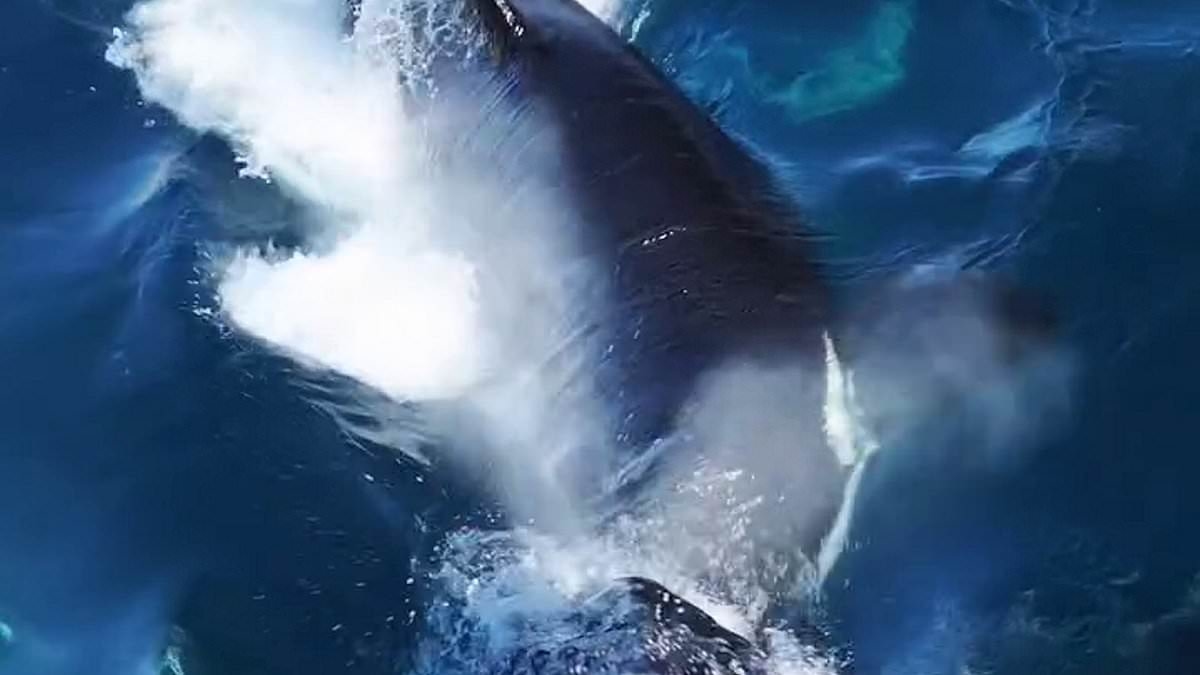
Living up to their 'killer' reputation: Watch the shocking moment a pod of orcas DROWNS a humpback whale off the coast of California
A heartbreaking video shows a pod of orcas hunting a humpback whale calf in the Sea of Cortés off the coast of California.
The orcas drag the struggling calf away from its mother and drown it by forcing it beneath the waves before it has a chance to breathe.
Photographer Carlos Guana, who captured the incident using a drone, described the scene as 'a reminder that nature is brutal every day'.
Mr Guana spotted the humpback mother and her calf as they were travelling north from their calving grounds in Mexico 's warm waters, towards the feeding grounds of Alaska.
Even though a newborn humpback calf can be 13 to 16 feet (4–5 metres) long and weigh a tonne or more, they are an easy source of food for nature's most deadly hunters.
Led by their matriarch, the orcas surrounded the calf and took turns slamming into the calf, pummelling it and pinning it down until it was too exhausted to fight back.
Finally, in a moment which Mr Guana described as 'cruel and deliberate', the orcas brought the dead calf back to the surface and appeared to show the body to its mother before swimming away to feed.
Orcas, known as killer whales, are some of the ocean's most intelligent and effective hunters. Some populations have learned to prey on whale calves as they travel from their calving grounds
Although orca attacks on humpback whales are relatively rare, scientists have found that they are much more common than you may expect.
'I don't believe it's rare that it happens,' says Mr Guana.
'Any whale watcher will tell you they often see what I call rake marks on the tails of humpbacks.
'Those long scratch–like marks mean orcas have attacked them or engaged with them using their teeth.'
Studies have found that, as humpback whale numbers have stabilised following the end of whaling, the number of orca attacks has increased.
This is especially true along humpback whales' migratory routes, where weaning calves present an easy and abundant source of food.
In these areas, some groups of whales appear to have specialised as whale hunters, developing hunting techniques for targeting calves.
One study of orca attacks off Western Australia found that three orca pods killed at least 14 humpback calves in 22 separate attacks.
Orcas: Key facts
Scientific name: Orcinus orca
Habitat: Found all over the world's oceans, but particularly in cold waters
Size: 8.5–9.9 metres
Weight: 4.7–6.6 tonnes
Diet: Orca pods will often specialise in one type of prey, but they can feed on fish, seals, dolphins, sharks, rays, whales, octopuses and squid.
Orcas, also known as killer whales, are not actually whales. They are actually the largest member of the dolphin family.
Orcas have complex social groups called pods, which are led by the eldest female, called the matriarch.
The matriarch is responsible for leading hunts and teaching the next generation their unique hunting techniques.
One killer whale tagged by researchers led her pod to attack eight humpback calves in just 20 hours, killing at least three.
The orcas in the attack filmed by Mr Guana are part of the Eastern Tropical Pacific, or ETP, population – a group known for taking on the biggest prey.
Mr Guana says: 'These particular orcas eat large marine mammals, sharks, even whale sharks – big things.'
At times when food is exceptionally abundant, orcas are also known to be selective eaters.
In some cases, certain populations of orcas have been known to be so fussy that they will only eat the breast meat from penguins they kill.
'They attacked and drowned the humpback, then basically just ate the tongue and left the rest of the whale there,' said Mr Guana.
This matches what previous studies have found, which found that orcas will often eat only the neck, tongue, lips, and ventral flaps of humpback calves.
Mr Guana says that the body soon attracted sharks, and other scavengers soon set upon the body.
While it might be upsetting, this hunting behaviour is also important for orcas to be able to support their own young and to teach them the skills they need to survive.
Without a reliable source of prey, the orca's young would not grow fast enough to survive on their own.
Mr Guana says: 'This scene, one of the most conflicted moments I've witnessed in nature, was extraordinary to witness.
'While this matriarch fed her young ones with this, and the carcass provided food to the sharks and other creatures that showed up, it was a reminder that nature is brutal every day.'
The carcasses of dead whales will eventually drift down to the ocean floor in an event known as a 'whale fall'.
The body will trigger a bloom of life as scavengers from all around are drawn in by the smell.
Even the whale's bones will support the local ecosystem for years to come as a place for invertebrates to colonise and as a source of energy for microbes.
'The price of a healthy ecosystem is the brutal moments that exist within. I captured the complete kill,' says Mr Guana.
Humpback whales live in oceans around the world. They travel incredible distances every year and have one of the longest migrations of any mammal on the planet.
Some populations swim 5,000 miles from tropical breeding grounds to colder, plentiful feeding grounds - this is why it is difficult to estimate population size, according to the National Oceanic and Atmospheric Administration (NOAA).
Of the 14 distinct populations, 12 are estimated to number more than 2,000 humpback whales each and two are estimated to number fewer than 2,000.
Some populations (such as those off eastern and western Australia) are believed to number in excess of 20,000 animals—a remarkable recovery given that the same populations were almost eradicated by whaling almost sixty years ago.
By contrast, the smallest known population is one which inhabits the Arabian Sea year-round, and may number as few as 80 individuals.
Threats to humpback whales include decline in food like Krill due to a combination of climate change and industrial-scale fishing.
Humpback whales can become entangled by many different gear types including moorings, traps, pots, or gillnets.
Once entangled, if they are able to move the gear, the whale may drag and swim with attached gear for long distances, ultimately resulting in fatigue, compromised feeding ability, or severe injury.
There is evidence to suggest that most humpback whales experience entanglement over the course of their lives, but are often able to shed the gear on their own.
Inadvertent vessel strikes can injure or kill humpback whales.
Humpback whales are vulnerable to vessel strikes throughout their range, but the risk is much higher in some coastal areas with heavy ship traffic.
Underwater noise threatens whale populations, interrupting their normal behaviour and driving them away from areas important to their survival.
Hashtags

Try Our AI Features
Explore what Daily8 AI can do for you:
Comments
No comments yet...
Related Articles

Daily Mail
 9 hours ago
- Daily Mail
Living up to their 'killer' reputation: Watch the shocking moment a pod of orcas DROWNS a humpback whale off the coast of California
They are among the ocean's most feared predators – and now a new video shows why orcas live up to their 'killer' reputation. A heartbreaking video shows a pod of orcas hunting a humpback whale calf in the Sea of Cortés off the coast of California. The orcas drag the struggling calf away from its mother and drown it by forcing it beneath the waves before it has a chance to breathe. Photographer Carlos Guana, who captured the incident using a drone, described the scene as 'a reminder that nature is brutal every day'. Mr Guana spotted the humpback mother and her calf as they were travelling north from their calving grounds in Mexico 's warm waters, towards the feeding grounds of Alaska. Even though a newborn humpback calf can be 13 to 16 feet (4–5 metres) long and weigh a tonne or more, they are an easy source of food for nature's most deadly hunters. Led by their matriarch, the orcas surrounded the calf and took turns slamming into the calf, pummelling it and pinning it down until it was too exhausted to fight back. Finally, in a moment which Mr Guana described as 'cruel and deliberate', the orcas brought the dead calf back to the surface and appeared to show the body to its mother before swimming away to feed. Orcas, known as killer whales, are some of the ocean's most intelligent and effective hunters. Some populations have learned to prey on whale calves as they travel from their calving grounds Although orca attacks on humpback whales are relatively rare, scientists have found that they are much more common than you may expect. 'I don't believe it's rare that it happens,' says Mr Guana. 'Any whale watcher will tell you they often see what I call rake marks on the tails of humpbacks. 'Those long scratch–like marks mean orcas have attacked them or engaged with them using their teeth.' Studies have found that, as humpback whale numbers have stabilised following the end of whaling, the number of orca attacks has increased. This is especially true along humpback whales' migratory routes, where weaning calves present an easy and abundant source of food. In these areas, some groups of whales appear to have specialised as whale hunters, developing hunting techniques for targeting calves. One study of orca attacks off Western Australia found that three orca pods killed at least 14 humpback calves in 22 separate attacks. Orcas: Key facts Scientific name: Orcinus orca Habitat: Found all over the world's oceans, but particularly in cold waters Size: 8.5–9.9 metres Weight: 4.7–6.6 tonnes Diet: Orca pods will often specialise in one type of prey, but they can feed on fish, seals, dolphins, sharks, rays, whales, octopuses and squid. Orcas, also known as killer whales, are not actually whales. They are actually the largest member of the dolphin family. Orcas have complex social groups called pods, which are led by the eldest female, called the matriarch. The matriarch is responsible for leading hunts and teaching the next generation their unique hunting techniques. One killer whale tagged by researchers led her pod to attack eight humpback calves in just 20 hours, killing at least three. The orcas in the attack filmed by Mr Guana are part of the Eastern Tropical Pacific, or ETP, population – a group known for taking on the biggest prey. Mr Guana says: 'These particular orcas eat large marine mammals, sharks, even whale sharks – big things.' At times when food is exceptionally abundant, orcas are also known to be selective eaters. In some cases, certain populations of orcas have been known to be so fussy that they will only eat the breast meat from penguins they kill. 'They attacked and drowned the humpback, then basically just ate the tongue and left the rest of the whale there,' said Mr Guana. This matches what previous studies have found, which found that orcas will often eat only the neck, tongue, lips, and ventral flaps of humpback calves. Mr Guana says that the body soon attracted sharks, and other scavengers soon set upon the body. While it might be upsetting, this hunting behaviour is also important for orcas to be able to support their own young and to teach them the skills they need to survive. Without a reliable source of prey, the orca's young would not grow fast enough to survive on their own. Mr Guana says: 'This scene, one of the most conflicted moments I've witnessed in nature, was extraordinary to witness. 'While this matriarch fed her young ones with this, and the carcass provided food to the sharks and other creatures that showed up, it was a reminder that nature is brutal every day.' The carcasses of dead whales will eventually drift down to the ocean floor in an event known as a 'whale fall'. The body will trigger a bloom of life as scavengers from all around are drawn in by the smell. Even the whale's bones will support the local ecosystem for years to come as a place for invertebrates to colonise and as a source of energy for microbes. 'The price of a healthy ecosystem is the brutal moments that exist within. I captured the complete kill,' says Mr Guana. Humpback whales live in oceans around the world. They travel incredible distances every year and have one of the longest migrations of any mammal on the planet. Some populations swim 5,000 miles from tropical breeding grounds to colder, plentiful feeding grounds - this is why it is difficult to estimate population size, according to the National Oceanic and Atmospheric Administration (NOAA). Of the 14 distinct populations, 12 are estimated to number more than 2,000 humpback whales each and two are estimated to number fewer than 2,000. Some populations (such as those off eastern and western Australia) are believed to number in excess of 20,000 animals—a remarkable recovery given that the same populations were almost eradicated by whaling almost sixty years ago. By contrast, the smallest known population is one which inhabits the Arabian Sea year-round, and may number as few as 80 individuals. Threats to humpback whales include decline in food like Krill due to a combination of climate change and industrial-scale fishing. Humpback whales can become entangled by many different gear types including moorings, traps, pots, or gillnets. Once entangled, if they are able to move the gear, the whale may drag and swim with attached gear for long distances, ultimately resulting in fatigue, compromised feeding ability, or severe injury. There is evidence to suggest that most humpback whales experience entanglement over the course of their lives, but are often able to shed the gear on their own. Inadvertent vessel strikes can injure or kill humpback whales. Humpback whales are vulnerable to vessel strikes throughout their range, but the risk is much higher in some coastal areas with heavy ship traffic. Underwater noise threatens whale populations, interrupting their normal behaviour and driving them away from areas important to their survival.

Daily Mail
a day ago
- Daily Mail
Scientists discover how to restore eyesight without laser surgery
Scientists are on the verge of developing a less invasive and more affordable, incision-free method to treat vision problems. Chemists in California stumbled upon the idea that vision issues could be addressed chemically, without the need for lasers. Their method could negate the need for LASIK, a quick laser eye surgery that reshapes the clear front part of the eye called the cornea to fix blurry vision, helping people give up glasses or contacts for nearsightedness, farsightedness, and astigmatism. LASIK permanently removes corneal tissue, but the method designed at Occidental College and the University of California, Irvine, chemically molds the cornea. Both fix vision by correcting the cornea's curve so that light focuses precisely on the retina. The team used a tiny electric current to lower the cornea's pH, making it more acidic. This loosened its collagen structure and made it moldable. A platinum lens designed as an ideal shape was placed over the cornea. As the tissue softened, it conformed to the lens's curve. Restoring the pH locked it into place. They tested the power of manipulating pH and fitting the plate in rabbit eyeballs in saline solution. The eyes consistently conformed to the plate, maintaining their shape 12 out of 12 times, and even showed signs of eliminating nearsightedness in two of them. In lab tests, the team used a saline-soaked rabbit eyeball to mimic conditions in real human eyes, and applied their pH-shifting technique. All 12 eyeballs successfully conformed to the desired shape of the template and, in 10 cases, deliberately modeled to mimic nearsightedness, the corneas adjusted to correct vision. Americans often treat vision problems, such as nearsightedness, farsightedness, and astigmatism, without surgery. Roughly 167 million people wear prescription eyeglasses, while 45 million use contact lenses. A healthy eye has a white outer part (sclera), clear front surface (cornea), and properly functioning internal structures that focus light perfectly on the retina. When the cornea is correctly curved, light bends precisely onto the retina for sharp vision. In impaired vision, such as nearsightedness, the cornea is too steep or flat, causing light to focus in front of or behind the retina instead. Reshaping the cornea through LASIK adjusts the cornea's curvature, which allows light to hit the retina properly and restore clear focus. LASIK is generally for those who want to do away with their eyeglasses and contact lenses. While the laser surgery is overall safe, it is not risk-free. Common short-term side effects include dry eyes, glare, especially at night, and rare complications like still needing glasses, healing issues with the corneal flap or corneal weakening over time, leading to lasting vision impairment. Most issues resolve, but some may need enhancement surgery or have lasting effects. Not everyone qualifies. Surgeons screen for thin corneas or other risk factors first. Now, researchers are exploring a way to reshape the cornea without having to make any incisions through a process known as electromechanical reshaping (EMR). 'The whole effect was discovered by accident,' said Brian Wong, a professor and surgeon at the University of California, Irvine. 'I was looking at living tissues as moldable materials and discovered this whole process of chemical modification.' Collagen-rich tissues, including corneas, rely on magnetic-like attractions between charged particles to hold their shape. Introducing a tiny electric current lowers the pH of the gel-like fluid surrounding its collagen fibers, turning rigid tissue temporarily soft. While the rabbit eye tissue was soft, Dr Wong and his partner, Dr Michael Hill, a professor of chemistry at Occidental College, applied the perfectly-shaped platinum plate to mold the cornea into a new shape. It did so in about a minute. When they restored pH, those attractions tightened, freezing the tissue in its new form. The work is still in its early stages. It is expected to begin a long process of detailed and precise studies in living animals, not just eyeballs in saline. The team will next explore how well EMR can treat common vision issues like nearsightedness, farsightedness and astigmatism. Dr Hill said: 'There's a long road between what we've done and the clinic. 'But, if we get there, this technique is widely applicable, vastly cheaper and potentially even reversible.' The team's findings were presented at the fall meeting of the American Chemical Society this week.


The Guardian
a day ago
- The Guardian
The AI future is too scary even for James Cameron. Where can the Terminator franchise go from here?
James Cameron has a confession: he can't write Terminator 7. And it's not because Hollywood won't let him, as he's too busy making the new Avatar – it's because reality keeps nicking his plotlines. 'I'm at a point right now where I have a hard time writing science-fiction,' Cameron told CNN this week. 'I'm tasked with writing a new Terminator story [but] I don't know what to say that won't be overtaken by real events. We are living in a science-fiction age right now.' It's an understandable quandary for the veteran film-maker. Back in 1984, when the first Terminator movie came out, there was genuine shock value in the idea of a killer robot travelling through time from a future in which the wretched dregs of humanity survive in a chrome-plated hellscape dominated by their robot overlords. These days, the only far-fetched part of the movie is the bit where the T-800 turns up alone and completely naked, as opposed to arriving flanked by a swarm of AI-guided drones. We may not have achieved time travel just yet, but we do have artificial intelligences capable of quietly teaching themselves sarcasm, city-wide facial recognition, and robot learning systems deciding who lives and dies. That's the heart of Cameron's problem: in 1984, Skynet was a terrifying piece of speculative fiction. In 2025, it's basically LinkedIn with nukes. The creeping dread of AI isn't a future shock any more; it's the news cycle. From AI-powered spyware in our pockets to deepfake scams and voice-mimicking chatbots, the Terminator franchise no longer has the monopoly on making you want to hurl your hi-tech personal possessions into the sea. Cameron seems to be caught between a rock and a hard place here, especially as this grand old sci-fi saga hasn't exactly been blowing anyone's CPU in well … decades. Terminator: Dark Fate, which the saga's creator at least had a basic hand in developing, struggled at the 2019 box office despite the return of Linda Hamilton and a storyline that tried to mix the franchise's classic 'unstoppable hunter' formula with a reunion tour for its surviving stars. Before that, we have to go all the way back to 1991's Terminator 2: Judgment Day to find a film that audiences really warmed to. The wilderness years between those two movies were littered with sequels that were too bleak, or too daft. What Cameron should be looking for is a complete system reboot to reinvigorate the saga in the way Prey brought fans back to Predator and Alien: Romulus restored interest in slimy Xenomorphs. All evidence suggests that the 70-year-old film-maker is far more interested in the current challenges surrounding AI, superintelligences and humankind's constant efforts to destroy itself, which doesn't exactly lend itself to the sort of back-to-basics, relentless-monsters-hunt-a-few-unlucky-humans-for-two-hours approach that has worked elsewhere. The challenge here seems to be to fuse Terminator's core DNA – unstoppable cyborgs, explosive chase sequences, and Sarah Connor-level defiance – with the occasionally rather more prosaic yet equally scary existential anxieties of 21st-century AI doom-mongering. So we may get Terminator 7: Kill List, in which a single, battered freedom fighter is hunted across a decimated city by a T-800 running a predictive policing algorithm that knows her next move before she does. Or T7: Singularity's Mom, in which a lone Sarah Connor-type must protect a teenage coder whose chatbot will one day evolve into Skynet. Or Terminator 7: Terms and Conditions, in which humanity's downfall comes not from nuclear warfare but from everyone absent-mindedly agreeing to Skynet's new privacy policy, triggering an army of leather-clad enforcers to collect on the fine print. Or perhaps the future just looks terrifying enough without Cameron getting involved – which, rather worryingly for the future of the franchise, seems to be the director's essential point. Then again, if anyone can make the apocalypse feel even worse than it already does, it's the man who previously convinced us that autonomous drones would hunt humans from the sky and that machines would learn to think and kill for themselves. We should have confidence he can do it again.
