


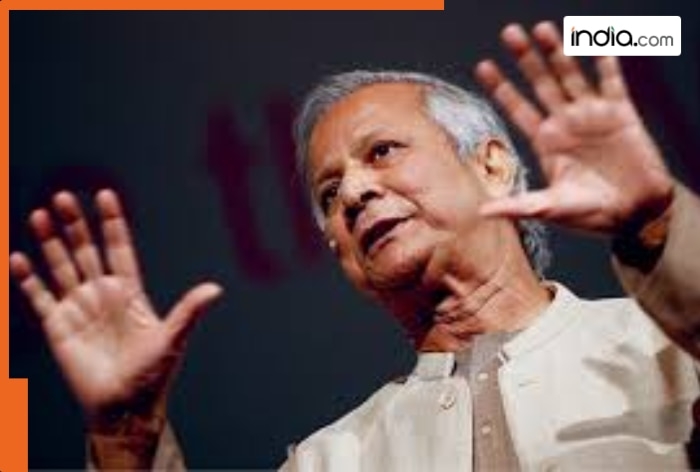
Anti India Yunus makes another statement on Northeast India, asks India's neighbour to..., will Modi govt teach a lesson to Bangladesh?
India-Bangladesh relations: In a matter of shock for the India amid the India-Pakistan tensions, Bangladesh head of government Muhammad Yunus has passed a comment that has taken the world by surprise. The head of the government has called for 'an integrated economic plan for the Seven System States of Bangladesh, Nepal, Bhutan and India'. Muhammad Yunus added that these countries and 'India's Northeast' will benefit more by staying together than by staying apart. Here are all the details you need to know.
Bangladesh's interim government head, Muhammad Yunus, shared a post on social media platform X following his meeting with Indira Rana, Deputy Speaker of Nepal's House of Representatives, in which he referenced Northeast India.
'Interim Government Chief Muhammad Yunus called for an integrated economic strategy between Bangladesh, Nepal, Bhutan and India's seven northeastern states, emphasizing the possibility of cross-border cooperation in hydropower, healthcare and road connectivity', Mohammad Yunus' office said in a post. Bangladesh issues a gazette notification
Bangladesh on Monday issued a gazette notification, officially banning all activities of deposed premier Sheikh Hasina's Awami League party under an overnight revised anti-terrorism law.
'The Home Ministry today issued the gazette notification banning all activities of the Awami League, its all front, associate and brotherly organisations,' Home Adviser Lt Gen (retd.) Jahangir Alam told a media briefing here.
According to the notification, Awami League and its affiliated organisations were banned under the Anti-Terrorism Act 2025 until Bangladesh's International Crimes Tribunal (ICT-BD) completed the trial of its leaders and activists, said a Home Ministry official.
The official said Section 18 of the revised law empowered the government to declare any 'entity' or organisation alongside an individual if they were found involved in terrorism based on reasonable grounds. The original Anti-Terrorism Act of 2009 did not have the provision of banning the 'entity'.
(With inputs from agencies)
Hashtags

Try Our AI Features
Explore what Daily8 AI can do for you:
Comments
No comments yet...
Related Articles
&w=3840&q=100)

Business Standard
 20 minutes ago
- Business Standard
US to screen immigrants for 'anti-Americanism' in process to get green card
Immigrants seeking a legal pathway to live and work in the United States will now be subject to screening for anti-Americanism', authorities said Tuesday, raising concerns among critics that it gives officers too much leeway in rejecting foreigners based on a subjective judgment. US Citizenship and Immigration Services said officers will now consider whether an applicant for benefits, such as a green card, endorsed, promoted, supported, or otherwise espoused" anti-American, terrorist or antisemitic views. America's benefits should not be given to those who despise the country and promote anti-American ideologies, Matthew Tragesser, USCIS spokesman, said in a statement. Immigration benefits including to live and work in the United States remain a privilege, not a right. It isn't specified what constitutes anti-Americanism and it isn't clear how and when the directive would be applied. The message is that the US and immigration agencies are going to be less tolerant of anti-Americanism or antisemitism when making immigration decisions," Elizabeth Jacobs, director of regulatory affairs and policy at the Centre for Immigration Studies, a group that advocates for immigration restrictions, said on Tuesday. Jacobs said the government is being more explicit in the kind of behaviours and practices officers should consider, but emphasised that discretion is still in place. "The agency cannot tell officers that they have to deny just to consider it as a negative discretion, she said. Critics worry the policy update will allow for more subjective views of what is considered anti-American and allow an officer's personal bias to cloud his or her judgment. For me, the really big story is they are opening the door for stereotypes and prejudice and implicit bias to take the wheel in these decisions. That's really worrisome," said Jane Lilly Lopez, associate professor of sociology at Brigham Young University. The policy changes follow others recently implemented since the start of the Trump administration including social media vetting and the most recent addition of assessing applicants seeking naturalisation for 'good moral character'. That will not only consider not simply the absence of misconduct but also factor the applicant's positive attributes and contributions. It means you are going to just do a whole lot more work to provide evidence that you meet our standards, Lopez said. Experts disagree on the constitutionality of the policy involving people who are not US citizens and their freedom of speech. Jacobs, of the Centre for Immigration Studies, said First Amendment rights do not extend to people outside the US or who are not US citizens. Ruby Robinson, senior managing attorney with the Michigan Immigrant Rights Centre, believes the Bill of Rights and the US Constitution protects all people in the United States, regardless of their immigration status, against government encroachment. A lot of this administration's activities infringe on constitutional rights and do need to be resolved, ultimately, in courts, Robinson added. Attorneys are advising clients to adjust their expectations. People need to understand that we have a different system today and a lot more things that apply to US citizens are not going to apply to somebody who's trying to enter the United States," said Jaime Diez, an immigration attorney based in Brownsville, Texas. Jonathan Grode, managing partner of Green and Spiegel immigration law firm, said the policy update was not unexpected considering how the Trump administration approaches immigration. This is what was elected. They're allowed to interpret the rules the way they want, Grode said. The policy always to them is to shrink the strike zone. The law is still the same. (Only the headline and picture of this report may have been reworked by the Business Standard staff; the rest of the content is auto-generated from a syndicated feed.)


Mint
an hour ago
- Mint
Trump administration to screen immigrants for ‘anti-American' views
The Trump administration plans to scrutinize social media for 'anti-American ideologies" when deciding to grant visa or green-card applications. U.S. Citizenship and Immigration Services, the primary agency in charge of legal immigration, said Tuesday that its officers should give significant weight to evidence that an immigrant 'has any involvement in anti-American or terrorist organizations" when reviewing residency, work and visa applications. When it comes to what registers as anti-American ideology, the updated guidance points to a provision of immigration law dating back to the Cold War that prohibits immigrants from becoming U.S. citizens if they are members of communist or anarchist organizations. It doesn't specify the range of speech the administration would categorize as anti-American. The Department of Homeland Security didn't respond to a request for clarification. 'America's benefits should not be given to those who despise the country and promote anti-American ideologies," USCIS spokesman Matthew Tragesser said Tuesday. Aaron Reichlin-Melnick, a senior fellow at the American Immigration Council, a national immigrant advocacy group, said relying on broad phrases to determine eligibility to live and work in the U.S. could be problematic. 'The term anti-American is ill-defined and malleable," he said. 'What one person may consider anti-American another person might consider pro-American." The latest directive builds on the agency's April announcement that it would screen immigrants' social media for evidence of antisemitism. As part of that shift, many immigrants, including those applying for tourist or student visas to the U.S., must now submit their social-media handles and make their profiles public for officers to review. It is another step in the Trump administration's goal of not only reducing overall immigration levels, but also in shaping the types of immigrants permitted to come to the country. The administration has also used allegations of anti-American and antisemitic activity against students who have participated in pro-Palestine protests. The administration also tightened citizenship standards last week in a separate policy memorandum that said applicants will need to prove 'good moral character." That includes contributing to the community, having a good education, holding down a job and paying taxes on time, according to Homeland Security. Write to Jack Morphet at Victoria Albert at and Michelle Hackman at


India Today
an hour ago
- India Today
US to screen immigration applicants for ‘anti-Americanism,' prompting criticism
Immigrants applying for legal status to live and work in the United States will now be evaluated for signs of 'anti-Americanism,' US authorities announced Tuesday. The change has drawn criticism over concerns that immigration officers may use overly subjective criteria to deny to US Citizenship and Immigration Services (USCIS), officers will begin assessing whether applicants have 'endorsed, promoted, supported, or otherwise espoused' anti-American, antisemitic, or terrorist ideologies when considering immigration benefits such as green benefits should not be given to those who despise the country and promote anti-American ideologies,' USCIS spokesman Matthew Tragesser said in a statement. 'Immigration benefits—including to live and work in the United States—remain a privilege, not a right.' The agency did not specify what exactly would qualify as anti-Americanism or how the policy would be implemented in Jacobs, director of regulatory affairs and policy at the Center for Immigration Studies, which advocates for more restrictive immigration policies, said the move signals a lower tolerance for anti-American or antisemitic sentiments in immigration cases.'The message is that the US and immigration agencies are going to be less tolerant of anti-Americanism or antisemitism when making immigration decisions,' Jacobs added that the agency is providing clearer direction on the types of behaviours to consider but emphasised that officers still retain discretion. 'The agency cannot tell officers that they have to deny — just to consider it as a negative discretion,' she WARN OF BIAS, LEGAL RISKS IN NEW IMMIGRATION ASSESSMENTCritics argue the policy risks introducing personal bias into immigration decisions due to vague definitions of what constitutes anti-American views.'For me, the really big story is they are opening the door for stereotypes and prejudice and implicit bias to take the wheel in these decisions. That's really worrisome,' said Jane Lilly Lopez, associate professor of sociology at Brigham Young directive follows other Trump-era immigration changes, including screening applicants' social media and a revised standard for assessing 'good moral character' in naturalisation cases. Under the new approach, applicants must demonstrate not just a lack of misconduct but also evidence of positive traits and contributions.'It means you are going to just do a whole lot more work to provide evidence that you meet our standards,' Lopez is ongoing debate over whether the new policy infringes on constitutional rights, especially around freedom of speech for non-citizens. Jacobs argued that First Amendment protections do not apply to individuals outside the country or those who are not US Ruby Robinson, senior managing attorney at the Michigan Immigrant Rights Center, disagreed, asserting that constitutional rights, including the Bill of Rights, protect everyone in the US regardless of immigration status. 'A lot of this administration's activities infringe on constitutional rights and do need to be resolved, ultimately, in courts,' Robinson have begun preparing clients for a stricter immigration environment.'People need to understand that we have a different system today and a lot more things that apply to US citizens are not going to apply to somebody who's trying to enter the United States,' said Jaime Diez, an immigration lawyer in Brownsville, Grode, managing partner at Green and Spiegel immigration law firm, said the new guidelines align with the Trump administration's longstanding views on immigration.'This is what was elected. They're allowed to interpret the rules the way they want,' Grode said. 'The policy always to them is to shrink the strike zone. The law is still the same.'- EndsWith inputs from Associated Press
