


Hong Kong leader says sudden removal of China's top official in the city was ‘normal'
HONG KONG--Hong Kong's leader said on Tuesday that China's recent removal of its top representative in the city, known for his hardline policies on national security, had been a 'normal' personnel change.
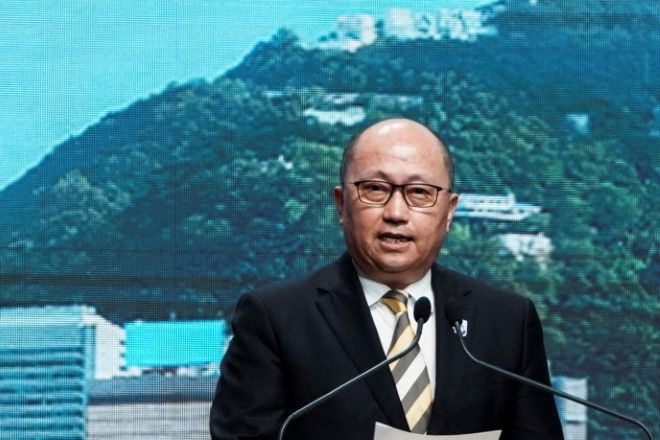
In a surprise development, China announced late on Friday that Zheng Yanxiong, the director of China's Liaison Office in Hong Kong - Beijing's main representative office in the city with powerful oversight over local affairs - had been 'removed' from his post.
He was replaced by Zhou Ji, a senior official with the Hong Kong and Macau Affairs Office on the State Council.
Zheng, who played a key role in the crackdown on Hong Kong's democratic movement in recent years, was also stripped of his role as China's national security adviser on a committee overseeing national security in Hong Kong.
No explanation by Beijing or Chinese state media was given for the change.
According to a person with knowledge of the matter, Hong Kong-based conglomerate CK Hutchison's proposed sale of its global port network to a consortium initially led by U.S. firm Blackrock had caught senior Chinese leaders 'by surprise' as they had not been informed beforehand and Zheng was partly blamed for that.
The person, who has spoken with the liaison office, declined to be identified as the discussions were confidential.
The Liaison Office gave no immediate response to faxed questions from Reuters.
Zheng had served in the post since January 2023 and while the position has no fixed term, his tenure was shorter than predecessors including Luo Huining and Zhang Xiaoming.
'The change of the Liaison office director is I believe, as with all changes of officials, very normal,' Lee told reporters during a weekly briefing, without being drawn on reasons for the reshuffle.
'Director Zheng has spent around 5 years (in Hong Kong). Hong Kong was going through a transition period of chaos to order,' Lee said, referring to the months-long pro-democracy protests that erupted across Hong Kong in 2019 while adding that he looked forward to working with Zhou.
CK Hutchison's ports deal has been criticized in Chinese state media as 'betraying' China's interests and bowing to U.S. political pressure.
The conglomerate, controlled by tycoon Li Ka-shing, agreed in March to sell the majority of its $22.8 billion global ports business, including assets along the strategically significant Panama Canal, to the consortium. The consortium is now being led by another member - Terminal Investment Limited, which is majority-owned by Italian billionaire Gianluigi Aponte's family-run MSC Mediterranean Shipping Company.
The deal is still being negotiated.
Asked whether Zheng's removal reflected a pivot by Beijing towards economic development from national security, Lee said Hong Kong still needed to pursue both.
'Hong Kong faces a stage where development and safety must be addressed at the same time because any development must have a safe environment.'
China promulgated a powerful national security law in 2020, arresting scores of opposition democrats and activists, shuttering liberal media outlets and civil society groups and punishing free speech with sedition - moves that have drawn international criticism.
Hashtags

Try Our AI Features
Explore what Daily8 AI can do for you:
Comments
No comments yet...
Related Articles

 27 minutes ago
SBI Holdings Seen Investing in Tohoku Bank
News from Japan Aug 20, 2025 08:44 (JST) Tokyo, Aug. 20 (Jiji Press)--Major Japanese online financial service group SBI Holdings Inc. is in talks on forming a capital and business tie-up with Tohoku Bank, which is mainly operating in Iwate Prefecture, part of the Tohoku northeastern Japan region, it has been learned. SBI Holdings is expected to acquire an equity stake of about 3 pct in the bank, which is listed on the Standard section of the Tokyo Stock Exchange, informed sources said. This would mark SBI Holdings' first investment in a regional bank since 2022, when it bought shares in Taiko Bank, based in the city of Nagaoka, Niigata Prefecture, central Japan. Tohoku Bank would be the 10th regional bank to receive investment from SBI Holdings, listed on the TSE's top-tier Prime section. SBI Holdings aims to accelerate its partnerships with regional banks while placing Tokyo-based subsidiary SBI Shinsei Bank at the center of its "fourth megabank" initiative. [Copyright The Jiji Press, Ltd.] Jiji Press


Japan Today
2 hours ago
- Japan Today
How to buy a home in Japan as a foreigner
Learn how to buy a home in Japan, including the purchase process, financing options and currently available properties. The webinar will be held from 6 p.m. to 7 p.m. (Japan Standard Time) on September 9. Host: Dovetail Inc Date: September 9 Time: 6 p.m. - 7 p.m. (Japan Standard Time) Admission: Free This webinar is intended for people interested in buying residential real estate in Japan and those interested in seeing examples of properties currently available for purchase. There has been a huge surge in interest in Japanese residential real estate in the last few years and remarkable headline numbers to support continued demand. For example, the average price of a new condominium in central Tokyo has now exceeded ¥100 million for the second consecutive year. The average price of land in Japan also rose 2.7% in 2025, the fourth straight year it has climbed and the fastest ever pace of increase. Demand has been driven by the booming tourist sector, incredibly low mortgage rates (with variable rates below 1.0%) and the continuing value of Tokyo residential property compared to other global markets. Yet, Tokyo's real estate remains exceptionally affordable compared to other major global markets like New York, Hong Kong and London. What about the practical considerations and actual processes behind the numbers? If you are interested in learning more about buying a home in Japan as a foreigner, we invite you to the next installment in this popular series of webinars hosted by Dovetail Inc, a Tokyo-based bilingual real estate brokerage. Topics Home buying procedure in Japan Interest rates Financing options based on your visa status Latest recommended property information from Daiwa House Q&A, time permitting LINC Inc LINC is a specialized real estate brokerage firm that has been exclusively serving foreigners living in Japan and overseas investors since its establishment in 2018. With a wide-reaching network of international residents and foreign investors, LINC bridges the gap between global clients and the Japanese real estate market. Backed by the expertise of its founder — formerly with Japan's largest housing company and an experienced consultant to major real estate firms — LINC has built strong, trusted relationships with real estate and housing companies across the country. This unique position allows LINC to serve as a vital link between foreign clients and high-quality opportunities in the Japanese real estate market. LINC's real estate seminars, held consistently for over five years, have become highly regarded among international residents and overseas investors. They invite you to join them and discover valuable insights into Japan's property market. Dovetail Inc Dovetail is a new and fast-growing brokerage located in central Tokyo. Their team includes a bilingual agent with five years experience in brokerage as well as staff experienced in housing support services for foreigners. Their staff can guide foreign buyers through the purchase journey, from initial fact-finding and needs analysis to explaining cultural nuances, tax rules and all the minutiae involved in purchasing a property as a foreigner. As their name suggests, the Dovetail team prides itself on streamlining and harmonizing the purchase process, with the goal of making your home buying journey as seamless as possible. Join them for this installment of their popular series of webinars on how to buy a home in Japan as a foreigner! Speakers CEO(Founder)/Licensed Real Estate Agent After years of managerial experience at one of the world's leading homebuilders in Japan, Shinichi received an MBA while working overseas. He specializes in providing consultation services in the real estate industry by partnering with professionals such lawyers, accountants, architects, and designers, etc. to find optimal solutions for clients. CEO / Dovetail Inc Yasuhiro leads Dovetail offering bilingual real estate brokerage services enhanced by technology and Gakken Group. Through Dovetail, he aims to help people build structure in their lives, unlocking greater possibilities. With a focus on innovation and connection, he strives to make real estate transitions seamless and impactful. Marika Smith Real Estate Consulting Marika has experience in both sales and administrative roles, including a position in the rental office industry. Currently, she supports clients in the residential and investment property sectors as a consultant and coordinator. Drawing on her background in marketing, she is comfortable with researching property information and staying informed about market trends. She assists clients with their property search and helps facilitate smooth communication throughout the process. Licensed Real Estate Agent Yukihiro is a licensed real estate agent with over five years of experience in both property sales and rentals. In his current role, he specializes in assisting clients — especially international residents — with finding their dream home in the Tokyo area. Before joining Dovetail, Yukihiro held a team leader position at a leading real estate company, where he developed a strong foundation in property consultation and customer service. Register Attendance is free but you must register in order to attend. Please click the link above then fill in the registration form. Zoom will send you an email with a link to the webinar, so please be sure to fill in your email address correctly. © Japan Today


The Diplomat
3 hours ago
- The Diplomat
China's Taiwan Dilemma: How Public Opinion Is Shifting Strategy From Force to Diplomacy
In the complex theater of international affairs, few issues generate as much intensity and global scrutiny as the future of Taiwan. Often framed through the binary lens of sovereignty versus secession, the 'Taiwan issue' remains a central thread in Beijing's domestic and foreign policy calculus. Yet, beneath the headlines and official pronouncements lies a more nuanced picture of how the Chinese public envisions resolving one of the most consequential territorial disputes in contemporary geopolitics. The latest findings from the Chinese Citizens' Global Perception Survey (CCGPS) reveal evolving preferences among the mainland Chinese public toward the Taiwan question. Conducted annually since 2023, with representative samples across gender, geography and socio-economic background, the CCGPS provides a statistically robust and demographically calibrated snapshot of popular sentiment in mainland China. It suggests that while the Chinese government continues to emphasize 'reunification' in official discourse, the public's appetite for resolution via military force is waning. At the same time, alternative diplomatic pathways – especially those involving both Taiwan and the United States – are gaining very modest traction among segments of the general population. The data from the most recent wave of the survey in 2025 explores three distinct resolution strategies: (1) military intervention, (2) direct diplomacy with Taiwan, and (3) diplomacy involving both the United States and Taiwan. These categories were rated on a seven-point Likert scale, allowing respondents to express degrees of preference rather than binary choices. When analyzing attitudes toward military resolution, the 2025 data reveals a subtle but perceptible shift. Although support remains relatively stable, the distribution of preferences appears to be flattening. In 2024, 22 percent of respondents selected a 4 on the Likert scale – representing moderate support for military resolution – while 15 percent opted for 7, indicating strong endorsement. By 2025, these figures dropped slightly to 19 and 15 percent respectively. Meanwhile, responses clustered at the lower end of the scale (1-3) stayed consistently between 10 to 12 percent. This pattern implies that while core support for a military solution has not collapsed, it has softened. The center of gravity in Chinese public opinion is slowly tilting away from confrontation, perhaps nudged by rising awareness of the economic and human costs tied to armed conflict. More striking is the public's growing comfort with diplomatic engagement directly with Taiwan. In 2025, 25 percent of respondents selected a score of 6 on the scale, reflecting strong agreement with pursuing direct diplomacy, while another 21 percent chose a score of 5. These numbers held steady compared to 2024, and when combined with the mid-point score of 4, which rose from 18 percent to 20 percent year-over-year, they suggest an emerging cluster of moderate to strong approval for diplomacy. Although official Chinese discourse rarely entertains the notion of Taiwan as a separate negotiating entity, the CCGPS results underscore the public's receptiveness to such dialogue, especially among younger, urban and educated respondents. The most geopolitically layered approach – tripartite diplomacy involving both Taiwan and the United States – elicits more caution. In 2025, 27 percent of respondents selected a score of 1 on the Likert scale, indicating strong disagreement with this strategy, an increase from 26 percent in 2024. Meanwhile, moderate responses remained static, with 20 percent choosing a score of 4 both years. Support at the highest end of the scale, a score of 7, was minimal, declining slightly from 7 to 8 percent, while a score of 6 dipped from 12 to 10 percent. This distribution points to entrenched skepticism toward U.S. involvement, possibly reflecting broader mistrust in the Sino-American relationship amid escalating rivalry over trade, technology and security. Nonetheless, the presence of some support at moderate and higher ranges reveals that for a portion of the population, multilateral dialogue retains strategic appeal. These attitudinal shifts are not occurring in a vacuum. The Chinese information ecosystem is rapidly evolving, and citizens are increasingly exposed to global narratives through digital platforms and cross-border interactions. This growing awareness appears to be tempering hardline views and fostering a more pragmatic lens. In fact, respondents with higher education and international exposure were notably more favorable to diplomatic options, reinforcing the idea that cosmopolitanism and strategic caution can coexist. The overall implications of these findings are both timely and instructive. First, they suggest that while nationalist fervor exists, it coexists with a pragmatic strain that increasingly favors diplomacy over force. This is not to say that China's official stance will shift quickly or radically. State narratives are crafted through a blend of ideology, strategic calculation and domestic political exigencies. However, domestic public opinion, especially if it trends away from confrontation, will exert subtle influence on foreign policy formation, especially in moments of crisis or miscalculation. Second, the tepid enthusiasm for involving the United States suggests a rising belief in self-sufficiency or skepticism of external arbitration. In a multipolar world where trust between major powers is increasingly fragile, such attitudes carry significant weight While elite perspectives and government positions often dominate discussions on Taiwan, public opinion inside China remains a relatively underexplored terrain. The CCGPS opens a window into this space, revealing a populace that is neither uniformly bellicose nor naively conciliatory. Instead, Chinese citizens appear increasingly aware of the stakes and costs of different strategies, and are navigating these choices with a blend of realism, caution and national pride. As tensions in the Taiwan Strait continue to mount, especially amid rising military maneuvers, technological competition and diplomatic pressure, understanding domestic opinion within China becomes vital. Whether Beijing ultimately chooses dialogue or confrontation may depend as much on domestic sentiment as on the calculus of leadership. The CCGPS data does not predict the future, but it does illuminate the conditions shaping it. If China is indeed entering a new era, one where soft power, image cultivation, and strategic patience play a greater role, then the Chinese public's evolving view of Taiwan suggests that the future may be less about military coercion and more about diplomatic choreography. Whether that pivot materializes remains to be seen, but the survey data offers one clear takeaway: the Chinese people are thinking deeply, and differently, about Taiwan. Foreign observers would do well to listen.
