


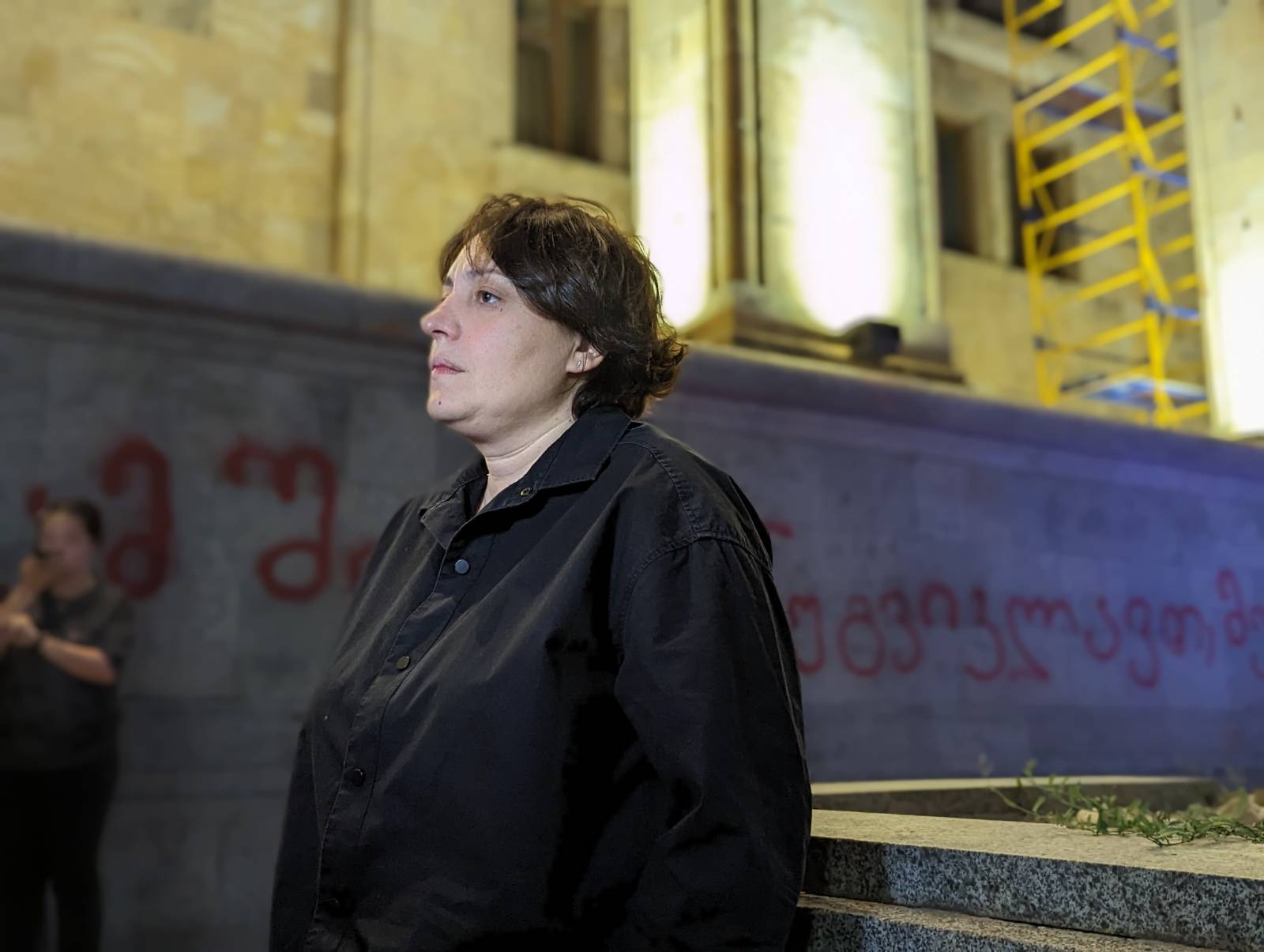
Elene Khoshtaria Goes On Hunger Strike as 'New Form of Struggle'
announced
a hunger strike, saying it is a 'new form of struggle.'
'Now that the regime has launched a new attack and arrested practically all of the opposition, I want to declare a new form of struggle — one that is not emotional or thoughtless, but victory-oriented,' Khoshtaria told reporters as she was announcing her 'firm decision' in the evening of June 27 in front of the parliament building on Tbilisi's Rustaveli Avenue, the epicenter of ongoing non-stop anti-Georgian Dream protests.
She vowed not to leave Rustaveli Avenue, citing tragic reports of detained protesters losing family members while in custody. At least three inmates have lost parents since their arrest over protests that erupted after Georgian Dream's late-November announcement to halt EU accession. The most recent case is the death of the father of Onise Tskhadadze, a well-known comedian currently on trial for group violence.
'If you can't see the value of life, the value of freedom […] here's my life, here's my freedom too — and you still can't beat us,' Khoshtaria said, addressing the ruling Georgian Dream party. She went on to say in her 'statement to people' that the 'only way' is 'revolution and their overthrow from the street.'
'I can't tell anyone when to take to the streets, go on hunger strike, go to prison, or come out,' Khoshtaria said. 'I can only say this with my example: I am ready to sacrifice myself against the regime — and I will.'
Six people, including five active opposition leaders, have been sentenced to several months in prison in recent days for refusing to appear before the Tsulukiani Commission in the Georgian Dream parliament, which they consider illegitimate. Two more are awaiting final rulings while in pre-trial custody.
All three other leaders of the Coalition for Change, an election alliance formed ahead of the 2024 parliamentary vote, which includes Khoshtaria's Droa, are currently jailed: Zurab Japaridze from Girchi – More Freedom has been sentenced to seven months, Ahali's Nika Melia to eight months, while Nika Gvaramia, Ahali's other leader, currently remains in pretrial detention anticipating a similar sentence.
Also Read:

Try Our AI Features
Explore what Daily8 AI can do for you:
Comments
No comments yet...
Related Articles

Civil.ge
 17 hours ago
- Civil.ge
Netherlands Suspends Rule-of-Law Training for Georgian Officials Over ‘Course of Authorities'
The Netherlands has suspended the participation of Georgian government officials in its Matra Rule of Law Training Programme, a move the Dutch Foreign Ministry called a 'difficult but necessary step' in response to the 'rapidly deteriorating situation in Georgia and the course of the authorities.' 'We call upon the Georgian authorities to uphold their responsibilities under international law: prosecuting those responsible for violence against protestors and journalists, releasing all political prisoners, and rescinding all repressive legislation,' the Ministry said in the statement released on X on August 18. The programme , designed and delivered by the Netherlands to Eastern Partnership and South East Europe countries, aims to strengthen institutional capacity by offering training and sharing best practices on rule of law topics. According to the Dutch Embassy in Georgia, close to 200 Georgian officials and civil servants have been trained over the years. 'The Georgian participants have greatly contributed to the quality of the trainings and of the multi-country MATRA network,' the Embassy said . 'The temporary suspension follows the rapidly deteriorated situation in the country, as a result of the deeply concerning actions by the Georgian authorities,' the Embassy added, echoing the remarks of the Dutch Ministry of Foreign Affairs. 'We sincerely hope that the situation in the country will improve in order for us to welcome Georgian participants in the future again.' The decision comes as part of a broader Western response to the continued anti-democratic moves by Georgian Dream authorities. The GD government has responded to protests that erupted late last November in response to the Georgian Dream's announcement of halting EU integration with force and repression. Dozens were arrested and are being tried on criminal charges, and the one-party parliament has adopted a string of repressive legislation cracking down on civil society, media, and minority groups . Eight opposition figures, including six active political leaders, were handed prison terms of several months for refusing to appear before the temporary investigative commission in the GD parliament. Also Read:


OC Media
4 days ago
- OC Media
Georgian authorities launch first FARA probe, targeting prominent NGOs
Sign in or or Become a member to unlock the audio version of this article The Caucasus is changing — so are we. The future of journalism in the region is grim. Independent voices are under threat — and we're responding by building a newsroom powered by our readers. Join our community and help push back against the hardliners. Become a member Georgia's Anti-Corruption Bureau has launched inspections against six prominent civil society organisations under the Foreign Agents Registration Act (FARA), warning that failure to register under the law is a criminal offence. At a joint press briefing on Friday, the groups said they had received official letters from the bureau on 11 August, describing it as a threat of criminal prosecution. Those targeted were the Civil Society Foundation, the women's rights group Sapari, Transparency International Georgia, the Social Justice Centre, the Media Development Foundation, and the International Society for Fair Elections and Democracy (ISFED). The move is the first of its kind since FARA was adopted earlier this year, indicating that unlike the previous foreign agent law, the government intends to enforce the law to target critics. In their letter to the NGOs, seen by OC Media, the Anti-Corruption Bureau claimed the groups may have been engaging in 'political activity' aimed at 'shaping, adopting, or influencing Georgia's domestic or foreign policy', as well as activity driven by the interests of a foreign government or foreign political party. According to the bureau, the inspection mentioned in the letters was based on a possible FARA violation. They added that their inspection aimed to identify individuals required to register as agents and to examine their activities. The bureau asked the organisations to explain why they did not submit a registration application on time. Advertisement 'Due to the failure to submit the registration application to the bureau within the period established by law, the individual is subject to criminal liability', the letter warned. Prominent civil society groups in Georgia, including election watchdogs, human rights groups, and others, have widely rejected the law, publicly vowing not to comply. As part of the inspection, the groups in question are required to explain 'what evidence has been destroyed' in the context of FARA, citing their public statements as the basis for the request. This likely refers to a June remark by Sapari's director, Baia Pataraia, who said that the vast majority of the organisation's archives had already been destroyed to ensure that sensitive information about its beneficiaries — women and children — would not fall into the wrong hands. 'We are independent Georgian NGOs' In response to the letters, the groups reiterated their long-stated position that they do not intend to register as agents of foreign interests. 'We are independent Georgian NGOs operating under our own statutes […] we serve solely the interests of our people and of Georgia', they said. The Georgian Dream government adopted FARA on 1 April, presenting it as a word-for-word translation of the US Foreign Agents Registration Act, also more commonly known as FARA. This followed widespread backlash against the 2024 foreign agent law, which critics labelled a 'Russian law', comparing it to the Kremlin's draconian regulations. Violations of Georgia's FARA law can be punished by up to five years in prison, a fine of up to ₾10,000 ($3,600), or both. Critics have repeatedly pointed out that the US law has not been used to target civil society and media organisations, and that Georgian Dream was disregarding US judicial practices over their own legislation in doing so. 'In the style of [Russian President Vladimir] Putin's Russia, the persecution of independent NGOs and free media aims to end democracy. But we will continue our work and will not leave the Georgian people without support', the organisations said on Friday. The letters follow the Anti-Corruption Bureau's June court-backed request for extensive information from civil society organisations. The bureau cited four laws at the time, including FARA, but the court approved the request without mentioning FARA, for unclear reasons. At the time, the organisations said the requested information included sensitive data about their beneficiaries, which they were unwilling to provide to the state. They appealed the first-instance court's approval, but unsuccessfully. Ultimately, several organisations pointed the bureau to publicly available information on their websites. The SJC allowed the bureau access only to information related to its own activities, such as grant agreements, without disclosing sensitive data about third parties. Responding to criticism from civil society, the head of the bureau, Razhden Kuprashvili, stated that the legal and financial documentation requested by his office 'does not go beyond the boundaries of the law'. In its June motion, the bureau sought to support its suspicion that the organisations were engaged in 'covert political activity' by citing public statements and social media posts from them and their representatives. A legislative crackdown against civil society In recent months, the ruling Georgian Dream party has adopted a series of restrictive laws and amendments, several of which have specifically targeted civil society organisations and independent media. One of the amendments made to the law on grants in April required civil society organisations to obtain the government's permission before receiving any grant from outside of Georgia. In addition, donor organisations must also submit a copy of the grant to the Georgian government beforehand. During the same period, the ruling party introduced the FARA law. Under the law, a foreign agent is defined as any person who is under the control of, or acts at the direction of, a foreign power and acts in the interests of that foreign power. The enforcement of both laws — including decisions about who is 'acting at the direction of a foreign power' and who is receiving unauthorised grants — has been entrusted to the Anti-Corruption Bureau, which is under the Prime Minister's Office. Georgian Dream has repeatedly claimed that new legislation was necessary to fight the 'influence of external powers'. Nonetheless, critics of the ruling party have insisted that these changes aim to undermine the media and civil society in an already fragile democracy. The restrictive laws were passed in a parliament where opposition is virtually nonexistent. Following the disputed 2024 elections, opposition parties refused to participate in parliamentary sessions. Since then, the ruling party has passed several new restrictive pieces of legislation without any obstacles, targeting the media, civil society, and other critics.

Civil.ge
5 days ago
- Civil.ge
22-Year-Old Tedo Abramovi Acquitted of Serious Drug Charges Linked to Protests
Tevdore (Tedo) Abramovi, a 22-year-old protester detained in December, was acquitted of serious drug charges, the second not-guilty verdict among those arrested in the context of pro-EU and anti-Georgian Dream protests since last November. Tbilisi City Court Judge Tamar Mchedlishvili announced the verdict early on August 15. Abramovi was charged with illegal purchase and possession of a large quantity of narcotics, punishable by 8 to 20 years in prison or life imprisonment. He pleaded innocent, with the defense arguing that drugs had been planted on him because of his activism, and citing the absence of safeguards, such as video evidence of the police search or the presence of a neutral, impartial witness, during the search. Abramovi walked free from the courtroom to the cheers of his supporters and family. 'To be punished in the country my parents taught me to love as a child, and to be punished for loving that country, is simply a shame,' Abramovi said in his closing remarks on August 14, according to Publika . 'I believe I will be proven innocent.' Abramovi, who was born in emigration and reportedly arrived in Georgia to take care of his grandmother, was arrested on December 7 last year while, according to the defense, on his way to a pro-EU rally. The defense alleges that police concealed evidence from the search that would have indicated his intended destination. Abramovi also alleged inhuman treatment upon his detention. Abramovi was charged under Article 260 of the Criminal Code with the illegal purchase and possession of a large quantity of narcotics, an offense punishable by 8 to 20 years in prison or life imprisonment, with police arguing the defendant was carrying 4.41548 grams of MDMA. Prosecutors initially claimed that Abramovi's resistance during the search prevented police from filming the procedure. But a police witness later testified that they had attempted to film the search but stopped due to a memory overload on the device. The prosecution cited forensic analysis indicating the presence of Abramovi's biological traces on the drug packaging. Abramovi, however, claimed that his saliva sample had been artificially taken upon detention. His defense noted that saliva was the only trace found on the packaging and cited a separate expert report which, they said, confirmed he had not used any narcotic substances. The lawyers also highlighted the prosecution's refusal to order a similar study. Abramovi's case was one of the six drug trials widely linked to the defendant's activism, with other cases including that of doctor and activist Giorgi Akhobadze, journalist Nika Katsia, and three Russian citizens – Anastasia Zinovkina, Artem Gribul , and Anton Chechin . Critics have pointed out that all cases have followed the same worrying pattern , including investigations initiated on unverified 'operative information' from undisclosed sources; testimonies relying solely on law enforcement officers and affiliated witnesses; and a lack of neutral observers or video recordings during searches. In a surprise verdict on August 6, Akhobadze was acquitted of his drug charges, marking the first not-guilty verdict among those arrested in the context of protests since November 2024. Commenting on the verdict, Georgian Dream Prime Minister Irakli Kobakhidze pointed to 'high legal standards' in Georgia, saying the court was obliged to release a person if '100% evidence' was lacking. 'Akhobadze was released from detention precisely because no video was made,' Kobakhidze told reporters on August 7. Abramovi's verdict marks the second acquittal after Giorgi Akhobadze, among dozens who have been detained in the context of protests since November 2024. Twelve persons were handed down jail sentences among those detained in the same period, including Anatoli Gigauri , Temur Zasokhashvili, Davit Lomidze, Mzia Amaghlobeli , Anri Kakabadze , Anri Kvaratskhelia , Saba Jikia , Giorgi Mindadze , Mate Devidze , Denis Kulanin, Daniel Mumladze, and Guram Khutashvili . Seven more remain in prison after being convicted over their involvement in the spring 2024 protests against the foreign agents law, including Omar Okribelashvili, Saba Meparishvili, and Pridon Bubuteishvili, who were convicted in January, Davit Koldari, Giorgi Kuchuashvili, and Giorgi Okmelashvili , who were convicted in February , as well as Irakli Megvinetukhutsesi, convicted in December. Eight individuals, including six active opposition politicians, were recently sentenced to prison terms of several months for defying the Georgian Dream investigative commission. , a civic platform documenting the cases of detainees, currently lists over 60 persons who were jailed in 2024-2025 and are considered political prisoners. The verdicts come as no police officer has been held accountable despite numerous documented abuses during dispersals. Dozens of protesters remain in pre-trial custody, awaiting their rulings on similar or other protest-related charges.
