



What flood insurance does and does not cover
That's because oftentimes insurance doesn't cover what the policyholder thinks it does — or thinks it should.
The disappointing surprise is that while the standard home insurance policy does cover fire and wind damage, even good property insurance typically doesn't cover things like flooding and earthquakes, which usually require a special and separate policy for each.
Here are the things to know about flood insurance.
Who has flood insurance
Most people who have flood insurance are required to have it.
Although many property owners have the option of purchasing flood insurance, it is mandated for government-backed mortgages that sit in areas that the Federal Emergency Management Agency deems highest risk. Many banks require it in high-risk zones, too.
But most private insurance companies don't carry flood insurance, leaving the National Flood Insurance Program run by FEMA as the primary provider.
Congress created the federal flood insurance program more than 50 years ago when many private insurers stopped offering policies in high-risk areas.
FEMA's Flood Map Service Center has an online tool to check your area. FEMA notes even a 1% chance of flooding is considered high risk because it amounts to a 1-in-4 chance of flooding over the life of a 30-year mortgage.
Who doesn't have flood insurance
Homeowners in high-risk areas who should have it sometimes decide not to get it. Someone who pays off their mortgage can drop their flood insurance once it's not required. Or if they purchase a house or mobile home with cash, they may not opt for it at all.
The rest of us are just rolling the dice, even though experts have long warned that flooding can happen just about anywhere because flood damage isn't just water surging and seeping into the land — it's also water from banks, as well as mudflow and torrential rains.
Mark Friedlander, spokesman for the Insurance Information Institute, an industry group, said only about 6% of U.S. households have a flood policy — primarily in the costal areas prone to hurricanes. That rate has remained steady in recent years despite the increasing frequency of severe flooding events, including in areas that are not formally considered by the government to be high risk.
'Lack of flood coverage is the largest insurance gap across the country,' Friedlander said in an email. 'Ninety percent of U.S. natural disasters involve flooding and flooding can occur just about anywhere it rains.'
What flood insurance covers
Even if a homeowner does have flood insurance, the coverage may not be enough to make a policyholder whole again.
FEMA's National Flood Insurance Program only covers up to $250,000 for single-family homes and $100,000 for contents. Renters can get up to $100,000 for contents, and commercial flood insurance will cover up to $500,000.
There are concerns that such flooding coverage limits are not robust enough, especially at a time when climate change is making strong hurricanes even stronger and making storms in general wetter, slower and more prone to intensifying rapidly.
And what typically happens to the people without flood insurance in a major storm is that they can try to recover some money from their standard home insurance but may end up in a fight to determine what damage is or isn't wind versus rain, or even 'wind-driven rain.'
Don Hornstein, an insurance law expert at the University of North Carolina, said the line between wind and water is a thin but very clear line that technical experts can determine. Should there be a proverbial tie, the law favors the insurance company.
'If the house was simultaneously destroyed by flood and, concurrently (by) wind, it's not covered by private insurance,' Hornstein said.
Hashtags

Try Our AI Features
Explore what Daily8 AI can do for you:
Comments
No comments yet...
Related Articles


Daily Mail
 15 minutes ago
- Daily Mail
New credit card frontrunner emerges as Amex-Chase battle heats up
American Express and Chase have long battled for the crown of America's favorite credit card. Now, new contenders are shaking up the leaderboard. Bank of America climbed to second place from fifth. Capital One stays in third place in JD Power's latest customer satisfaction rankings. Chase fell to fourth, while Amex held onto the top spot. The annual survey scores issuers across seven factors, including rewards, customer service, account management, and fees. In addition to naming an overall winner across all card types — from airline-branded to no-fee and premium rewards cards — the study also highlights leaders in each category. Capital One's Savor card was ranked best among no-annual-fee rewards cards, a category especially popular with younger, budget-conscious users. Among premium cards — with annual fees ranging from $95 to $795 — Amex's Platinum returned to first place after dropping last year. Chase's Sapphire Reserve fell to fourth. The survey comes as consumers juggle tighter finances: 53 percent of cardholders now carry a balance month to month, and 56 percent are classified as 'financially unhealthy.' Average monthly credit card spending also dipped to $1,058, down from $1,126 a year earlier. Still, satisfaction climbed among cardholders who pay their balances in full, said J.D. Power's John Cabell. Rewards credit cards with fee American Express's Platinum Card is the overall pick for rewards cards that come with an annual fee this year, leaping up from fourth place last year. Chase's Sapphire Reserve fell from third place last year, to fourth place this year as competition for travel rewards heats up. Rewards credit cards with no-annual fee Capital One's Savor Rewards card held on to the top spot for the second year in a row. Chase's Freedom Flex fell from second to fifth. American Express landed the top spot. It is known for its lavish perks and use of celebrities to promote its cards. Australian model Elle MacPherson is seen here promoting the Amex Red card Airline co-brand credit cards Most popular airlines issue their own credit cards in partnership with a bank. Last year Southwest's Rapid Rewards Premier Card, in partnership with Chase, was ranked the best. Frequent fliers appear to have turned on the card, which has tumbled to ninth. American Airlines' AAdvantage Executive World Elite card issued with Citi soared to first place Credit cards have perks for frequent flyers, including cashback for hotels Other co-brand credit cards Hilton Honors American Express was the highest-ranked co-branded card overall, knocking Apple's Goldman Sachs-issued card off its perch. Costco's Citi Visa also outranked Apple. Apple's future in the credit card business remains uncertain as Goldman retreats from consumer banking. Meanwhile, a recent report showed how the value of credit card reward points has been gradually falling - as inflation has taken hold. A reward point has long been worth around one cent when used to cover other purchases. But one cent has lost around 20 percent of its purchasing power since 2018, according to the Bureau of Labor Statistics. This means a point has also fallen in value by about the same amount. If you built up 50,000 points with a major credit card issuer in 2020 and still have not spent them, they are now worth about 41,300. Inflation starts to bite into the value of points if users redeem them directly through a bank's portal or online app Card issuers are also adjusting their offerings. Venture X cardholders will soon lose the ability to extend Capital One airport lounge access for guests and additional cardholders from February. The move is to tackle overcrowding. Amex has rolled out digital waitlists at its lounges to tackle long lines. Citibank is entering the premium travel card market with its upcoming Strata Elite, designed to appeal to affluent travelers. The 'Strata Elite', due later this year, will be a direct rival to Chase's Sapphire Reserve card and American Express's travel-focused Platinum card.
Daily Mail
15 minutes ago
- Daily Mail
Fury as Home Depot does screeching U-turn on tariff price promise
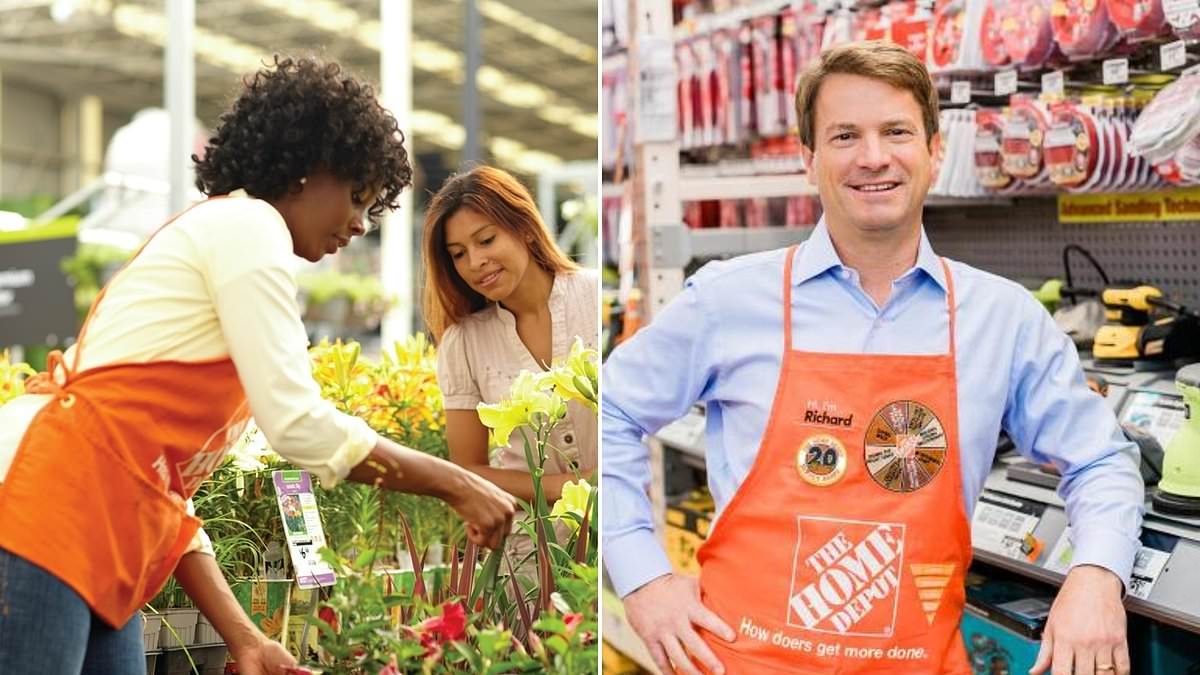
Home Depot is preparing to raise prices, just months after promising to hold the line on costs. On Tuesday, CFO Richard McPhail said tariffs are forcing the home improvement giant to pass along higher costs to shoppers. 'Tariff rates are significantly higher today than they were at this time last quarter,' McPhail told The Wall Street Journal. 'So, as you would expect, there will be modest price movement in some categories, but it won't be broad-based.' The shift marks a reversal from May, when McPhail pledged to 'generally maintain our current pricing levels across our portfolio.' Home Depot, which runs more than 2,300 stores, has tried to diversify its global supply chain to be less reliant on China, which faces the highest tariffs. Half of its products are now made in the US. Still, analysts say tariffs are squeezing margins. 'Home Depot is finding that tariffs will bite in terms of its own costs,' Neil Saunders, retail expert at GlobalData, told Daily Mail. 'It will need to selectively raise prices on some products as we move through this year.' Still, Saunders noted that the company can't raise prices across the board. Rival chains have been merchandising lower prices to attract customers while mixing in higher prices, making it risky for any retailer to move too aggressively. 'Being competitive on price is key for Home Depot,' Saunders added. 'It will also not be alone. Other retailers, including other DIY chains, will need to increase their prices, too.' Still, Home Depot executives said they're confident the company can use its scale to bring some cost relief to customers. While shoppers might see price hikes on certain items, executives say the entire bill is cheaper at its stores. 'Our customers tend to shop with us for their entire project – not for a single item here or there,' McPhail said. The chain tells the Daily Mail that half of its product is made in the US 'For example, they probably aren't going to just buy a bathtub. They're also going to buy the tile, the grout, the shower head, the vanity. 'So, we're focused on protecting the value of the entire project.' Home Depot isn't the only retailer under pressure. Earlier this month, American carmaking giants Ford and GM slashed their profit expectations while reporting billion-dollar tariff costs this year. Walmart, Target, Best Buy, and Amazon all initially warned consumers that President Donald Trump's tariffs would continue to drive costs higher. Trump lashed out at the companies for making the pronouncements, urging retailers to 'eat the tariffs' and sending administration officials to call price hikes a 'hostile and political act.' The moves have largely silenced retailers from openly discussing price hikes. However, they're still slowly making their way through the economy. In July, core inflation rose to 3.1 percent, a 0.3 percentage point increase from June. Days later, the Labor Department reported that July's producer price index, which measures inflation before it reaches consumers, was up 0.9 percent from June and 3.3 percent from a year earlier.

Daily Mail
15 minutes ago
- Daily Mail
How Bristol will use the box-office return of Louis Rees-Zammit to crack America
As Louis Rees-Zammit spoke to the media for the first time as a Bristol player at the club's state-of-the-art training centre on Tuesday, work was already well underway at the Bears on how best to benefit from his arrival. Rees-Zammit is a huge talent on and off the field. His rugby return from the NFL is good news for both the player and his new employers as the ambitious English club outfit looks to expand not only at home, but abroad. The USA, in particular, remains a target area for growth.
