


Latest news with #SamantaSchweblin

Scroll.in
 4 days ago
- Entertainment
- Scroll.in
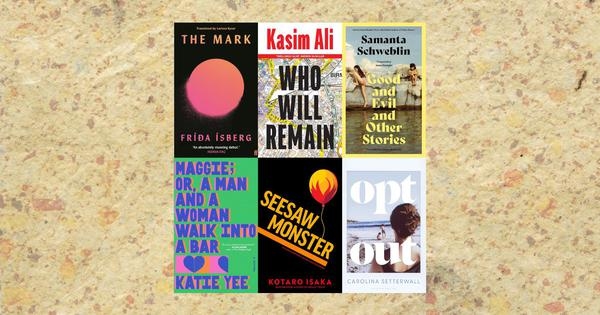
August global fiction: Six novels from around the world to add to your bookshelf
All information sourced from publishers. Good and Evil and Other Stories, Samanta Schweblin, translated from the Spanish by Megan McDowell A gripping blend of the raw, the astonishing and the tragic, every story is as perfectly unexpected as a snare: tightly, exquisitely wound, ready to snap at a touch. Here, a young father is haunted by the consequences of a moment of distraction; tragedy is complicated by the inexplicable appearance of an injured horse; an attempted poisoning leads two writers to startling conclusions; a lonely woman's charity is rewarded with home invasion. And in the shocking opening story, a mother surfaces from the depths of the lake behind her house, where she saw something awful yet alluring. Guilt, grief and relationships severed permeate this mesmerising collection – but so do unspeakable bonds of family, love and longing, each sinister and beautiful. M aggie; or, A Man and a Woman Walk Into a Bar, Katie Yee A man and a woman walk into a restaurant. The woman expects a lovely night filled with endless plates of samosas. Instead, she finds out her husband is having an affair with a woman named Maggie. A short while after, her chest starts to ache. She walks into an examination room, where she finds out the pain in her breast isn't just heartbreak – it's cancer. She decides to call the tumour Maggie. Unfolding in fragments over the course of the ensuing months, Maggie; Or, a Man and a Woman Walk Into a Bar, follows the narrator as she embarks on a journey of grief, healing, and reclamation. She starts talking to Maggie (the tumour), getting acquainted with her body's new inhabitant. She overgenerously creates a 'Guide to My Husband: A User's Manual' for Maggie (the other woman), hoping to ease the process of discovering her ex-husband's whims and quirks. She turns her children's bedtime stories into retellings of Chinese folklore passed down by her own mother, in an attempt to make them fall in love with their shared culture – and to maybe save herself in the process. The Mark, Fríða Ísberg, translated from the Icelandic by Larissa Kyzer The Icelandic Psychological Association has prepared a test. They call it a sensitivity assessment: a way of measuring a person's empathy and identifying the potential for anti-social behaviour. In a few days' time, Iceland will vote on whether to make the test compulsory for every citizen. The nation is bitterly divided. Some believe the test makes society safer; others decry it as a violation. As the referendum draws closer, four people – Vetur, Eyja, Tristan and Ólafur – find themselves caught in the teeth of the debate. Each of them will have to reckon with uncomfortable questions: Where do the rights of society end and the rights of the individual begin? When does utopia become dystopia? Who Will Remain?, Kasim Ali Amir has grown up in Alum Rock, Birmingham, under the care of his sensible older brother, Bilal, and his cousin Saqib, born just a few days before Amir. Alum Rock can be a troubled place, but Amir has managed to keep his head down, worked hard and stayed out of trouble … until now. When Saqib is killed in a gang fight and Bilal announces his engagement, Amir suddenly loses the two men who keep him grounded. Amir's university grades are collapsing, he's running out of money, and pressure mounts from every direction. As tensions flare, the friends left around him start to draw Amir into their more dangerous pursuits, and the family ties that have bound him so completely begin to unravel. Amir decides he only has himself to rely on and must take his future into his own hands. Seesaw Monster, Kotaro Isaka, translated from the Japanese by Sam Malissa Miyako suspects her mother-in-law is a murderer. It's not just a case of them rubbing each other up the wrong way – there is definitely something suspicious going on. But Miyako isn't exactly what she seems either. Her husband has no idea about her past life as a secret agent. When she decides to use her professional skills to investigate her mother-in-law, the delicate equilibrium of their lives is thrown wildly out of balance. Many decades later, in a future world where electronic communication has been irrevocably compromised, confidential messages must be delivered by trusted couriers like Mito. But one delivery pulls Mito into a conspiracy beyond his wildest imaginings, and forces him into a race against time to defeat a world-changing technological threat. Opt Out, Carolina Setterwall, translated from the Swedish by Deborah Bragan-Turner Everything will be fine. That is what Mary and John promise when they tell their two children that they are getting a divorce. But while the end of their marriage offers them both freedom from their dissatisfaction, it brings to the fore the pain and resentments that have always percolated through their relationship and throws into stark relief their shortcomings as partners and as parents. While John finds a second chance at love – still retaining the support of their children – Mary is forced to contend with the fact that, having always yearned for the approval of others, she is thoroughly unprepared for the waves of change that are coming to reshape her life. Told from the alternating perspectives of Mary and John as they separately navigate life in the wake of their separation, Opt Out is an astute examination of the constrictive power of gender roles, and a reckoning with our impossibly idealised conceptions of motherhood.


Irish Times
11-08-2025
- Entertainment
- Irish Times
Fiction in Translation: The prisons we inhabit
In Good and Evil and Other Stories , (Picador, 192pp, £16.99) Samanta Schweblin once again proves herself to be one the most unsettling and incisive voices in contemporary fiction. The collection, translated by her long-time collaborator Megan McDowell, offers six stories that move from the heartbreaking to the surreal, and are all marked by a claustrophobia that is at once spatial, emotional and existential. While Schweblin's stories are marbled with the dreamlike and the inexplicable, her characters are profoundly human, trapped by relationships, by expectations, by their own spiralling thoughts. Welcome to the Club, the bitterly ironic story about a failed suicide attempt, quivers with tension and fear – not of death, but of the hum and bustle of mundane family life, of the dread inspired by a child asking 'Mommy, are you happy?'. In A Fabulous Animal, Elena, who is dying, calls an old friend she has not seen since she left Argentina, but what might have been just another casual conversation is haunted by the vision of a dying horse, and an accident that shattered both their lives. In the most devastating story, An Eye in the Throat, two parents care for a bright two-year-old who suffered a serious injury when he swallowed a battery. But it's not the panic and the anxiety of illness that leads to the collapse of the family, but a seemingly anodyne incident in which the boy wanders off. Years later, the father's phone still rings in the dead of night, but when he answers there is only the dead air on the other end of the line. This simple supernatural trope offers a brilliant example of Schweblin's ability to make the uncanny feel inevitable, to weave abject horror out of silence and fear and the haunting nature of unresolved guilt. McDowell's translation is exceptional, effortlessly capturing the dark poetry of Schweblin's prose like a series of whispered confessions, and preserving the oppressive tone and the strange tenderness of the original. READ MORE [ Samanta Schweblin's Fever Dream review: extraordinary work full of eerie menace Opens in new window ] Annah, Infinite (Tilted Axis Press, 345pp, £19.99) is not a translation in the customary sense, but is subtitled 'translated from the painting Annah la Javanaise " . Through her writings, poetry and exhibitions, the Indonesian polymath Khairani Barokka has spent more than a decade exploring Paul Gauguin's unsettling and disturbingly sexual portrait of a child that is all-too-often hailed as a masterpiece, with little consideration for the sitter. Little is known about Annah (and, as Barokka points out, like all nouns in Indonesian the name can be singular or plural, so Annah may be multiple, or infinite). Gauguin's art dealer, Ambroise Vollard, claims to have 'gifted' the child to the artist when she was 'about 13', and Annah was widely assumed to be Gauguin's lover. But the painting (now in a private collection) and its digital versions offer no information about this child historically described as 'Javanese', 'mulatto', 'mixed-race', 'Ceylonese', 'half-Indian, half-Malayan'. What Barokka explores in this dazzling, endlessly imaginative piece of non-fiction is Annah, a child, perhaps multiple children, who may have been she/he/they or dia – the gender-neutral Indonesian pronoun used for everyone. Through essay, poetry and image, she tries to understand who Annah might have been, considers their pain, the abusive nature of their relationship, the unbridled license afforded to 'artistic genius', and in particular to men. Through this study of a single canvas and its subject, Barokka presents a brilliant book that defies classification, one that delves into linguistics, colonial history, queer theory and memoir, and is by turns lyrical, angry, tender and pained, harking back to the pioneering work of Linda Nochlin and John Berger, but blazing a new trail that is as unexpected as it is enthralling. A single image is also the inspiration for Capitalists Must Starve by Park Seolyeon translated by Anton Hur. The photograph, taken during the Japanese colonial occupation of Korea, shows Kang Juryong, a striking worker sitting on the roof of the Pyongwon rubber factory in Pyongyang in 1931. From the power of this image and the scant details known about the historical figure of a pioneering female activist, Seolyeon fashions a novel that is spare and stark, but shot through with joy, love and sensuality. Capitalists Must Starve begins at the end, in a cell, where Kang Juryong, an imprisoned union activist now on hunger strike, attempts to lift her bruised and beaten body so she can turn her back to the approaching footsteps in a last gesture of defiance. From here, Seolyeon takes us back to West Gando (the Korean name for Manchuria), to the day when, at the age of 20 (already considered too old to be a bride), she was married off to a man-boy of 15. In arranging the wedding, the Jeonbin's parents hoped to prevent their son running away to join the Liberation Army. In this, they failed: Seolyeon delicately and tenderly evokes the passionate conversations and the growing friendship between the mismatched bride and groom that gradually grows into love. Juryong has no wish to stop her husband achieving great things, and when he leaves to join the rebels, she goes with him. Though at first, Juryong is left to cook and tend for the men, she is befriended by Baek Gwangwoon and proves an audacious and ingenious comrade during dangerous missions. Humiliated by Juryong's successes, Jeonbin sends his wife away, though she briefly returns when a comrade comes to tell her that her husband is dying. Having been widowed at a young age, Juryong is horrified to discover that her parents plan to marry her off again, so they might own their house and land, Juryong leaves for Pyongyang. But her determination to be a 'modern girl' founders when poverty dictates that she take work in a rubber factory. Juryong's gradual politicisation and her innate sense of justice are simply and powerfully portrayed – and when the strike led by workers to protest against a decrease in pay is brutally crushed, her decision to climb on to the factory roof and stage a hunger strike seems as inevitable as it is courageous. Hur's taut, masterful translation wisely refuses to pander to what anglophone readers might not know, but maintains the brittle tension of Seolyeon's spare prose, and brilliantly succeeds in conjuring a time, a place and a movement and a pioneering activist who became a catalyst for change from within her cell. [ Translated fiction reviews: the best of China's incredibly deep storytelling tradition Opens in new window ] Imprisonment seems to be a theme in this month's choices. Later this year, Dubliners will have the opportunity to hear the Kurdish poet İlhan Sami Çomak, the first honorary member of the Dublin Book Festival. But when Words that Walk through Walls (Palewell Press, 121pp £12) was published recently, such an event was impossible, since İlhan was a prisoner before he became a poet. Arrested in 1993, at the age of 21, he spent 30 years as a political prisoner in Turkey. While in jail, he published eight volumes of what Ruth Padel describes as 'lyric poems of astonishing beauty, vitality and strength', which garnered numerous prizes. Led by his long-time editor Caroline Stockford, with Kelly Davis Words that Walk through Walls is a luminous, achingly poignant conversation. Writers from around the world (among them Theo Dorgan, Celia de Fréine and Leeanne Quinn) address poems to İlhan, who replies to some with poems of his own. It is a powerful, compelling, often uplifting collection that brings together a host of poets and translators, one that encapsulates, reflects upon and frames İlhan's shimmering work and his resilience as he asks: How much of flight is wind, how much the bird? How much the stubborn call of freedom? Branches follow the logic of light and the natural miracle of reaching. We must reach out.
