


Latest news with #TokyoHanedaAirport


Metro
 12-08-2025
- General
- Metro
How four people survived the second-deadliest plane crash that killed 520
Only four people were pulled out alive from the wreckage of the doomed Japan Airlines flight 123 after it crashed on a mountainside. One of the world's deadliest plane disasters struck four decades ago when the passenger jet carrying 524 people crashed shortly after takeoff. Four people, including an eight-year-old child, miraculously escaped the decimated wreckage after the Boeing 747SR-46 plane crashed onto a remote mountain area of Mount Takamagahara. The Japan Airlines flight 123, known as JAL123, remains Japan's worst aviation accident to date. It has been dubbed the Titanic of Japan's aviation world. This is the story of the doomed Japan Airlines flight 123 that will never be forgotten. The Boeing plane took off from Tokyo Haneda Airport and headed towards Itami, Osaka, as usual on August 12, 1985. The plane was packed with families flying on their summer vacations to escape the hot and humid Tokyo weather – a total of 509 passengers and a 15-strong crew. But just 12 minutes after takeoff, parts of the plane exploded due to decompression, causing the ceiling near the toilets to collapse and tearing a hole in the fuselage designed to protect the passengers. To make matters worse, the explosion damaged the tail fin and the four hydraulic lines on the plane, causing it to rise and fall uncontrollably after the pilots had declared an emergency. For a terrifying 30 minutes, the pilots fought to regain control of the plane, which climbed and fell again as they attempted to return to Tokyo. Meanwhile, passengers began to accept their fate and wrote final messages to their loved ones. But the out-of-control plane continued to descend and got closer to the mountains, where it crashed and exploded. It took rescue crews more than 15 hours to get to the crash site, where four survivors, all women, had managed to stay alive. Off-duty flight attendant Yumi Ochiai, mum Hiroko Yoshizaki, 34, with her eight-year-old daughter Mikiko, and Keiko Kawakai, 12, who lost her family in the crash. Keiko was shot out of the plane on impact and catapulted into a tree, where she was found with serious injuries. All four had sat in the rear of the aircraft. The women were seated in the final rows – from 54 to row 60. Yumi recalled the final moments in the plane before everything went silent: 'After the crash, I heard harsh panting and gasping noises from many people. I hear it coming from everywhere, all around me. There was a boy crying 'mother.' I clearly heard a young woman saying 'Come quickly!'.' The JAL123 disaster is known as Japan's aviation industry's equivalent of the sinking of the Titanic, Christopher Hood, a fellow at the University of Bath's Centre for Death and Society, said. Hood, who has written a book about the crash and spent a night at the crash site to get into the shoes of the survivors, said as many as 100 people might have survived the impact. 'If the rescue teams arrive sooner, there would have been more survivors. The survivors there knew it was getting quieter and quieter. Fifteen hours is a long time.' He said the lack of GPS at the time contributed to possible miscalculations as search aircraft relayed the location back to the control tower in degrees and miles, but 'the problem is the speed they are going at, making it it difficult to judge and there's a margin of error. With degrees, one degree makes a 1-2km difference already. 'And the defence force reported back in nautical miles, while Japan uses kilometres. It was the perfect storm and it was a mountainous area.' The Japanese society is less interested in the individual survivours than often is the case in the UK and US, Hood explained. Most of the media attention focused on the 12-year-old Keiko, who became a nurse and helped victims when an earthquake hit. Hood said the cause of the crash is still debated to this day. While the official cause is a faulty repair to the bulkhead, which led to the decompression explosion, an alternative theory is that air was leaking out slowly, which the tail was not designed to take, eventually causing it to break. A wilder theory, which has been debunked, is that the plane was hit by a missile, which then led to cover-up attempts. Hood said the same plane had been involved in an accident in 1978, claiming that the repairs were done 'incorrectly.' He told Metro the impact of the crash was 'huge' in 1985, and it has been etched in the society's consciousness. 'The list of passengers was read on TV, and this is how many people found out about their loved one,' Hood said. He said: 'It is the deadliest single plane crash, and it had an incredible number of people for a domestic flight. Imagine this happening on a flight from London to Edinburgh. 'The crash happened on August 12, which is like the day of the dead or Halloween, and it added symbolism. There were famous people on board, and so many people connect themselves to the crash with one or two steps.' More Trending The disaster struck just days after the 40th anniversary of the brutal atomic bombings of Hiroshima and Nagasaki, which added to the collective pain. Hood said the next generations in Japan will learn about the disaster and interest will 'only grow rather than go away.' 'And families are keen for it to be reported. This crash has become the figurehead of all transport accidents.' Every year, people gather at the JAL123 at the Osutaka ridge in the Ueno village, with this year marking 40 years. Get in touch with our news team by emailing us at webnews@ For more stories like this, check our news page. MORE: Virgin Atlantic relaunches flights to 'iconic' winter sun destination after 6 years MORE: 'Europe's Hawaii' that's often dubbed a 'Canaries alternative' is having a record-breaking year MORE: Emirates announces flight rule change that will affect every passenger from October 2025


USA Today
26-05-2025
- USA Today
Flight diverted to Seattle after passenger tried to open plane's door, authorities say
Flight diverted to Seattle after passenger tried to open plane's door, authorities say Show Caption Hide Caption Flying is the safest way to travel according to global safety experts Flying is the safest way to travel, according to experts. An All Nippon Airways flight traveling from Tokyo to Houston was diverted to Seattle-Tacoma International Airport after a passenger reportedly tried to open the plane's exit doors mid-flight, authorities said. The plane, travelling from Tokyo Haneda Airport to Houston Intercontinental Airport, was about nine hours into its 12-hour journey when it made the diversion, according to FlightAware. The flight landed safely at 4:19 a.m. local time, where it was met by Port of Seattle Police and the FBI Seattle. "Port of Seattle Police were called due to reports of a passenger who attempted to open exit doors during the flight," said Chris Guizlo, spokesperson for the Port of Seattle. In a statement to USA TODAY, All Nippon Airways confirmed the incident, stating ANA Flight 114 "was diverted in-flight to Seattle due to an unruly passenger." Fellow passengers and crew members had restrained the man while the plane was in the air, according to Amy Alexander, a spokesperson for the FBI Seattle. Upon arrival, Port of Seattle Police gave an assessment and determined he was experiencing a medical crisis. He was then transported to a local hospital by emergency medical services for further treatment, police said. While the plane sat on the tarmac of Seattle-Tacoma International Airport, another passenger became "frustrated" at the diversion and punched the bathroom door, according to the airport. The second individual was deplaned for "unruly behavior" and the flight resumed to Houston, landing about four hours after its scheduled arrival time. No charges have been filed against either passenger at this time, the FBI said. "The safety of our passengers and crew are our top priority and we applaud the efforts of local law enforcement for their support," All Nippon Airways said. A Japanese airline based in Tokyo, All Nippon Airways services several U.S. destinations, including Los Angeles, Seattle, Honolulu, and New York, with flights to Asia. In 2024, a highly intoxicated passenger on an All Nippon Airways flight from Tokyo to Seattle reportedly bit a flight attendant in the arm an hour after takeoff, the Japanese airline told The Japan Times. The unidentified passenger was restrained by the flight crew, reported Kyodo News. As of May 18, there have been 597 reports of unruly passengers in 2025 to the Federal Aviation Administration.


Gulf Insider
19-05-2025
- Business
- Gulf Insider
Bahrain Named World's Cleanest Airport In 2025 By Skytrax
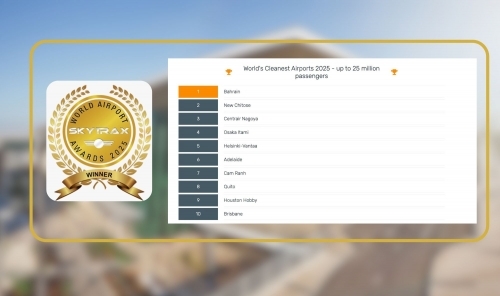
Bahrain International Airport has achieved global recognition as the World's Cleanest Airport for 2025 in the category of airports handling up to 25 million passengers, according to the UK- based air transport rating organization, Skytrax. This prestigious distinction places Bahrain at the forefront of global aviation hygiene standards, further reinforcing the Kingdom's commitment to excellence in travel infrastructure and passenger experience. Japan also celebrated significant success, with Tokyo Haneda Airport earning the title of the World's Cleanest Major International Airport, topping the global list for cleanliness among high- traffic terminals. The Japanese capital's gateway outshined other prominent hubs, while Centrair Nagoya, Tokyo Narita, Kansai, and Osaka Itami were also ranked among the cleanest airports in the world across both main and mid-sized categories. In Skytrax's World's Cleanest Airports 2025 (Up to 25 Million Passengers) list, Bahrain led the top 10, followed by: Bahrain International Airport New Chitose Airport (Japan) Centrair Nagoya (Japan) Osaka Itami Airport (Japan) Helsinki-Vantaa (Finland) Adelaide Airport (Australia) Cam Ranh International Airport (Vietnam) Quito International Airport (Ecuador) Houston Hobby Airport (USA) Brisbane Airport (Australia) Meanwhile, Singapore Changi Airport reclaimed the top honor as the World's Best Airport 2025, receiving multiple accolades including the World's Best Airport Dining, Best Airport Washrooms, and Best Airport in Asia. This marks the 13th time Changi has secured the leading title at the World Airport Awards, held last month at the Passenger Terminal Expo in Madrid. Yam Kum Weng, CEO of Changi Airport Group, expressed gratitude for the continued recognition: 'Changi Airport is honoured to be named by Skytrax as the World's Best Airport for the 13th time. It is indeed gratifying to receive this recognition, which certainly encourages us to continue striving to provide the best travel experience.' Doha's Hamad International Airport, previously a three-time winner of the World's Best Airport title, was ranked second overall in 2025 and won awards for the World's Best Airport Shopping and Best Airport in the Middle East. Tokyo Haneda Airport claimed third place globally in overall rankings, followed by: Singapore Changi Seoul Incheon Hong Kong International Centrair Nagoya Tokyo Narita Kansai International Taiwan Taoyuan Zurich Airport Dubai International (DXB) The dual triumph for Bahrain and Japan in cleanliness rankings highlights the rising importance of passenger hygiene satisfaction, especially in a post-pandemic era. These awards also serve as a testament to national and airport-level efforts in elevating global travel standards. Also read: GASTAT: Total Number of Passengers at Saudi Airports Jumps 15% to Over 128 Million in 2024

Daily Tribune
18-05-2025
- Daily Tribune
Bahrain Named World's Cleanest Airport in 2025 by Skytrax
TDT | Manama Bahrain International Airport has achieved global recognition as the World's Cleanest Airport for 2025 in the category of airports handling up to 25 million passengers, according to the UK-based air transport rating organization, Skytrax. This prestigious distinction places Bahrain at the forefront of global aviation hygiene standards, further reinforcing the Kingdom's commitment to excellence in travel infrastructure and passenger experience. Japan also celebrated significant success, with Tokyo Haneda Airport earning the title of the World's Cleanest Major International Airport, topping the global list for cleanliness among high-traffic terminals. The Japanese capital's gateway outshined other prominent hubs, while Centrair Nagoya, Tokyo Narita, Kansai, and Osaka Itami were also ranked among the cleanest airports in the world across both main and mid-sized categories. In Skytrax's World's Cleanest Airports 2025 (Up to 25 Million Passengers) list, Bahrain led the top 10, followed by: Bahrain International Airport New Chitose Airport (Japan) Centrair Nagoya (Japan) Osaka Itami Airport (Japan) Helsinki-Vantaa (Finland) Adelaide Airport (Australia) Cam Ranh International Airport (Vietnam) Quito International Airport (Ecuador) Houston Hobby Airport (USA) Brisbane Airport (Australia) Singapore Changi Airport Meanwhile, Singapore Changi Airport reclaimed the top honor as the World's Best Airport 2025, receiving multiple accolades including the World's Best Airport Dining, Best Airport Washrooms, and Best Airport in Asia. This marks the 13th time Changi has secured the leading title at the World Airport Awards, held last month at the Passenger Terminal Expo in Madrid. Yam Kum Weng, CEO of Changi Airport Group, expressed gratitude for the continued recognition: 'Changi Airport is honoured to be named by Skytrax as the World's Best Airport for the 13th time. It is indeed gratifying to receive this recognition, which certainly encourages us to continue striving to provide the best travel experience.' Doha's Hamad International Airport, previously a three-time winner of the World's Best Airport title, was ranked second overall in 2025 and won awards for the World's Best Airport Shopping and Best Airport in the Middle East. Tokyo Haneda Airport Tokyo Haneda Airport claimed third place globally in overall rankings, followed by: Singapore Changi Seoul Incheon Hong Kong International Centrair Nagoya Tokyo Narita Kansai International Taiwan Taoyuan Zurich Airport Dubai International (DXB) The dual triumph for Bahrain and Japan in cleanliness rankings highlights the rising importance of passenger hygiene satisfaction, especially in a post-pandemic era. These awards also serve as a testament to national and airport-level efforts in elevating global travel standards.
