



Mysterious 1,400-year-old cross depicting site of Jesus' crucifixion redraws early Christian maps
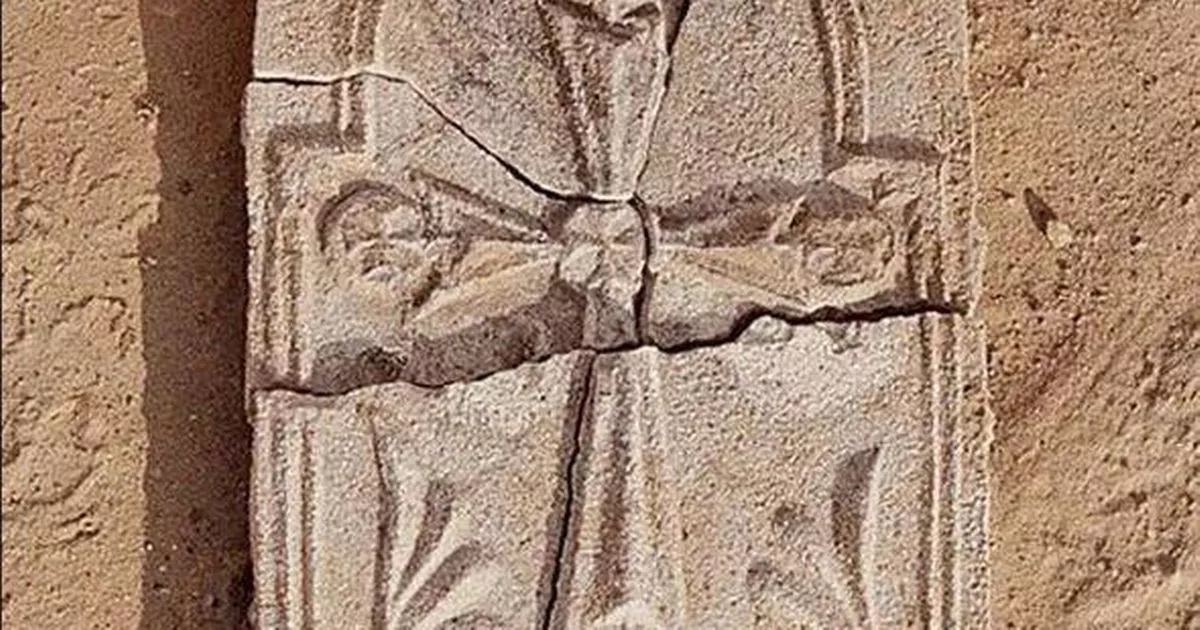
Archaeologists working at Abu Dhabi's Sir Bani Yas Island uncovered the artifact that features a stepped pyramid representing Golgotha, where Christians believe Jesus was crucified, and leaves sprouting from its base.
It was found among the ruins of a church and monastery, suggesting a Christian community flourished on the island during the seventh and eighth centuries.
Christianity during this period was typically associated with the Levant, Mesopotamia and parts of Europe, making the discovery of a thriving community on a southeastern Arabian Gulf island both unexpected and historically significant.
At the same time, the region was undergoing profound religious change as Islam was rising and spreading rapidly across Arabia, while older pagan traditions lingered and Christianity was thought to be fading.
However, the presence of a flourishing Christian settlement here challenges that assumption.
Maria Gajewska, lead archaeologist at the site, said: 'Every element of the cross incorporates regional motifs.
'It tells us that Christianity in this region was not only present but flourished, adapting visually to its local context. We had settlements of Christians that were not just existing but were clearly thriving.'
Mohamed Khalifa Al Mubarak, chairman of the Department of Culture and Tourism, called the discovery 'a powerful testament to the UAE's profound and enduring values of coexistence and cultural openness,' adding that the find highlights a history of peaceful religious diversity in the region.
The excavations this season also uncovered pottery, glass artifacts and a small sea-green bottle that may have held oil or rosewater.
The cross is about 10.6 inches long, 6.7 inches wide, and roughly 0.8 inches thick.
Archaeologists believe it could have been an object of veneration and placed on a wall with worshippers kneeling before it.
Hager Al Menhali, an Emirati archaeologist at the department, told The National: The plaster was resting face down and something about it caught my attention.'
She added that a 'distinct fingerprint on the back,' speculating it was left by the person who crafted the stucco plaque.
Future studies will include radiocarbon dating and further exploration of the courtyard houses, which could eventually be incorporated into a broader visitor trail.
'These discoveries deepen our connection to the past and inspire future generations to embrace the spirit of unity and mutual respect that has long defined our community,' Al Mubarak said.
Evidence from the excavation suggested that senior monks may have lived in the courtyard buildings, walking to the church for services or using the spaces for spiritual retreats.
The well-built structures, made of limestone and coral with cisterns for water, indicate a comfortable existence rather than a purely hermitic life.
The Christian community belonged to the Church of the East, a branch that stretched from the Middle East to China.
The Sir Bani Yas discovery offers a rare glimpse into how Christianity not only survived but expanded eastward, linking Arabian Gulf communities into the wider story of the faith's spread toward India and Asia.
Evidence of a church and monastery on Sir Bani Yas, dating to the seventh and eighth centuries, was first uncovered in the early 1990s,
Another monastery, likely linked to the same church, was discovered on an island in Umm Al Quwain in 2022. Similar sites have also been identified in Kuwait, Iran, and Saudi Arabia.
Archaeologists are still investigating why the Sir Bani Yas settlement declined.
The church is believed to have been fragmenting before the rise of Islam, troubled by internal schisms as rival branches sought independence.
However, evidence suggests that early Christian and Islamic communities in the region communicated and traded peacefully. So far, no external event has been identified as the cause of the site's abandonment.
What is striking, archaeologists said, is that the buildings appear unusually clean, with little sign of collapse or rubble. This suggested the residents may have left intentionally, planning to return, rather than being forced out by disaster or conflict.
Hashtags

Try Our AI Features
Explore what Daily8 AI can do for you:
Comments
No comments yet...
Related Articles

Daily Mirror
 43 minutes ago
- Daily Mirror
Mysterious cross depicting Christ's crucifixion rewrites the origins of Christianity
The 1,400-year-old plaque, found among the ruins of a church in Abu Dhabi, shows a depiction of a cross with a stepped pyramid evoking Golgotha - where Christians believe Jesus was crucified A 1,400 year old plaque showing a cross is transforming experts' knowledge of Christianity's eastward reach. Researchers excavating Abu Dhabi's Sir Bani Yas Island discovered the relic, which displays a stepped pyramid reminiscent of Golgotha - the site where Christians believe Jesus was crucified - with foliage emerging from its foundation, according to the Daily Mail. The artefact was unearthed amongst the remains of a church and monastery, suggesting a Christian settlement that prospered on the island throughout the seventh and eighth centuries, while recent reports show how a previously unexplored 'Area X' begins to give up its religious secrets. Early Christians Christianity during this era is commonly linked with the Levant, Mesopotamia and sections of Europe, making proof of a flourishing community on a southeastern Arabian Gulf island both surprising and historically important, , reports the Express. Simultaneously, the area was experiencing dramatic religious transformation as Islam was emerging and expanding swiftly throughout Arabia, whilst ancient pagan customs persisted and Christianity was believed to be declining. Nevertheless, the existence of a thriving Christian settlement here contradicts that belief. Christianity flourished Maria Gajewska, chief archaeologist at the location, explained: "Every element of the cross incorporates regional motifs. "It tells us that Christianity in this region was not only present but flourished, adapting visually to its local context. We had settlements of Christians that were not just existing but were clearly thriving." Mohamed Khalifa Al Mubarak, chairman of the Department of Culture and Tourism, hailed the discovery as "a powerful testament to the UAE's profound and enduring values of coexistence and cultural openness," adding that the find underscores a history of peaceful religious diversity in the region. This season's excavations also unearthed pottery, glass artefacts and a small seagreen bottle that may have contained oil or rosewater. The cross itself measures about 10.6 inches long, 6.7 inches wide and roughly 0.8 inches thick. Archaeologists speculate it could have been an object of veneration, mounted on a wall with worshippers kneeling before it. Hager Al Menhali, an Emirati archaeologist at the department, told The National: "The plaster was resting face down and something about it caught my attention." She noted a "distinct fingerprint on the back," suggesting it was left by the person who crafted the stucco plaque. Future studies will involve radiocarbon dating and further exploration of the courtyard houses, which could eventually be incorporated into a broader visitor trail. "These discoveries deepen our connection to the past and inspire future generations to embrace the spirit of unity and mutual respect that has long defined our community," Al Mubarak said. Findings from the dig suggested that senior monks may have resided in the courtyard buildings, making their way to the church for worship or utilising the spaces for spiritual retreats. The well-constructed structures, built from limestone and coral with water cisterns, indicate a comfortable lifestyle rather than a purely hermitic existence. The Christian community was part of the Church of the East, a denomination that extended from the Middle East to China. The Sir Bani Yas find provides a rare insight into how Christianity not only endured but flourished eastward, connecting Arabian Gulf communities to the broader narrative of the faith's expansion towards India and Asia. Sir Bani Yas Signs of a church and monastery on Sir Bani Yas, dating to the seventh and eighth centuries, were first unearthed in the early 1990s. A further monastery, probably connected to the same church, was found on an island in Umm Al Quwain in 2022. Comparable sites have also been located in Kuwait, Iran and Saudi Arabia. Archaeologists continue to examine why the Sir Bani Yas settlement went into decline. The church is thought to have been fracturing before Islam's emergence, plagued by internal divisions as competing branches pursued independence. However, historical evidence indicates that early Christian and Islamic communities in the area coexisted peacefully and engaged in trade. To date, no external event has been pinpointed as the reason for the site's desertion. Intriguingly, archaeologists have noted that the buildings seem remarkably tidy, with scant evidence of collapse or debris. This implies that the inhabitants may have departed voluntarily, intending to return, rather than being driven away by catastrophe or strife.

Daily Mail
9 hours ago
- Daily Mail
Mysterious 1,400-year-old cross depicting site of Jesus' crucifixion redraws early Christian maps
A 1,400-year-old plaque depicting a cross reshapes the understanding of how far east Christianity spread. Archaeologists working at Abu Dhabi's Sir Bani Yas Island uncovered the artifact that features a stepped pyramid representing Golgotha, where Christians believe Jesus was crucified, and leaves sprouting from its base. It was found among the ruins of a church and monastery, suggesting a Christian community flourished on the island during the seventh and eighth centuries. Christianity during this period was typically associated with the Levant, Mesopotamia and parts of Europe, making the discovery of a thriving community on a southeastern Arabian Gulf island both unexpected and historically significant. At the same time, the region was undergoing profound religious change as Islam was rising and spreading rapidly across Arabia, while older pagan traditions lingered and Christianity was thought to be fading. However, the presence of a flourishing Christian settlement here challenges that assumption. Maria Gajewska, lead archaeologist at the site, said: 'Every element of the cross incorporates regional motifs. 'It tells us that Christianity in this region was not only present but flourished, adapting visually to its local context. We had settlements of Christians that were not just existing but were clearly thriving.' Mohamed Khalifa Al Mubarak, chairman of the Department of Culture and Tourism, called the discovery 'a powerful testament to the UAE's profound and enduring values of coexistence and cultural openness,' adding that the find highlights a history of peaceful religious diversity in the region. The excavations this season also uncovered pottery, glass artifacts and a small sea-green bottle that may have held oil or rosewater. The cross is about 10.6 inches long, 6.7 inches wide, and roughly 0.8 inches thick. Archaeologists believe it could have been an object of veneration and placed on a wall with worshippers kneeling before it. Hager Al Menhali, an Emirati archaeologist at the department, told The National: The plaster was resting face down and something about it caught my attention.' She added that a 'distinct fingerprint on the back,' speculating it was left by the person who crafted the stucco plaque. Future studies will include radiocarbon dating and further exploration of the courtyard houses, which could eventually be incorporated into a broader visitor trail. 'These discoveries deepen our connection to the past and inspire future generations to embrace the spirit of unity and mutual respect that has long defined our community,' Al Mubarak said. Evidence from the excavation suggested that senior monks may have lived in the courtyard buildings, walking to the church for services or using the spaces for spiritual retreats. The well-built structures, made of limestone and coral with cisterns for water, indicate a comfortable existence rather than a purely hermitic life. The Christian community belonged to the Church of the East, a branch that stretched from the Middle East to China. The Sir Bani Yas discovery offers a rare glimpse into how Christianity not only survived but expanded eastward, linking Arabian Gulf communities into the wider story of the faith's spread toward India and Asia. Evidence of a church and monastery on Sir Bani Yas, dating to the seventh and eighth centuries, was first uncovered in the early 1990s, Another monastery, likely linked to the same church, was discovered on an island in Umm Al Quwain in 2022. Similar sites have also been identified in Kuwait, Iran, and Saudi Arabia. Archaeologists are still investigating why the Sir Bani Yas settlement declined. The church is believed to have been fragmenting before the rise of Islam, troubled by internal schisms as rival branches sought independence. However, evidence suggests that early Christian and Islamic communities in the region communicated and traded peacefully. So far, no external event has been identified as the cause of the site's abandonment. What is striking, archaeologists said, is that the buildings appear unusually clean, with little sign of collapse or rubble. This suggested the residents may have left intentionally, planning to return, rather than being forced out by disaster or conflict.


BBC News
3 days ago
- BBC News
Five Newcastle and Northumberland stories you might have missed this week
A student strikes gold during her first dig, an anti food-waste cafe faces closure, a cache of bombs is found under a playground, old Metro trains are scrapped and lane closures begin on a city centre motorway. Here are five stories from across Tyneside and Northumberland you might have missed this week. Student strikes gold 90 minutes into first dig An international student discovered a piece of 9th Century gold just 90 minutes into her first archaeological early medieval object was found by Newcastle University student Yara Souza at a recent excavation in Redesdale, was buried close to the route of Dere Street, a major Roman road which ran between York and Edinburgh and which eventually became part of the modern-day more about the rare find here Anti food-waste cafe faces closure A cafe battling food waste is set to lose its premises due to city centre redevelopment plans, bosses have Magic Hat says it has saved some 400 tonnes of food from going to landfill since opening in Newcastle in events manager Anna Wiltshire said it now faced a "heartbreaking" closure, as its base at Newcastle City Council-owned Higham House was being more about the cafe set to lose its premises here The man who found the first of 177 bombs under a playground For decades, generations of children have had a blast tearing round a Northumberland park and playground, all the while oblivious to a cache of World War Two bombs buried beneath them. Steven Parkinson had just begun work in January installing new equipment at Scotts Park in Wooler, a town encircled by the rolling Cheviot he was digging, his eye caught something in the ground that was "a bit suspicious".Read more about the cache of bombs here Old Metro trains recycled for scrap Former Tyne and Wear Metro trains are being recycled for scrap, on the 45th anniversary of the opening of the which operates the system, said it was bidding a fond farewell to its decades-old "workhorses", as its new fleet was being phased part of the scrapping process the carriages are ripped open so metal, including aluminium, copper and steel, can be more about the trains being scrapped here Lane closures begin on city centre motorway Drivers have been warned to allow extra time for their journeys as "disruptive" roadworks begin on a city centre lane closures have started on the northbound carriageway of the A167(M) Central Motorway in Newcastle, with work expected to last 18 City Council said the works were taking place at the same time as repairs to the Tyne Bridge to reduce the total time motorists were more about the lane closures here Follow BBC Newcastle on X, Facebook, Nextdoor and Instagram.
