



Bangladesh interim govt to unveil ‘July Declaration' on August 5
Dhaka, Aug 2 (PTI) The Bangladesh interim government of Muhammad Yunus on Saturday said it would unveil on August 5 the 'July Declaration", coinciding with the first anniversary of the ouster of then prime minister Sheikh Hasina's Awami League regime.
'The interim government has finalised the draft of the July Declaration. It will be presented on Tuesday, August 5, 2025, before the nation in the presence of all parties in favour of the mass upheaval," Yunus's press wing said in a statement.
The Yunus-led interim government wants to give constitutional recognition to the student-led uprising that took place last year in July-August, which led to the ouster the Sheikh Hasina. This recognition is known as the July Declaration.
Information adviser Mahfuj Alam, whom Yunus earlier called the 'main brain" or the mastermind of what is dubbed the July uprising, meanwhile, said the much-anticipated July Declaration was now a 'reality".
'It will be announced on August 5. I thank everyone for keeping this issue alive in the public conscience and helping pave the way for its implementation," said Alam, who was one of the top leaders of Students Against Discrimination (SAD).
The SAD led last year's violent campaign that eventually toppled the Awami League regime, prompting Hasina to flee the country on August 5, 2024. However, the idea for the July Declaration arose to SAD leaders by the end of December last year.
A leading SAD figure, Hasnat Abdullah, now a top leader of the National Citizen Party (NCP), an offshoot of the SAD that emerged in February this year visibly with Yunus's blessings, on December 28 last year announced a 'declaration of the July Revolution" would be declared in the capital on December 31.
In the subsequent days, SAD leaders put in their efforts to popularise terms such as 'Second Republic" through the July Declaration.
They planned a grand rally to announce the 'proclamation" to 'bury" Bangladesh's 1972 'Mujibist Constitution", and declare the Awami League 'irrelevant", sparking political tensions and speculations.
Yunus's government initially preferred to distance itself from the move, calling it a 'private initiative", but in a surprise announcement later said the government itself would prepare the 'proclamation of July uprising" incorporating views of the SAD, all participating students, political parties and stakeholders.
The proponents of the declaration say it is aimed at 'unifying the nation around last year's core values of anti-fascism, democratic resurgence, and state reform" but it sparked debate among political parties – not only over its content alone but also over whether it should be granted constitutional status.
Former prime minister Khaleda Zia's Bangladesh Nationalist Party (BNP) standing committee member Amir Khasru Mahmud Chowdhury said there was no scope to bring any change in the political process outside parliament, which does not exist in the country.
'There is no scope for constitutional amendments outside it (parliament)," he said at a party rally in the capital.
The senior BNP leader said discussions regarding constitutional amendment were still underway but if any amendments were to be made to the constitution, they must be done through parliament.
Legal experts said the existence of Bangladesh would be at stake if 1972 constitution is scrapped, as demanded by the SAD earlier. PTI AR GSP GSP
view comments
First Published:
Disclaimer: Comments reflect users' views, not News18's. Please keep discussions respectful and constructive. Abusive, defamatory, or illegal comments will be removed. News18 may disable any comment at its discretion. By posting, you agree to our Terms of Use and Privacy Policy.
Hashtags

Try Our AI Features
Explore what Daily8 AI can do for you:
Comments
No comments yet...
Related Articles
&w=3840&q=100)

First Post
 18 minutes ago
- First Post
'To bring Ukraine war to end': US says Trump's 'intent' behind India tariffs was to pressure Russia
The White House has said that the 'intent' behind 50% tariffs on India was to pressure Russia to end the war in Ukraine. US President Donald Trump speaks after signing an executive order on creating a White House 2028 Olympics task force in the South Court Auditorium of the White House in Washington, DC, on August 5, 2025. (Photo: Brendan Smialowski/AFP) US President Donald Trump wants the war in Ukraine to end at the earliest and that is why he has put sanctions on India, according to the White House. Trump has slapped 50 per cent tariffs on India — 25 per cent on July 31 as part of the rollout of tariffs for more than 60 countries and additional 25 per cent on August 6 over the purchase of Russian oil. He has accused India of driving the Russian war machine. STORY CONTINUES BELOW THIS AD White House Press Secretary Karoline Leavitt on Tuesday said that Trump has put 'tremendous public pressure' to end the Russian war in Ukraine and his actions on India are a part of that. 'The President has put tremendous public pressure to bring this war to a close. He has taken actions as you seen sanctions on India and other actions as well. He has made himself very clear that he wants to see this war and he has rejected the ideas of others that have been raised that we should wait another month before any meetings takes place. The President wants to move forward and bring war to an end as quickly as possible,' said Leavitt. However, Trump has not imposed any tariffs or sanctions on Russia so far. Instead, he has continuously accepted Russia's terms and put Ukraine in a tough spot. VIDEO | Washington DC: Addressing a press briefing, White House press secretary Karoline Leavitt refers to sanctions on India while talking about ending Russia-Ukraine war. She says, "The President has put tremendous public pressure to bring this war to a close. He has taken… — Press Trust of India (@PTI_News) August 19, 2025 STORY CONTINUES BELOW THIS AD ALSO READ: Trump's 50% tariffs may cut exports to US by 60%, lower GDP growth by 1%, say analysts Trump's tariffs on India along with a host of other actions, such as the meddling in the Kashmir issue, undermining India on Operation Sindoor, and aligning himself with Pakistan, have driven the India-US relationship to the lowest point in years. Trade talks between the two countries have also stalled. In July, India and the United States were close to finalising a draft for a deal but Trump intervened and made new unrealistic demands that led to a stalemate.


Hindustan Times
18 minutes ago
- Hindustan Times
EPS accuses DMK of disrupting his rallies
Chennai: AIADMK general secretary and Tamil Nadu's leader of Opposition Edappadi Palaniswami (EPS) outburst against an ambulance driver during his campaign has triggered a political row Former Tamil Nadu chief minister and AIADMK leader Edappadi K Palaniswami. (PTI PHOTO) EPS charged that the ruling DMK has been sending empty abundances to disturb his campaign. 'I have seen such empty ambulances come in at least some 30 times to disrupt my campaign,' he said. 'This is a planned attempt to distract us…If this happens again, the ambulance itself will have to carry the driver as a patient.' The incident happened in Anicut in Vellore district during EPS' statewide tour 'Makkalai Kaapom, Tamizhagathai Meetpom' (Save the people, Revive Tamil Nadu) ahead of the 2026 assembly elections. The visibly angered opposition leader asked the ambulance driver to stop and demanded that it be checked. He asked his party cadre to note down this ambulance's registration number and file a police complaint. Responding to the incident, health minister M Subramanian said that EPS' accusations were baseless and accused EPS of holding meetings on major arterial roads and blocking ambulance movement. 'There are as many as 1,330 numbers of emergency ambulances (which people call by dialling 108) across Tamil Nadu,' the minister said. 'The 108 emergency ambulances respond within 8–10 minutes of a call. The former chief minister's instructions to note down vehicle registration numbers amounts to a threat to doctors and medical staff who serve the public. His threat to the ambulance driver is uncivilised and damages his own public image. This amounts to threatening the health system itself,' he added.

Indian Express
an hour ago
- Indian Express
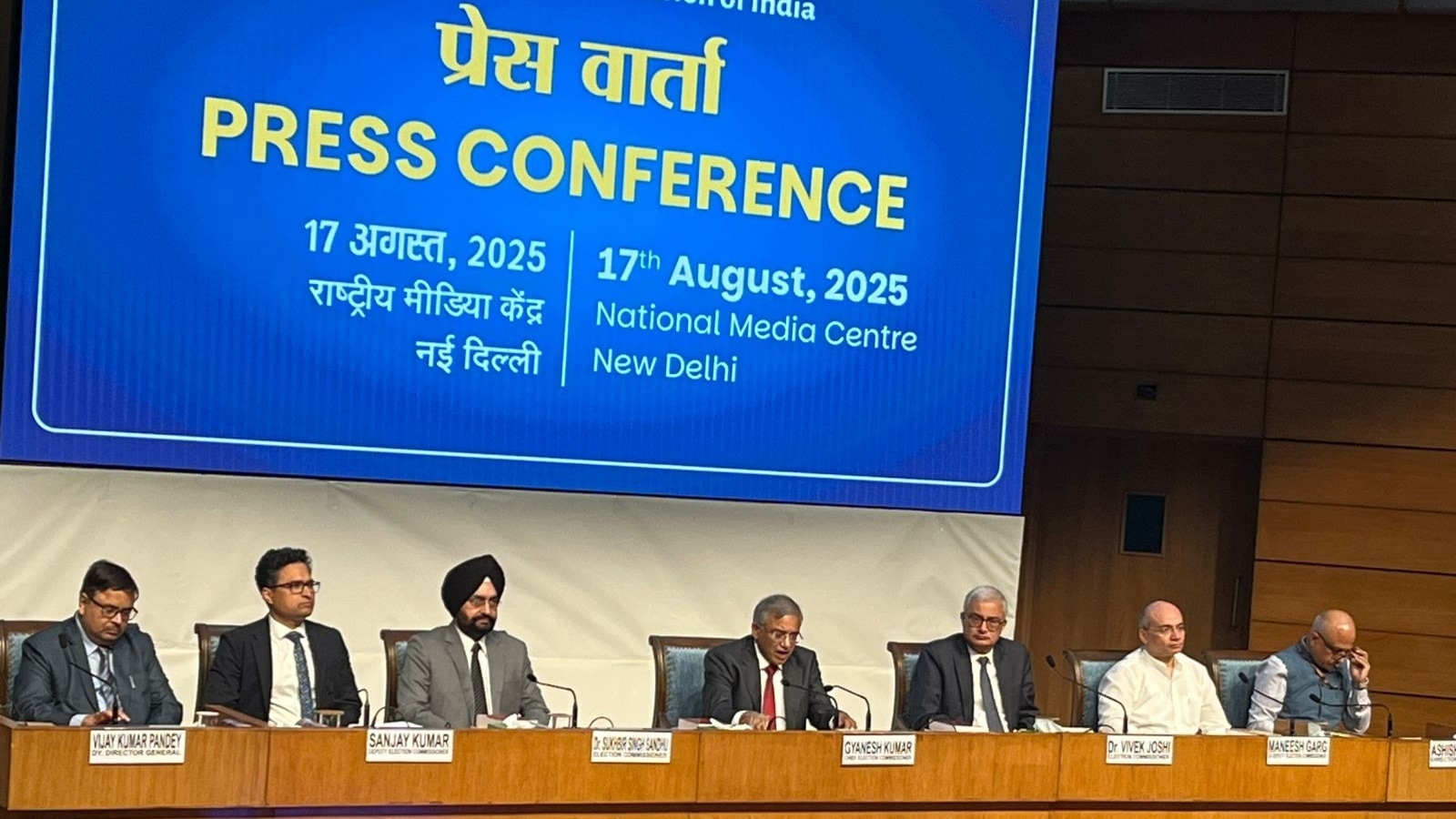
S Y Quraishi writes: For EC, a return to transparency is not just desirable — it is necessary
Free and fair elections are the lifeblood of a democracy, and the electoral roll is its very foundation. Without an accurate, inclusive and credible roll, the process risks being undermined at its very start. In a country as large and diverse as India, where the electorate exceeds 960 million, the preparation and continuous updating of electoral rolls is an extraordinary logistical and democratic exercise. It is through these rolls that the principle of 'one person, one vote' is given practical shape. The Election Commission of India (ECI), constitutionally mandated to conduct free and fair elections, has over the decades placed emphasis on the integrity of the electoral roll. The Supreme Court has repeatedly underscored this, holding that free and fair elections form part of the basic structure of the Constitution, and that accurate voter lists are integral to that process. Transparency has long been the ECI's guiding principle. From making draft rolls publicly available for claims and objections, to deploying technology for online search, to inviting political parties and civil society to participate in verification drives, the ECI has tried to keep the process open to scrutiny. For decades, this openness was a source of immense public trust. Surveys by the Centre for the Study of Developing Societies (CSDS) through the 1990s and 2000s consistently found trust levels in the ECI to be among the highest for any public institution, often exceeding 75-80 per cent. This trust was earned through visible impartiality, procedural fairness, and innovations that enhanced both access and credibility. One of the most remarkable exercises in electoral roll management was undertaken under the leadership of CEC N Gopalaswami in the 2007 Uttar Pradesh assembly elections. The ECI, then concerned about inflated rolls and the potential for bogus voting, introduced an innovative method to deal with the problem of 'SAD' voters — an acronym for Shifted, Absent, or Dead voters. Instead of deleting these names, which could have led to controversy or large-scale disenfranchisement, the ECI prepared a separate list of such voters for each polling station, based on door-to-door verification. These lists were handed over to the presiding officers, who were tasked to do a thorough check when such voters came and record how many of them actually turned up to vote. The result was telling: In most constituencies, only 2-3 per cent of these SAD voters appeared at the polling station. (This practice was followed up in other states, too, but the result was not the same. In Gujarat, about 24 per cent of the voters from the SAD list turned up.) With the list in the hands of the presiding officers, impersonation became impossible. The exercise virtually eliminated bogus voting and was hailed as a 'thundering success' — a practical demonstration of how field innovation, without disenfranchising anyone, could protect the purity of the poll. From 2011 onwards, the ECI began marking National Voters' Day on January 25. The idea was twofold: To celebrate the democratic spirit and to focus public attention on voter enrolment and participation, especially of the young. Each year, a new theme has reinforced the centrality of the voter: Greater Participation for a Stronger Democracy (2011 and 2012). Inclusive and Qualitative Participation (2013). Ethical Voting (2014). Easy Registration, Easy Correction (2015). Inclusive and Qualitative Participation (2016). Empowering Young and Future Voters (2017). Accessible Elections (2018). No Voter to be Left Behind (2019). Electoral Literacy and Making Our Voters Empowered, Vigilant, Safe and Informed (2020 and 2021). Making Elections Inclusive, Accessible and Participative (2022). Nothing Like Voting, I Vote for Sure (2023). Nothing Like Voting, I Vote for Sure — Every Voter Matters (2024, 2025). Running through these years is a clear institutional message: Every single voter counts, and no eligible citizen should be excluded for want of opportunity or access. The current Special Intensive Revision (SIR) in Bihar is ostensibly part of this tradition. Through the SIR, the ECI aims to capture new voters, correct errors, and remove ineligible names through a de novo process. Around 2003-4, the ECI had taken a decision to stop making voter rolls de novo as by then most state rolls had been digitised and electronic voter cards distributed. This practice was followed by successive Commissions. Even the present Commission conducted the 2024 general elections with a summary revision, which meant that the existent rolls were cross-checked by door-to-door visits and additions and deletions made. What was valid till 2024 has suddenly become wrong. Were the Commissions in the last two decades less wise? The trust the ECI once commanded almost unquestioningly is now under greater public scrutiny. Allegations of executive overreach, perceived inaction in the face of violations, and reduced transparency have prompted debates about whether the institution is as fiercely independent as before. While the procedural architecture for transparency — such as draft roll publication, booth-level officer verification, and stakeholder consultation — remains in place, the perception of impartiality is as important as its reality. Reinforcing this trust is as crucial as ensuring technical accuracy. In the current SIR, the Commission has released a granular breakdown of deletions: About 65 lakh names removed, including 22 lakh deceased voters, 36 lakh permanently shifted or untraceable individuals, and 7 lakh duplicates. This precision in identifying and removing inaccuracies is laudable. However, the number of new voters added after this clean-up has not been made public — leaving an incomplete picture of the revision's net effect. That is a serious omission, as the addition of bogus voters is a perennial complaint. The SC issued a landmark interim order on August 14, directing the ECI to publicly disclose the names and reasons for exclusion of approximately 65 lakh voters removed from Bihar's draft rolls. The names must be published within 48 hours, through multiple platforms — including district electoral websites, public notice boards, and newspapers, radio, and television. This directive aims to enhance transparency, prevent voter disenfranchisement and ensure accountability in electoral roll revisions — critical to preserving public trust ahead of the Bihar elections. The Court clarified it was not curtailing the ECI's authority to conduct revisions but underscored that such authority must be exercised transparently. It emphasised that citizens should not depend on intermediaries or political agents to know whether their names were removed. Public access is fundamental to democratic accountability. For an organisation that has built its reputation as one of the most respected election management bodies in the world, returning to its fullest, most uncompromising version of transparency is not just desirable — it is necessary for the preservation of democratic trust. If the ECI truly believes 'every vote matters', it must prove it by showing every voter it has added — not just every name it has removed, and every duplicate voter it has detected. The writer is former Chief Election Commissioner of India and author of An Undocumented Wonder — The Making of the Great Indian Election
