


Why Japanese Moon mission's failure during landing marks yet another setback for private operators
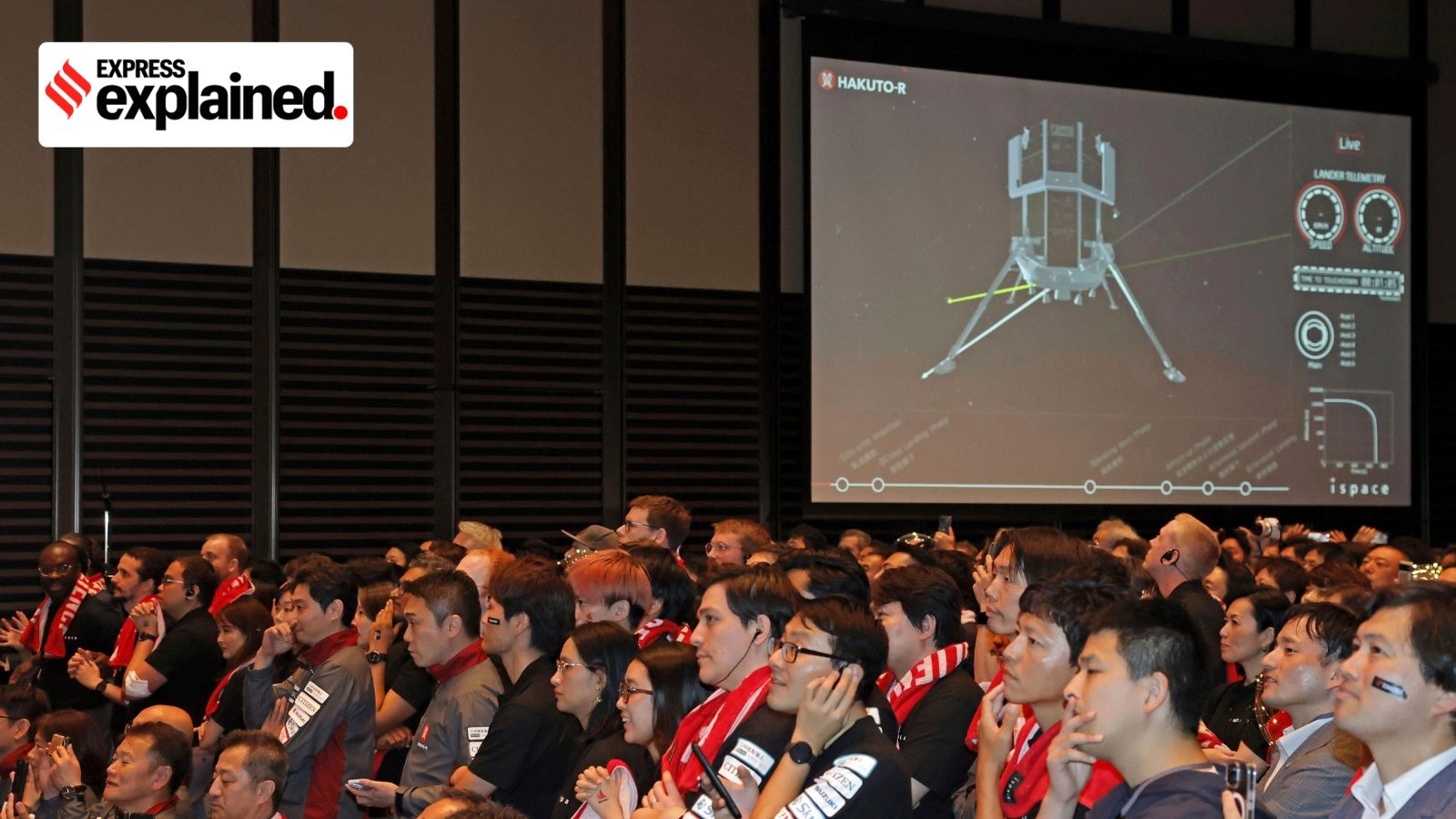
The Hakuto-R mission, carried out by the private Japanese company ispace, had a lander called Resilience and a rover called Micro. Just ahead of touchdown this morning, communications with the spacecraft were lost.
'The lander descended from an altitude of approximately 100 km to approximately 20 km, and then successfully fired its main engine as planned to begin deceleration. While the lander's altitude was confirmed to be nearly vertical, telemetry was lost thereafter, and no data indicating a successful landing was received, even after the scheduled landing time had passed,' ispace said in a statement.
'Based on the currently available data, the Mission Control Centre has been able to confirm the following: the laser rangefinder used to measure the distance to the lunar surface experienced delays in obtaining valid measurement values. As a result, the lander was unable to decelerate sufficiently to reach the required speed for the planned lunar landing. Based on these circumstances, it is currently assumed that the lander likely performed a hard landing on the lunar surface,' it said.
Chandrayaan-2, which was launched in 2019, had met with a similar fate, having been unable to slow down in the final stages due to a malfunction in the thrusters.
This is the second failure for the Hakuto-R mission to land on the Moon. Its previous attempt in 2023 had also been unsuccessful.
The latest failure accentuates the continuing struggle of private space companies to achieve a clean and safe landing on the Moon. In the last two years alone, five missions from private companies — the other four from the United States — have tried to land on the Moon, and only one has been able to do it cleanly.
US-based Firefly Aerospace has been the only one to make a successful soft-landing so far, with its Blue Ghost mission touching down on March 2. Intuitive-Machines, a Houston based company, got its spacecraft to land twice on the Moon, once last year and then again in March this year, but both times the landing was not entirely perfect. Another US company Astrobotic Technologies had attempted to land its Peregrine mission but it faced technical difficulties during the flight, and the mission could not make its way to the Moon.
Earlier, Israel's Beresheet mission, by a company called SpaceIL, had attempted a moon landing in 2019, but ended up crashing in a similar fashion to the latest incident.
The last part of the landing operation, wherein the speeding spacecraft slows down to make a soft-landing, is the most complex part of the Moon missions. This is where most of the accidents have happened. The Luna-25 mission in 2023, which was marking the return of Russia to the Moon, also ended in a failure during the final moments of landing.
In the last five years, a moon landing has been attempted 12 times, by national as well as private space agencies, and only five of these have been able to land in a manner that fulfils the science objectives of the mission. These include Chandrayaan-3 by India, the SLIM mission by Japan, and Chang'e 5 and 6 missions from China.
An increasing number of private space players have been getting ready with their Moon missions, amidst a renewed urgency to explore the Moon with the objective of establishing facilities for long-term stay and research. US space agency NASA, in particular, has been encouraging the private space companies to build capacities and participate in these missions. It has launched a programme called Commercial Lunar Payload Service (CLPS) that is aimed at helping private companies to regularly undertake these complex missions. The missions sent by Astrobotic Technologies, Intuitive Machines and Firefly Aerospace were all part of this CLPS programme. Over a dozen space companies have been contracted by NASA for carrying out these kinds of sorties to the Moon.
Hashtags

Try Our AI Features
Explore what Daily8 AI can do for you:
Comments
No comments yet...
Related Articles


Time of India
 24 minutes ago
- Time of India
Columbia scientists develop world's first prototype ‘Universal Antiviral'
Scientists at Columbia University are developing a universal antiviral. This treatment aims to protect against many viruses, including influenza and COVID-19. The therapy is inspired by a rare genetic mutation. It uses mRNA technology to produce antiviral proteins. Tests on mice and hamsters show reduced viral replication. This offers short-term protection during outbreaks. Tired of too many ads? Remove Ads Rare disorder reveals hidden defense Tired of too many ads? Remove Ads Turning biology into therapy A temporary but powerful shield Challenges ahead A team of Columbia University scientists says it may be closer than ever to creating a universal antiviral , a treatment designed to temporarily shield people against a wide range of viruses, from influenza to experimental therapy, detailed August 13 in Science Translational Medicine , is inspired by a rare genetic mutation that gives a small number of people an extraordinary ability: resistance to nearly all viral infections About 15 years ago, Columbia immunologist Dr. Dusan Bogunovic began studying patients with a rare immune condition known as ISG15 deficiency . Though these individuals were more prone to certain bacterial infections, they seemed to shrug off viral illnesses without ever developing study revealed that the mutation caused a constant, low-level state of immune activation, a kind of background inflammation that was highly effective at blocking viruses. 'The type of inflammation they had was antiviral,' Bogunovic recalled in a Columbia University of reproducing the harmful aspects of ISG15 deficiency, Bogunovic's team identified 10 specific proteins responsible for most of the antiviral protection. They then engineered an mRNA-based therapy, similar in design to COVID-19 vaccines, that prompts cells to briefly produce those through the nose into the lungs of mice and hamsters, the treatment significantly reduced replication of both influenza and SARS-CoV-2, the virus that causes COVID-19. In cell culture tests, the therapy appeared to resist a wide variety of a vaccine, which builds lasting immunity to a specific pathogen, this treatment provides only short-term protection, estimated at three to four days in animals. Researchers say that could make it particularly valuable at the beginning of outbreaks, giving first responders, health workers, and high-risk populations an immediate layer of defense while vaccines are still in therapy also does not interfere with long-term immunity, meaning patients could still develop protective memory after infection or concept remains in early stages. Researchers say improving the delivery system, ensuring enough of the proteins are produced in the right tissues, is the biggest hurdle before moving into human trials. More work is also needed to determine how long protection lasts and how safe repeated dosing might experts say the findings are promising. By activating the body's own antiviral machinery, the therapy could offer a virus-agnostic defense that works even when the identity of a new pathogen is unknown.


India.com
4 hours ago
- India.com
Good Bye B-2, Hello B-21: World's First Sixth-Gen Super Bomber Ready – Who's In Its Crosshairs?
Washington: After the success of Operation Midnight Hammer against Iran, the United States Air Force is preparing to induct the B-21 Raider, the world's first sixth-generation stealth bomber. Long regarded as the crown jewel of America's bomber fleet, the B-2 Spirit is now moving toward retirement. Major General Jason Armagost, head of the Eighth Air Force, spoke about the transition during a webinar hosted by the Mitchell Institute for Aerospace Studies. His command oversees the current fleet of B-2, B-1 and B-52 bombers. He said the B-21 will give the Air Force a campaign-ready strike force capable of deploying multiple classes of weapons and carrying out missions across continents at the same time. Northrop Grumman, the developer of the Raider, describes the aircraft as the world's first true sixth-generation bomber. The Air Force plans to acquire a good number of units, signalling the scale of the programme. A New Era in American Strike Capability The B-52 and B-1 bombers entered service in the 1990s. The B-2 Spirit soon took the lead as the most advanced stealth platform in the world. The fleet remained small; only 21 aircraft were ever built. One was lost in a crash, while another has been grounded. Maintenance costs also remain extremely high. These limits drove U.S. planners to fast-track the B-21 Raider. The B-21 is still in testing phase. Its design resembles the B-2's flying wing, though it carries major upgrades. The air inlets are recessed to evade radar detection. The 2-D exhaust system suppresses heat emissions and makes infrared tracking difficult. The aircraft is equipped with advanced radar, electronic warfare systems and intelligence, surveillance, reconnaissance (ISR) technology. It also features a long strike range, allowing operations across vast areas without mid-air refueling. The Raider's open-system architecture will allow easy integration of new weapons and future technologies, giving it an edge in adaptability. U.S. Strategy for the B-21 Reports suggest that the Air Force aims to add at least 100 B-21 bombers to its fleet. Analysts warn this may fall short. When the B-2 was conceived, the target was 132 units, though only 21 were completed. The limited production pushed costs above $2 billion per aircraft. A similar shortfall in B-21 procurement could again raise the price per plane to extreme levels. Senior U.S. commanders have advised a much larger fleet, with some recommending more than 200 units. Their reasoning is to ensure the United States can project airpower simultaneously across Asia, Africa and the Middle East. The calls for expansion have grown louder with the possibility of confrontation with China in mind.


The Hindu
4 hours ago
- The Hindu
ISRO accelerating country's space ambitions, says its chief
From a modest 35-kg payload with its first indigenous launch vehicle SLV-3, in 1980, India is now aiming for a giant leap — the Indian Space Research Organisation (ISRO) is conceiving an advanced heavy-lift rocket capable of carrying nearly 75,000 kg payload into space. 'This rocket will be the height of a 40-storey building. We are also in the advanced development stages of Gaganyaan and its first unmanned mission is planned very shortly,' ISRO chairman and Secretary, Department of Space, V. Narayanan said on Tuesday. Delivering the 84th convocation address at the Osmania University here, was visibly happy explaining the country's space journey, the organisation's accomplishments and future plans. 'Chandrayaan-4 programme is already approved. The Bharathiya Anthariksh Station shall be a reality by 2035 for which the initial modules will start as early as 2027. An Indian must land on the moon and return safely by a fully indigenous moon mission by 2040. A Venus Orbiter Mission has also been approved and we shall be sending a spacecraft to study planet Venus. A heavy lift Next Generation Launch Vehicle with recoverable first stage has also been approved,' he informed, and added that the government of India's Space Sector Reform will bring about a vibrant space ecosystem in the country. Mr. Narayanan, breaking down the new India slogan 'Jai Jawan, Jai Kisan, Jai Vigyan, Jai Anusandhan' urged graduates to seize the diverse opportunities before them and channel their efforts towards making India a developed nation by 2047. Quoting former President A.P.J. Abdul Kalam's Wings of Fire, he stressed the importance of building inner strength of character and reminded students that learning is a continuous process. He expressed hope that Osmania University would one day produce research and academic contributions worthy of global recognition, including the Nobel Prize. Mr. Narayanan was conferred with honorary Doctor of Science at the convocation. A record 1,261 Ph.D degrees were awarded, and 121 gold medals were presented to top-performing students for academic years 2022-2023 and 2023-2024. In a first, a gold medal was introduced for 'best PhD thesis in English by a tribal student' and Professor Samudrala Satyanarayana Murthy memorial gold medal was instituted for MBA Finance. Chancellor and Governor Jishnu Dev Varma, Vice-Chancellor Kumar Molugaram, registrar G. Naresh Reddy, deans and heads of departments were among those present.
