


Defying all odds with nuclear power
THE country is hoping going nuclear can help it meet soaring energy demand while taming emissions, but faces serious challenges to its goal of a first small modular reactor by 2032.
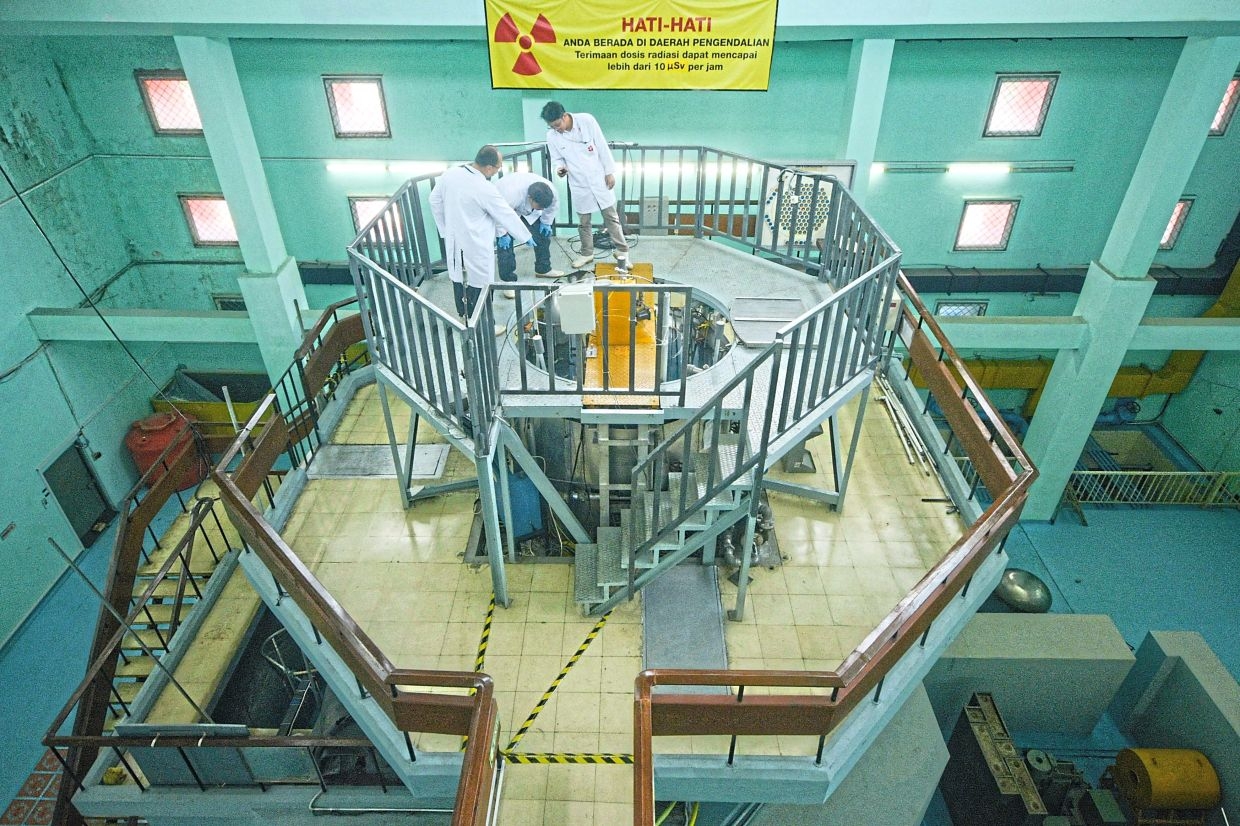
Its first experiment with nuclear energy dates to February 1965, when then-president Sukarno inaugurated a test reactor.
Sixty years later, South-East Asia's largest economy has three research reactors but no nuclear power plants for electricity.
Abundant reserves of polluting coal have so far met the enormous archipelago's energy needs.
But 'nuclear will be necessary to constrain the rise of and eventually reduce emissions,' said Philip Andrews-Speed, a senior research fellow at the Oxford Institute for Energy Studies.
President Prabowo Subianto has promised to ensure energy security while meeting a pledge to eliminate coal-powered electricity generation within 15 years.
Coal accounts for around two-thirds of electricity generation in Indonesia, which targets net-zero by 2050.
The government wants 40-54GW of the 400GW it projects will be generated nationwide by 2060 to come from nuclear.
It hopes to kickstart capacity with a reactor on the country's part of Borneo 'by 2030 or 2032', according to Energy Minister Bahlil Lahadalia.
It will be a small modular reactor, which has a lower capacity than traditional reactors but is easier to assemble and transport.
The total number of plants planned has not been detailed, but the government has begun scouting locations – a challenge for a country located on the seismically active 'Ring of Fire'.
'Currently, 29 potential locations have been identified for the construction of nuclear power plants,' Dadan Kusdiana, acting secretary-general of the National Energy Council (DEN), said.
All are outside the country's biggest island of Java, in line with government goals to develop the archipelago's centre and east. The sites would also put facilities near energy-hungry mining sites.
While Japan's quake and tsunami-triggered Fukushima disaster has stalled nuclear progress in some parts of Asia, proponents say nuclear can be done safely in Indonesia.
'North Java, East Sumatra, West Kalimantan and Central Kalimantan are considered as low-risk zones,' said Andang Widi Harto, a nuclear engineering researcher at Yogyakarta University.
Countries from Vietnam to Belgium are also growing or retaining nuclear capacity as they struggle to meet net-zero goals to combat climate change.
While Indonesia isn't alone in the nuclear pivot, it has little domestic expertise to draw on.
It will look abroad for help, said Dadan, citing 'serious interest' from providers including Russia's Rosatom, China's CNNC and Candu Canada.
The Indonesian subsidiary of US company ThorCon is already seeking a licence for an experimental 'molten-salt reactor'.
It wants to use shipyards to build reactors that will be towed to coastal or offshore locations and 'ballasted' to the seabed.
Dadan said DEN has also visited France's EDF SA to explore possible cooperation.
French President Emmanuel Macron is due in Indonesia this week on a South-East Asia tour.
EDF said there are currently 'no discussions underway on nuclear with Indonesia,' though its CEO Bernard Fontana will be part of Macron's delegation.
A second French firm, Orano, also said it had not discussed collaboration with Indonesia.
The government has not said how much it expects the nuclear ramp-up to cost, but Dadan insists the money will be there.
'Various potential international investors ... have shown interest', including Russia, the United States, Denmark, South Korea and China, he said. — AFP
Hashtags

Try Our AI Features
Explore what Daily8 AI can do for you:
Comments
No comments yet...
Related Articles

New Straits Times
 21 minutes ago
- New Straits Times
Top military officers hold Ukraine talks after Trump rules out US troops
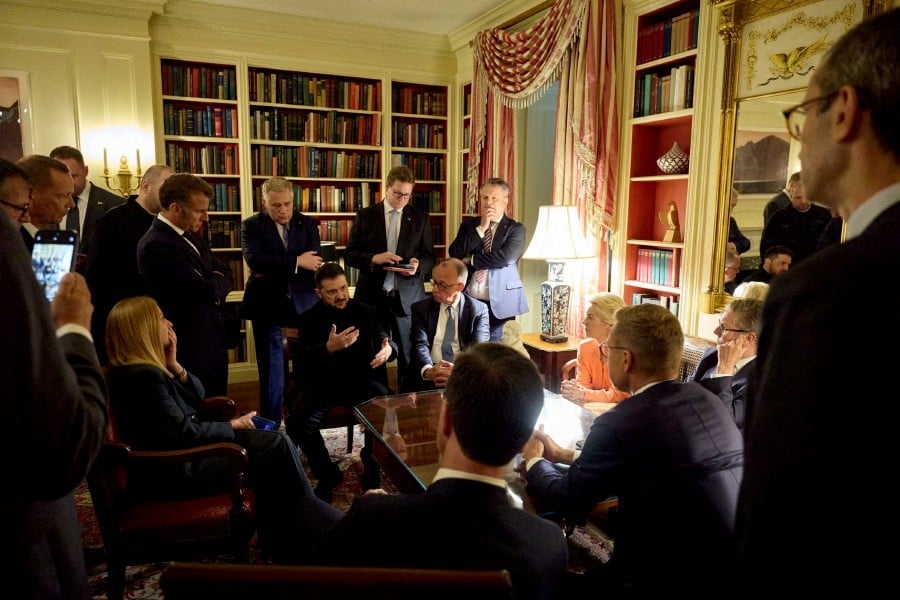
WASHINGTON: Top US and European military officers met in Washington Tuesday to discuss the mechanics of a possible Ukraine peace deal, after President Donald Trump ruled out sending American troops to back an agreement but suggested air support instead. In a flurry of diplomacy aimed at ending the war, Trump brought Ukrainian President Volodymyr Zelenskyy and European leaders to the White House on Monday, three days after his landmark encounter with Russia's Vladimir Putin in Alaska. But while Trump said Putin had agreed to meet Zelenskyy and accept some Western security guarantees for Ukraine, those promises have been met with extreme caution by Kyiv and Western capitals, and many details remain vague. Putin proposed holding the summit with Zelenskyy in Moscow, three sources familiar with a call between Trump and the Russian leader told AFP. One source said Zelenskyy immediately said no to meeting in the capital of his country's invader. Featured Videos As Western leaders push for an agreement, top US officer General Dan Caine held talks Tuesday evening with European military chiefs to discuss "best options for a potential Ukraine peace deal," a US defence official told AFP. The in-person talks precede a virtual meeting of military chiefs from Nato's 32 member countries on Wednesday, in which Caine is also scheduled to participate. Trump, long a fierce critic of the billions of dollars in US support to Ukraine since Russia invaded in 2022, earlier said that European nations were "willing to put people on the ground" to secure any settlement. "France and Germany, a couple of them, UK, they want to have boots on the ground," Trump said in a Fox News interview. "We're willing to help them with things, especially, probably, if you talk about by air." Asked what assurances Trump had that US boots would not be on the ground, he replied: "Well, you have my assurance and I'm president." The White House later doubled down on Trump's statements – but gave few new details on either the summit or the security guarantees. Press Secretary Karoline Leavitt told reporters that Trump "has definitively stated US boots will not be on the ground in Ukraine" and that the use of US air power was an "option and a possibility." Leavitt insisted that Putin had promised Trump he would meet Zelenskyy, and said top US officials were "coordinating" with Russia on a summit. Trump had dramatically interrupted his meeting with Zelenskyy and the Europeans at the White House on Monday to call the Russian leader. Allies have expressed doubts that Putin will go through with the meeting, but the Europeans are seizing on the possibility of a peace deal following the Trump talks. French President Emmanuel Macron and British Prime Minister Keir Starmer brought together around 30 of Ukraine's allies known as the "Coalition of the Willing" for virtual consultations. Starmer told them coalition teams and US officials would meet in the coming days to "prepare for the deployment of a reassurance force if the hostilities ended," a Downing Street spokesperson said. Russia has warned that any solution must also protect its own "security interests" and has ruled out Ukraine joining Nato. Foreign Minister Sergei Lavrov added that any meeting between the leaders "must be prepared very thoroughly." Lavrov's comments, and Putin's offer of Moscow as a summit venue, reinforced European fears that Russia was once again stalling. Macron said he wanted the summit to take place in Geneva, a historic venue for peace talks. Switzerland said it was ready to offer immunity to Putin, who faces an arrest warrant from the International Criminal Court over the war. Macron and German Chancellor Friedrich Merz have both said the summit could take place in two weeks. The White House declined to comment on a Politico report that it was eying Hungary's capital Budapest as a venue for a follow-up three-way summit including Trump. On the streets of Kyiv, there was skepticism about whether the latest talks can end the grinding conflict. "The main problem is Putin himself doesn't want it," said Anton, 32, who works in a warehouse. But in Moscow, some people were more optimistic. "I hope we can agree on mutually beneficial terms," said Vyacheslav, 23, who works for the government. --AFP
New Straits Times
21 minutes ago
- New Straits Times
Syrian, Israeli diplomats met in Paris to discuss 'de-escalation'
DAMASCUS: Syria's foreign minister met with an Israeli diplomatic delegation in Paris on Tuesday to discuss "de-escalation and non-interference in Syria's internal affairs", state news agency SANA reported. The latest in a series of US-mediated talks resulted in "understandings that support stability in the region", the agency said. Washington has been at work in recent weeks to try to resolve security issues in Syria and Lebanon, which its ally Israel says have prompted it to take military action. Despite a truce reached last November, Israel has continued to hit targets of the Iranian-backed Hizbollah group in Lebanon, and it has occupied territory and hit targets across Syria since last year's fall of dictator Bashar al-Assad. Tuesday's meeting in Paris follows one between Syrian Foreign Minister Assad al-Shaibani and Israeli Minister of Strategic Affairs Ron Dermer in Baku in late July, and another meeting in Paris before that. Israel and Syria have technically been at war since 1948, and the talks also discussed reviving a disengagement accord from 1974 that created a buffer zone between the two countries. "These talks are taking place under US mediation, as part of diplomatic efforts aimed at enhancing security and stability in Syria and preserving the unity and integrity of its territory," the agency said. The recent meetings between the two countries come after deadly sectarian clashes in July in southern Syria's Druze-majority Sweida province which left over 1,400 people dead. The clashes initially pitted local Druze fighters against Sunni Bedouin tribes but soon saw the involvement of Syrian government forces and Israel, with the latter saying it wanted to protect the Druze. Last month, Israel struck the Syrian presidential palace and the army headquarters in Damascus. The United States, an ally of Israel but who has expressed support for Syria's new leaders, announced a ceasefire between the two sides overnight on July 18.--AFP


The Sun
21 minutes ago
- The Sun
Florida executes man for 1982 murder by lethal injection
MIAMI: A 67-year-old man convicted of a 1982 murder was executed by lethal injection in Florida on Tuesday. Kayle Bates received the death penalty in 1983 for killing Janet Renee White. The 24-year-old victim was abducted from her Lynn Haven insurance office. White was stabbed to death in nearby woods after returning from lunch. Officials confirmed the execution occurred at 6:17 pm at Florida State Prison. The United States has conducted 29 executions in 2025, marking the highest number since 2014. Lethal injection accounted for 24 of these executions nationwide. Two executions were carried out by firing squad this year. Three inmates died through nitrogen hypoxia, a controversial new method. This technique involves pumping nitrogen gas into a face mask until suffocation occurs. United Nations experts have condemned nitrogen gas as cruel and inhumane. Florida leads all states with 10 executions performed in 2025. The death penalty remains abolished in 23 American states currently. Three additional states maintain formal moratoriums on capital punishment. California, Oregon and Pennsylvania have halted executions through gubernatorial orders. Former President Donald Trump supports expanding capital punishment. He advocated for increased use of executions 'for the vilest crimes' upon taking office. - AFP
