


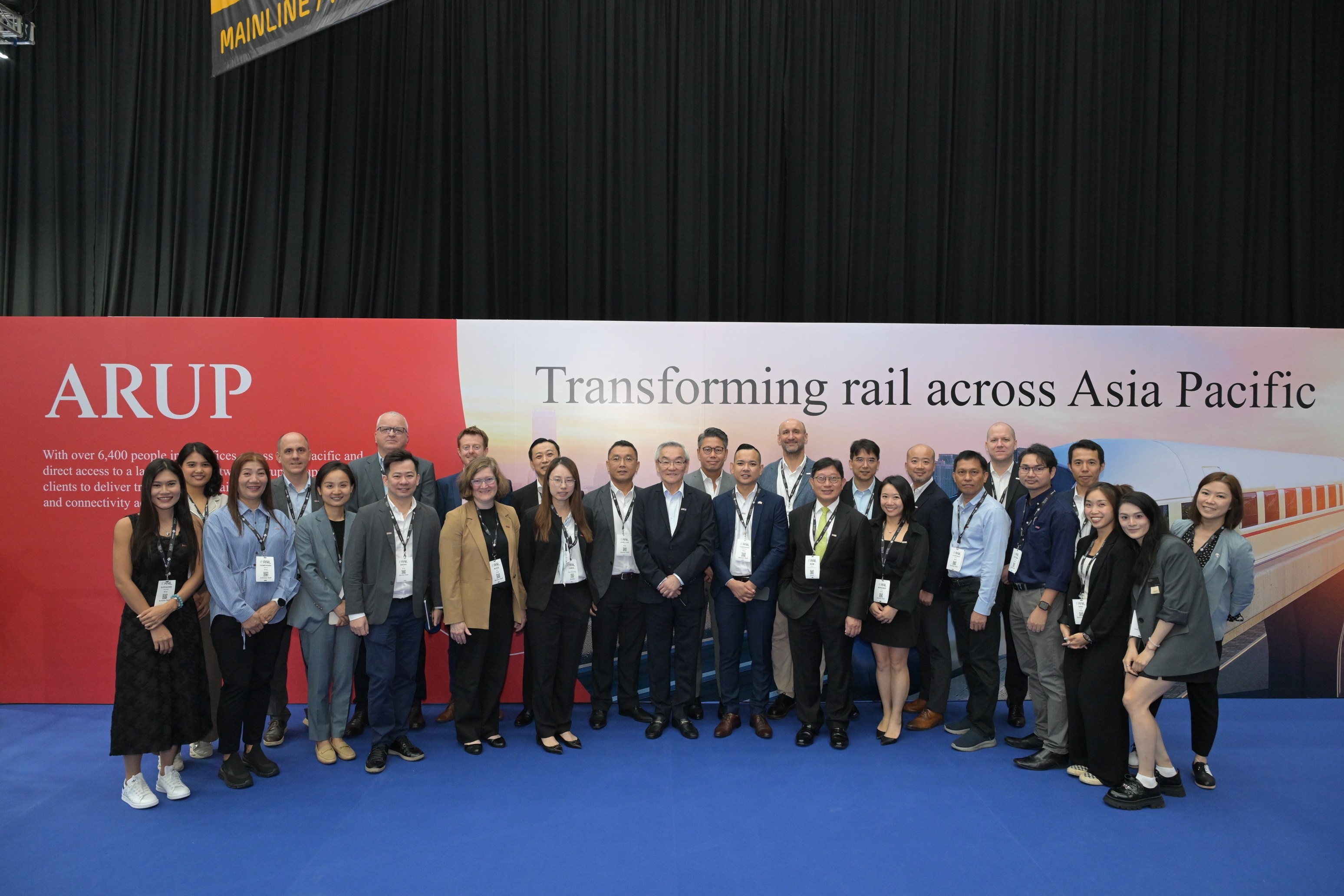
Arup experts share trends shaping the future of rail at Asia Pacific Rail
HONG KONG SAR – Media OutReach Newswire – 29 May 2025 – Rail leaders of global sustainable development consultancy Arup from across the Asia Pacific region shared their insights into the future of rail at Asia Pacific Rail 2025, ranging from the role of transit-oriented development in funding rail infrastructure, the use of the latest green and smart technology in transit systems, station transformation, and customer journey planning.
Held in Bangkok on 28-29 May 2025, the major rail event in the region was attended by 4,000 people and brought together more than 160 speakers and 200 exhibitors.
As moderator of the keynote panel, TC Chew, Managing Director of APAC at Arup, discussed with leaders of key rail organisations in the region the crucial role of Transit-Oriented Development (TOD) in making public-private partnerships (PPPs) financially viable and sustainable, the challenges in implementing TOD as well as opportunities for future regional collaboration.
ADVERTISEMENT
'Governments are under increasing pressure to look for innovative ways to fund rail projects. TOD could be part of the answer. If planned and designed carefully, TOD can help address challenges such as a growing population and demand for housing and employment, while promoting efficient transport options needed for a long-term sustainable future,' said TC.
James Musgrave, APAC Rail Business Leader at Arup, said, 'From the Kowloon Station development in Hong Kong to the Sydney Metro Martin Place integrated station development in Australia, Arup provided strategic planning, design and engineering expertise to maximise the value of investment in transit infrastructure and the positive impact on the community it serves. When we create an impactful TOD, we don't just change how a city moves, we redefine how people live.'
Three leaders from Arup also spoke at Asia Pacific 2025 on major topics in railway development:
Alberto Battois, Malaysia Rail Business Leader, on 'Integrated mobility – what next?';
Carol Lau, Associate Director, on 'New forms of smart and green mass transit systems for medium capacity network – planning and design'; and
Aden Chua, Associate, on 'Digitalising station transformation'.
In addition, Arup sponsored the British Embassy Reception, where Arup's clients and partners connected with rail leaders to exchange ideas and share insights. With over 6,400 people in 28 offices across Asia Pacific and direct access to a larger global network, Arup is committed to supporting clients to deliver transformative railways that enhance lives and connectivity across cities and nations.
Hashtag: #Rail #TransitOrientedDevelopment #Arup
https://www.arup.com/
https://www.linkedin.com/company/arup/
https://twitter.com/arup
https://www.facebook.com/ArupGroup/
Wechat: Arup奥雅纳
https://www.instagram.com/arupgroup/
The issuer is solely responsible for the content of this announcement.
Arup
Arup is a global built environment consultancy with advisory and technical expertise across more than 150 disciplines. We create safe, resilient, and regenerative places, bringing a Total Design approach to our work for our clients.
Hashtags

Try Our AI Features
Explore what Daily8 AI can do for you:
Comments
No comments yet...
Related Articles


Zawya
 14 hours ago
- Zawya
ICAO DGCA urges Asia-Pacific States to adopt ACI recommendations
Airports Council International Asia-Pacific & Middle East (ACI APAC & MID), the trade association representing over 600 airports, made strong recommendations at the 60th ICAO Conference of Directors General of Civil Aviation (DGCA) for Asia and Pacific regions in Sendai, Japan recently. The Members of the Conference endorsed the ACI APAC & MID's recommendations and encouraged States to take appropriate steps for implementation. ACI APAC & MID estimates that by 2053, airports in Asia-Pacific alone will handle 10 billion passengers annually—equivalent to today's total global traffic. To prepare for this exponential growth, governments and regulators must introduce forward-looking policies and promote affordable air travel, while Airports should improve safety standards, strengthen climate resilience, and incorporate security-by-design from the beginning to prepare for this exponential growth. Against the backdrop, ACI APAC & MID presented four papers advocating for smarter, safer, sustainable and connected airports. Key areas included careful adaptation of ICAO SARPS, climate adaptation, easing travel barriers, and integrating security into design, all aimed at making airports future-ready. Stefano Baronci, Director General of ACI Asia-Pacific & Middle East, said: 'Asia is already home to six of the world's fastest-growing markets, while countries like China, India, Indonesia, Japan, Vietnam, and Thailand are poised to enter the exclusive billion-passenger club. With over half of all new aircraft deliveries destined for this region and air traffic movements expected to hit 47 million by 2043, the challenge is not about growth but readiness. The DGCA Conference continues to provide a positive direction in the region's approach to airport development. We are pleased with the overwhelming support from states on our policy recommendations and the positive conclusions of the conference, which reflect a shared commitment of our industry.' • Transposition of ICAO Annex 14 SARPs: ACI Asia-Pacific & Middle East cautioned against a one-size-fits-all model that may hamper operations and safety considerations. The paper highlighted efforts by ACI, ICAO APAC, and several States in developing the guidance for transposing Annex 14 Vol. I SARPs into national aerodrome standards. ICAO urged States to apply the guidance and provide feedback, and the conference fully endorsed the establishment of national aerodrome standards based on ICAO Regional Guidance. • Climate Adaptation Guidance and Tools: ACI Asia-Pacific & Middle East introduced its Climate Adaptation Guidance, Risk Maturity Tool and Climate Risk Assessment Tool enabling airports to assess and mitigate risks from extreme weather events such as heatwaves, cyclones, and floods. The Conference adopted the recommendations and agreed to engage in regional collaboration to boost climate resilience. • Barriers to Air Travel for Consumers (co-sponsored by IATA): ACI APAC & MID and the International Air Transport Association (IATA) jointly urged States and Territories to remove discriminatory taxes on aviation, consider the financial viability of airport operators when determining concession fees and simplification of visa processes to make travel more affordable and accessible. • Enhancing Security with Appropriate Airport Design (co-sponsored by Singapore and the US): With support from Singapore and the USA, ACI APAC & MID reiterated its call to embed security into airport design through a "security-by-design" approach—ensuring the evolving requirements of security operations are addressed early to avoid costly retrofits and inefficiencies. The Conference fully endorsed the proposed action to integrate security considerations into the design of new and refurbished airport infrastructure. As the region enters the new phase of growth, ACI APAC & MID remain committed to supporting airports and working with governments and industry stakeholders is making aviation continue to deliver social and economic benefits. Copyright 2025 Al Hilal Publishing and Marketing Group Provided by SyndiGate Media Inc. (
Zawya
21 hours ago
- Zawya
Asia Pacific Employers Lead in Health, Wellbeing Personalisation and Governance: Aon Study
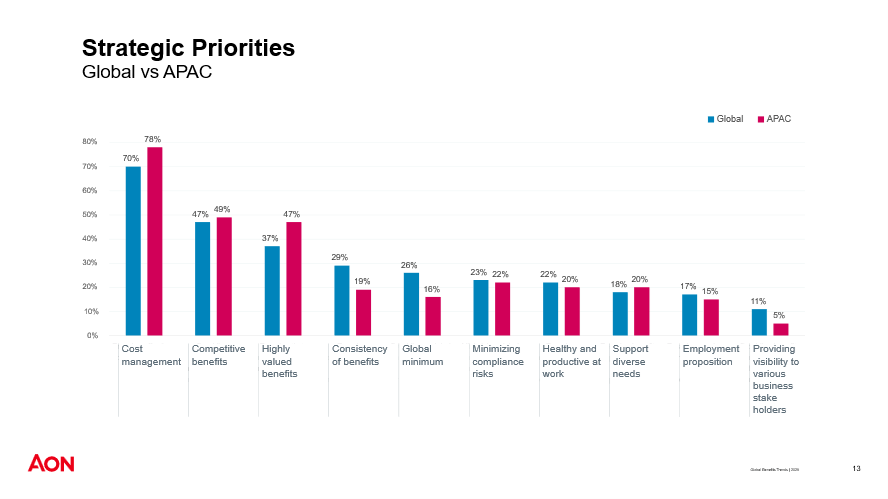
SINGAPORE - Media OutReach Newswire - 19 August 2025 - Aon plc (NYSE: AON) has released its 2025 Global Benefits Trends Study, spotlighting Asia Pacific (APAC) as a region driving innovation in employee benefits strategy. With 518 global HR professionals and 103 APAC-headquartered companies participating, the study reveals a strong regional focus on employee health, personalisation and governance—setting APAC apart from global peers. "As organisations navigate economic uncertainty and rising employee expectations, the ability to deliver personalised, equitable and cost-effective benefits is a strategic differentiator," said Tim Dwyer, head of Human Capital for APAC at Aon. "Our survey signals APAC is leading the way in aligning benefits strategy with workforce needs. Through innovative, data-driven analytic programmes, businesses are building resilient, future-ready programs for their workforce." Key Findings for APAC 1. Health and productivity a strategic priority APAC is the only region to rank "health and productivity of employees" among its top five strategic priorities. This reflects the region's reliance on service labour and the outsized impact of workforce wellbeing on global supply chains. 2. Personalisation gains ground Thirty-two percent of leading multinationals participating in the survey have global guidelines requiring local markets to introduce benefit choice. APAC firms, in particular, are more likely to offer flexibility in annual leave and career development, aligning with employee preferences. Moreover, 65 percent of employees at multinational firms are willing to sacrifice current benefits for better personalisation. 3. Technology-enabled benefits delivery Sixty percent of leading multinationals (that is multinationals who have a global benefits strategy, an effective governance framework that is formally adopted and endorsed by senior management, reviewed and updated on a periodic basis and access to comprehensive data in most countries) rely heavily on technology to deliver personalised benefits experiences. APAC companies are early adopters of artificial intelligence (AI) for benefits selection and wellbeing support, with 28 percent planning to implement AI-driven solutions. 4. Cost containment remains central Thirty-one percent of companies from the global survey are considering remarketing or changing providers, though only 37 percent are investing in wellbeing initiatives, suggesting a gap between strategic intent and execution. 5. Governance and strategy execution Leading APAC organisations are three times more likely to have formal governance committees and senior management endorsement of their global benefits strategy and are 2.5 times more likely to have global benefit guidelines outlining preferred design and financing approaches. "Health and productivity of the workforce are crucial, and the large size of the populations in this region means that small changes can have a large impact," said Alan Oates, head of global benefits for APAC at Aon. "Prioritising health and productivity of employees reflects the critical importance of workforce in the region to the supply chain for many multinational organisations. Organisations across the region must continue to adapt their employee benefits strategies to meet evolving workforce expectations and economic challenges as they strive to remain competitive. This study underscores the importance of aligning benefits strategy with workforce needs while managing manage rising costs and governance complexity — especially in a region as diverse as APAC." About the Study: The 2025 Global Benefits Trends Study surveyed HR leaders with global responsibilities across multiple regions. The findings provide a comprehensive view of how multinational companies are evolving their benefits strategies to remain competitive in a complex global environment. Download the full report: Aon 2025 Global Benefits Trends Study Hashtag: #Aon The issuer is solely responsible for the content of this announcement. About Aon Aon plc (NYSE: AON) exists to shape decisions for the better — to protect and enrich the lives of people around the world. Through actionable analytic insight, globally integrated Risk Capital and Human Capital expertise, and locally relevant solutions, our colleagues provide clients in over 120 countries with the clarity and confidence to make better risk and people decisions that protect and grow their businesses. Follow Aon on LinkedIn, X, Facebook and Instagram. Stay up to date by visiting Aon's newsroom and sign up for news alerts here. Disclaimer The information contained in this document is solely for information purposes, for general guidance only and is not intended to address the circumstances of any particular individual or entity. Although Aon endeavours to provide accurate and timely information and uses sources that it considers reliable, the firm does not warrant, represent or guarantee the accuracy, adequacy, completeness or fitness for any purpose of any content of this document and can accept no liability for any loss incurred in any way by any person who may rely on it. There can be no guarantee that the information contained in this document will remain accurate as on the date it is received or that it will continue to be accurate in the future. No individual or entity should make decisions or act based solely on the information contained herein without appropriate professional advice and targeted research. Aon


Gulf Business
5 days ago
- Gulf Business
Middle East businesses embrace AI-powered analytics to drive smarter decisions
Karl Crowther, vice president at Alteryx MEA and APAC/Image: Supplied Across the Middle East, organisations are increasingly leveraging AI-powered analytics to boost operational efficiency and accelerate decision-making. Karl Crowther, vice president at Alteryx MEA and APAC, explains that modern analytics platforms are bridging the gap between governance, flexibility, and innovation. 'Traditionally, businesses have had to choose between governance, flexibility, and innovation, but that's changing. Newer solutions now bring together low-code/no-code analytics, AI assistance, and strong governance in a single, centrally managed environment, allowing more teams to access insights securely and at scale,' Crowther says. 'In fact, Alteryx research shows that 94 per cent of analysts say their role now directly influences strategic decisions.' Future-proofing businesses with analytics and automation As markets become more data-driven and digitally connected, analytics and automation are central to future-proofing businesses. 'It's no longer just about analyzing the past; it's about scaling insights and acting on them in real time,' Crowther notes. Organisations are seeking both flexibility and AI readiness, combining intelligent automation with collaborative, enterprise-ready platforms to stay ahead of the rapid pace of AI innovation. The public sector, he adds, is approaching analytics differently. 'Governments in the region are using these tools to improve services, increase transparency, and make better decisions. For instance, Abu Dhabi plans to be the world's first fully AI-native government across all digital services by 2027. As they adopt AI, there's a strong focus on governance, security, and following regulations like GDPR.' Upskilling for a data-fluent workforce With demand for data fluency growing, organisations are taking a broader approach to upskilling, empowering entire teams rather than a handful of specialists. 'Yet challenges like data integration and quality issues continue to slow progress, especially as businesses move to the cloud. In fact, our recent survey found that nearly half of data analysts cite data quality as their biggest obstacle. Organisations should make analytics more accessible and simplify data prep with AI-powered insights,' Crowther explains. Building a strong data culture, he says, goes beyond technology. 'The most successful companies are those that treat analytics as a core part of their decision-making DNA… One key practice we see is activating the entire decision-making ecosystem, from frontline analysts to senior managers, to build momentum across all levels of the organisation. Alteryx research, nine out of 10 respondents in the Middle East, including 93 per cent in the UAE, report that AI has significantly transformed their work in the past year. These companies also recognise that culture change isn't instant. They celebrate small wins and use those early successes to spark broader adoption.' Key trends shaping enterprise data strategies Crowther highlights several trends shaping enterprise data strategies in EMEA, including the need to make data AI-ready while maintaining trust and governance. 'As organisations work to unlock value from AI, they're also confronting fragmented architectures, siloed data sources, and growing regulatory expectations like GDPR. In response, we're seeing a shift toward more centralised, auditable data workflows where governance is built in from the start, not bolted on later.' The democratisation of analytics is further changing the landscape. 'By putting AI and insights into the hands of non-technical users, organisations are no longer reliant on small, centralised teams to unlock value from their data. This shift enables faster, more informed decision-making across departments… Companies that provide flexible, scalable tools, while maintaining transparency and control over how AI is used, are better positioned to adapt quickly to market shifts, drive innovation from the ground up, and turn data into a competitive advantage,' Crowther says. Real-world impact across industries Alteryx-powered analytics are delivering measurable results across sectors in the region. Crowther points to the financial services industry as an example: 'One standout example is Bank al Etihad in Jordan, which has seen a measurable impact from Alteryx-powered analytics. With a network of over 50 branches, the bank needed to streamline its manual data preparation and reporting processes, which previously took an average of two days per report using spreadsheets. By adopting Alteryx, the bank was able to automate these workflows, significantly improving reporting speed, accuracy, and responsiveness to ad hoc requests.' Navigating ethical and regulatory considerations As AI and automation become more embedded in business processes, ethical and regulatory considerations are critical. 'Companies need to ensure that every data process is transparent, auditable, and aligned with both internal policies and external regulations like GDPR. This includes safeguarding personally identifiable information, removing proprietary IP, and involving legal and compliance teams early in the development and deployment of AI-driven solutions. Building trust with customers, regulators, and employees will be essential to unlocking long-term value from AI in a responsible and sustainable way,' Crowther advises. Opportunities ahead Looking forward, the Middle East and Africa present significant growth opportunities for analytics adoption. Crowther emphasises, 'The biggest opportunities lie in making analytics more accessible, automating routine processes, and ensuring data is AI-ready and well-governed. What excites me most is how quickly the region is moving from early adoption to real impact, with analytics becoming a core part of how organisations operate and grow.' With AI projected to contribute $100bn to the UAE's GDP and $135.2bn to Saudi Arabia's by 2030, businesses that embrace analytics, automation, and a data-driven culture are poised to transform operations, enhance decision-making, and gain a competitive edge.
