



Surjewala visits state to collect money: Ravi
alleged that Randeep Singh Surjewala, Congress general secretary in-charge of Karnataka, visited the state not to listen to people's problems but to collect money.
Tired of too many ads? go ad free now
"Giving money is a Congress tradition. During the Mughal rule, there was a system of giving money. If the Congress high command is not paid, those in power lose their positions. To stay in power, money must be given, and he toured the state for that purpose. The people will teach Congress leaders a proper lesson," Ravi said on Monday.
Regarding Eshwarappa joining BJP, Ravi said he would not comment on someone who was expelled from BJP.
Ravi also said there needs to be research on the increasing heart attacks in the state. "Whether it is due to lifestyle, food habits or mental stress, scientific research is necessary. When a mother or infant dies, the health minister is not bothered. Politics should be set aside, and a team of experts should be formed to conduct research and provide a report," Ravi said.
On the BJP state president's post, the MLC said the position is not vacant in the state.
Ravi also stated that he is not aspiring for any position.
Eshwarappa challenges Siddaramaiah on Constitution
Former deputy chief minister KS Eshwarappa on Monday challenged CM Siddaramaiah over Constitution. "We should not deviate from the original preamble of the Constitution. Incorporating the terms secular and socialist was inappropriate," he said. Eshwarappa directed three queries to Siddaramaiah: "Who added the words 'secular' and 'socialist' to the Constitution, and when? Did Indira Gandhi add these words during the Emergency?"
Eshwarappa said the RSS does not control BJP's decisions.
Tired of too many ads? go ad free now
The expelled BJP leader said people from various castes asking him to join the saffron party. "I need to speak with many BJP leaders, and then I'll consider joining the party. I won't join any other party apart from the BJP. Other parties are making offers, saying 'bring your son, what do you need, what should we give your son,'" he claimed.

Try Our AI Features
Explore what Daily8 AI can do for you:
Comments
No comments yet...
Related Articles

India.com
 8 minutes ago
- India.com
Centre to introduce bills that can sack the PM, CMs and top ministers held in custody for 30 days
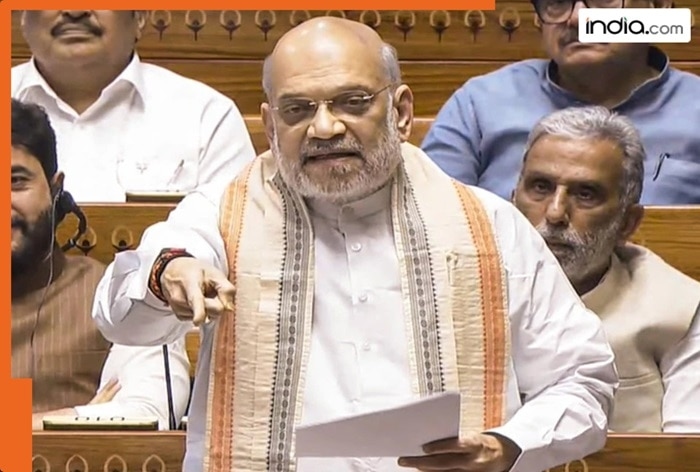
Centre to introduce bills that can sack the PM, CMs and top ministers held in custody for 30 days Union home minister Amit Shah will bring three important bills in the Lok Sabha on Wednesday. These bills say that if any minister, chief minister, or even the prime minister is arrested or kept in custody for 30 days in a row for a crime that can lead to at least five years in jail, they will have to leave their post. The government's schedule for the Lok Sabha shows that the three bills are – The Constitution (130th Amendment) Bill, The Jammu & Kashmir Reorganization (Amendment) Bill, and The Government of Union Territories (Amendment) Bill. The schedule also mentions that after the bills are introduced, there will be a proposal to send them to a joint parliamentary committee for review. Together, these bills aim to create a new system that will apply to ministers and chief ministers in states and Union territories like Jammu & Kashmir, as well as Union ministers and even the prime minister at the Centre. However, the bills also make it clear that once the arrested leader is released, they can be appointed to their position again. The new bills, which also include a constitutional amendment, say that if the Prime Minister, a Chief Minister, or any minister in a state or Union Territory (including Delhi) is arrested and kept in custody for 30 days in a row on charges that carry at least five years of jail, they will have to step down on the 31st day. If they don't resign, they will automatically lose their post. For Union Territories like Jammu and Kashmir, the bill states that if a minister or the Chief Minister is detained for 30 days, the Lieutenant Governor must remove them if the Chief Minister advises so. But if no advice is given by the 31st day, then from the next day the minister or Chief Minister will automatically lose their position. The same rule is proposed for the Union government and the states. If the Prime Minister or any minister is in custody for 31 days straight, they will automatically be removed from office. The explanation attached to the bill says this step is necessary to protect constitutional values and keep people's trust in their leaders. It points out that while leaders represent the hopes and faith of citizens, the Constitution does not currently have any rule to remove a Prime Minister or minister if they are arrested on serious criminal charges. The note adds that ministers are expected to have integrity and set an example. If a minister is facing grave criminal allegations and remains in custody, it can harm constitutional values, weaken good governance, and break the trust that people have placed in them.


Hindustan Times
8 minutes ago
- Hindustan Times
Nebraska on the verge of bankruptcy because of tariffs, labor shortages? Truth behind viral claim
A rumor circulating online has claimed that as of August 2025, Nebraska is on the verge of bankruptcy because of tariffs and labor shortages after immigration raids were carried out. This claim, however, does not appear to be true, has revealed. Nebraska on the verge of bankruptcy because of tariffs, labor shortages? Truth behind viral claim (Pixabay - representational image) The state constitution says that Nebraska must balance its budget every year; it cannot have a debt and cannot go bankrupt. Farmers in Nebraska, however, have been experiencing uncertainty due to new economic measures. This did put a strain on its grain sales to China. What does the rumor claim? A rumor that circulated this month claimed that Nebraska was $500 million short of its budget because of the economic damage tariffs and labor shortages inflicted on its farms. Immigration raids caused the labor shortages, per the rumor. A video (archived) on Instagram claimed that the state witnessed $2 billion worth of contracts for exporting soybeans to China canceled after the tariffs were imposed. The video was shared on Facebook too. The video was shared by TikTok user @joeclark207, who identified himself as an elected official from Georgia. confirmed that Joe Clark had actually been a council member for Fayetteville since 2020. Is Nebraska seeking help to avoid bankruptcy? The outlet said that no evidence was found about the state seeking help to avoid bankruptcy. Nebraska, in fact, is constitutionally mandated to balance its budget to ensure no debt is incurred. Article IV-7 of the Nebraska State Constitution reads, 'No appropriations shall be made in excess of the recommendation contained in such budget including any amendment the Governor may make thereto unless by three-fifths vote of the Legislature, and such excess so approved shall be subject to veto by the Governor.' Article XIII-1 of the Constitution says, 'The state may, to meet casual deficits, or failures in the revenue, contract debts never to exceed in the aggregate one hundred thousand dollars, and no greater indebtedness shall be incurred except for the purpose of repelling invasion, suppressing insurrection, or defending the state in war, and provision shall be made for the payment of the interest annually, as it shall accrue, by a tax levied for the purpose, or from other sources of revenue, which law providing for the payment of such interest by such tax shall be irrepealable until such debt is paid.' To put it simply, the state must not spend more money than it takes in. In April 2025, the state's economic forecasting board announced a $190 million shortfall in revenue for the 2025 fiscal year, adding that it was going to collect $90 million less than projected in 2026 and $100 million less in 2027. An April 26, 2025, report by The Nebraska Examiner said that the budget deficit for 2025 would be closed with state reserves. Read More | Trump softens stance on India, China tariffs? What he said after meeting Putin The Nebraska Legislature in May 2022 went on to pass several budget bills for 2025-27, closing the projected deficit. This left a surplus of $1.1 million. Nebraska really did announce in July this year that it had ended its fiscal year with $86 million less in tax revenue than it had projected, in part due to tax cuts. Farmers in the state did face uncertainty after President Donald Trump decided to implement tariffs on China. The US Bureau of Economic Analysis reported (archived) at the end of June that Nebraska's gross domestic product had shrunk by 6.1% in the first quarter of 2025. "Agriculture, forestry, fishing, and hunting, which decreased in 39 states, was the leading contributor to the decreases in 11 states, including Nebraska, Iowa, Montana, and Kansas," the report read. At the time, KLKN reported that this happened because of higher costs and lower corn and soybean prices. According to the report, John Hansen, president of the Nebraska Farmers Union, said that this was "the worst financial time for family farmers in decades." In March this year, WOWT reported that the Nebraska Farm Bureau said the state's farmers sell $2.1 billion in grains to China every year, and were worried about a trade war between China and the United States.


Indian Express
8 minutes ago
- Indian Express
Election Commission's SIR in Bihar: A spectre of exclusion
The Special Intensive Revision (SIR) initiated by the Election Commission (EC) in June 2025 has resulted in the exclusion of 6.5 million voters from the electoral rolls in Bihar, where Assembly elections are due in November. Article 326 of the Constitution says that elections to the Lok Sabha and state assemblies 'shall be on the basis of adult suffrage, that is to say, every person who is a Citizen of India and who is not less than eighteen years of age' shall be entitled to be registered as a voter unless disqualified under the Constitution or the law on the grounds of 'non-residence, unsoundness of mind, crime or corrupt or illegal practice'. In effect, millions of citizens have overnight become non-citizens, contrary to the Constitution and the law. What an irony, considering that B R Ambedkar declared, 'Franchise is the most fundamental thing in a democracy,' and the exclusion of any person entitled to be on the electoral rolls 'merely as a result of the prejudice of a local government, or the whim of an officer… would cut at the very root of democratic government'. According to Ambedkar, the Central Election Commission would ensure the preparation and revision of electoral rolls in ways 'so that no injustice may be done to any citizen in India'. While debating the new Article 324 (old 289), Ambedkar said, 'the House affirmed without any kind of dissent that in the interests of purity and freedom of elections to the legislative bodies, it was of the utmost importance that they should be freed from any kind of interference from the executive'. Over the last decade, there has been continuous interference by the Modi government in the functioning of constitutional bodies, directly or indirectly raising serious questions about their independence. Even in June 1949, in the Constituent Assembly (CA) debate, Ambedkar said, 'It has been brought to the notice both of the Drafting Committee as well as the Central Government that in… provinces, the executive… is instructing or managing things in such a manner that those people who do not belong to them either racially, culturally or linguistically, are being excluded from… the electoral rolls.' In 2025, such an exclusion is a reality, confirming Ambedkar's fears. Shibban Lal Saxena had serious doubts about the independence of the EC and argued that persons appointed to it must enjoy the confidence of 'all parties'. K M Munshi warned, 'Corrupt practices do not necessarily apply to the candidates. There may be corrupt practices by the government of the day.' Alladi Krishnaswamy Ayyar noted on November 8, 1948 that the boldest step taken by the CA was in the matter of 'universal adult suffrage with a belief in the common man and in his power to shape the future of the country'. The role of the Opposition was also discussed extensively in the CA. Z H Lari said, '…it is not in our interest but in the interests of Democracy that there should be proper opposition which is constructive and charged with a duty to the country.' Naziruddin Ahmad even said, 'Sir, opposition in a democratic house is a great necessity… if we cannot ensure any opposition, we should rather call the Constitution that of an 'undemocratic, sovereign republic'.' He feared that, 'As soon as some criticism is made, some members of the majority party get impatient. As soon as arguments are advanced, the so-called prestige of the government is supposed to be at stake, and therefore those arguments are opposed, resented, and sometimes treated with indifference and contempt.' Do we not see this behaviour by the ruling party today, inside and outside Parliament? Ambedkar said on December 17, 1948, 'that in our view democracy does not mean a police state, where a secret police can arrest or liquidate people without trial. It does not mean a totalitarian state where one party can seize power and keep opposition parties suppressed and not give them freedom to function freely and with equal facilities. It can not mean a society or state where an individual is made a robot or where they are reduced to a small screw in the big machine of the state'. The current functioning of central investigating agencies, the repeated and unchecked 'encounters' of citizens, and the gross and open abuse of state machinery and state media are all directed to promote the objectives of the party in power. This scenario tells us just how right Ambedkar was. Even Syama Prasad Mookerjee supported and echoed Ambedkar on that day: 'We shall go ahead with our work in spite of all difficulties and obstacles and help to create that great India united and strong, which will be the motherland of not this community or that, not this class or that, but of every person… inhibiting this great land irrespective of race, caste, creed or community where everyone will have an equal opportunity, an equal freedom, an equal status.' The Supreme Court has even held that the Election Commission is not 'imperium in imperio' under the Constitution. The philosophy, ideology, spirit and morality behind the Constitution of India can only be understood from these debates. The nation, its people, the executive, the ruling and Opposition parties, the EC and the constitutional courts must all strive to defend these ideals fiercely. A failure to do so will reduce this great nation to a dictatorship. The writer is former president of the Supreme Court Bar Association
