


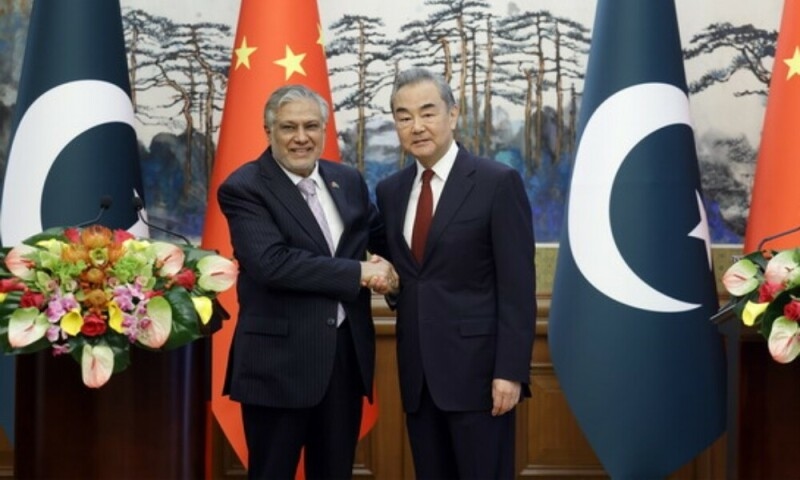
Chinese foreign minister to co-chair strategic dialogue in Islamabad on Thursday
He is visiting Pakistan at the invitation of Deputy Prime Minister and Foreign Minister Senator Mohammad Ishaq Dar, the Foreign Office said on Tuesday.
The visit is part of the regular high-level exchanges between Pakistan and China to further deepen their 'All-Weather Strategic Cooperative Partnership', and reaffirm support on the issues of respective core interests.
The FO said the visit is also part of the regular high-level exchanges to enhance economic and trade cooperation, and reaffirms Pakistan and China joint commitment to regional peace, development and stability.
Pakistan, China hold consultations on arms control, non-proliferation, disarmament
A day ago, the 10th Round of Pakistan-China Bilateral Consultations on Arms Control, Non-Proliferation, and Disarmament was held in Beijing wherein the two sides engaged in a comprehensive exchange of views on issues related to global and regional peace and security.
Additional Secretary of Arms Control, Disarmament, and International Security Division at Pakistan's Ministry of Foreign Affairs Ambassador Tahir Andrabi and Director General of Department of Arms Control at Ministry of Foreign Affairs of China Sun Xiaobo led their respective delegations at the forum in Beijing.
The two sides engaged in a comprehensive exchange of views on issues related to global and regional peace and security. They also reviewed the situation in South Asia, with particular emphasis on the challenges to security and strategic stability, the Foreign Office said in a statement.
Hashtags

Try Our AI Features
Explore what Daily8 AI can do for you:
Comments
No comments yet...
Related Articles

Express Tribune
 2 hours ago
- Express Tribune
Pak, UK agree to boost strategic ties, trade
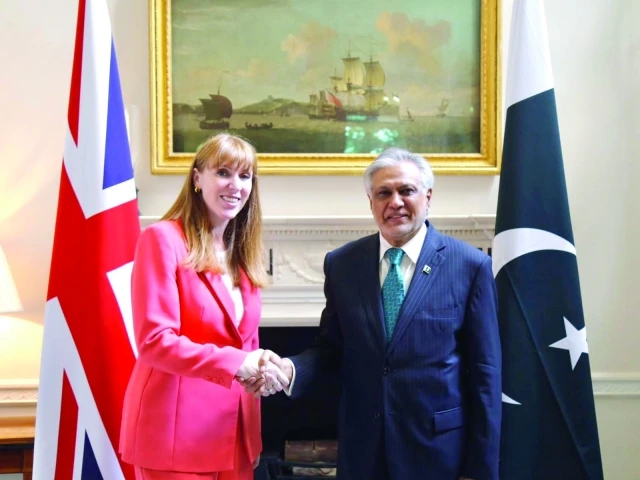
Deputy PM and Foreign Minister Ishaq Dar meets UK Deputy Prime Minister Angela Rayner in London, underscoring efforts to deepen bilateral relations. PHOTO: EXPRESS Deputy Prime Minister and Foreign Minister Ishaq Dar on Tuesday met UK Deputy Prime Minister Angela Rayner in London, in a bid to deepen bilateral cooperation across trade, investment, diplomatic engagement and people-to-people links. During the meeting, both sides reaffirmed the "growing importance" of Pakistan-UK ties, agreeing to increase high-level contacts, expand cultural and educational exchanges and further strengthen economic and development partnerships. The UK remains Pakistan's largest European trading partner and its third-biggest export destination globally. The two sides reviewed efforts to increase bilateral trade, which stood at $2.974 billion in 2021, and welcomed growing British investment in Pakistan, which has so far crossed the $10 billion mark. Britain's development assistance in areas such as education, health and macroeconomic stabilisation was also acknowledged. Pakistan and the UK maintain an Enhanced Strategic Dialogue (ESD) framework, covering cooperation on counterterrorism, climate change and regional stability, while also leveraging the presence of over 1.6 million Pakistani diaspora members in the UK to foster closer people-to-people ties. Both Dar and Rayner agreed to continue exploring new avenues for collaboration under what they described as a mutually reinforcing strategic partnership. Separately, Senator Dar held a meeting with Commonwealth Secretary-General Shirley Ayorkor Botchwey, to reaffirm Pakistan's commitment to the organisation and express support for its sustainable development and connectivity agendas. Dar felicitated Botchwey on her appointment and sought enhanced Commonwealth attention towards Pakistan's vulnerability to climate change.

Business Recorder
4 hours ago
- Business Recorder
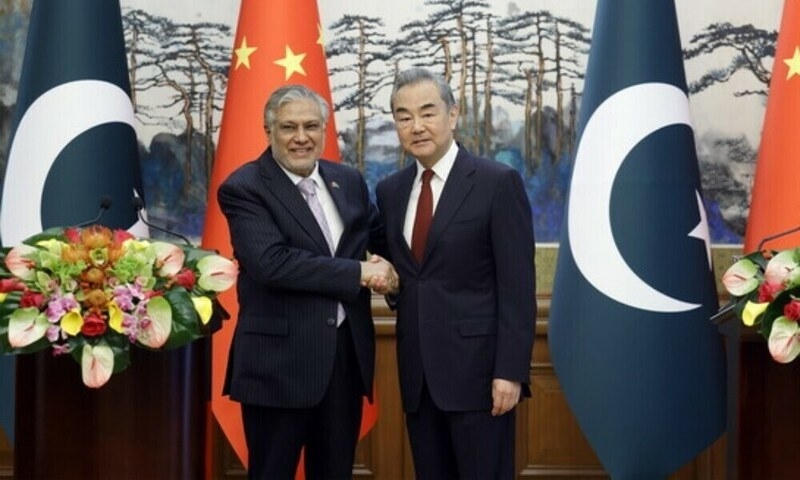
Chinese FM due tomorrow to attend strategic dialogue
ISLAMABAD: Top Chinese diplomat, member of the Politburo of the Communist Party of China and Foreign Minister, Wang Yi, is visiting Islamabad for co-chairing the 6th Pakistan-China Foreign Ministers' Strategic Dialogue on August 21, 2025. Deputy Prime Minister and Foreign Minister, Senator Ishaq Dar had invited the Chinese FM to visit Pakistan, Foreign Office (FO) Spokesperson, Shafqat Ali Khan announced in a statement on Tuesday. The visit is part of the regular high-level exchanges between Pakistan and China to further deepen their 'All-Weather Strategic Cooperative Partnership', reaffirm support on the issues of respective core interests, enhance economic and trade cooperation, and reaffirm their joint commitment to regional peace, development and stability. Wang Yi will reach Islamabad from New Delhi after concluding his crucial visit of India. The two sides will review the entire spectrum of Pakistan-China bilateral relations and exchanges views on regional and global developments of mutual interest. Pakistan, China hold consultations on arms control, non-proliferation, disarmament It is to mention here that DPM Dar last visited Beijing on his three-day official visit on May 19-21 to discuss regional and bilateral discussion following Pakistan-India tension in the wake of April 22 Pahalgam attack. Dar had met top Chinese leadership. Furthermore, the FO spokesperson said the 10th Round of Pakistan-China Bilateral Consultations on Arms Control, Non-Proliferation, and Disarmament was held on 18 August 2025 in Beijing. Ambassador Tahir Andrabi, Additional Secretary of the Arms Control, Disarmament, and International Security Division at Pakistan's Ministry of Foreign Affairs, and Sun Xiaobo, Director General of the Department of Arms Control at the Ministry of Foreign Affairs of the People's Republic of China, led their respective delegations. The two sides engaged in a comprehensive exchange of views on issues related to global and regional peace and security. They also reviewed the situation in South Asia, with particular emphasis on the challenges to security and strategic stability. The discussions covered a wide range of topics related to disarmament and non-proliferation, focusing on the agenda of the UN General Assembly First Committee, the Conference on Disarmament, and key international disarmament agreements, such as the Biological and Toxin Weapons Convention (BTWC) and the Chemical Weapons Convention (CWC). The security implications of emerging technologies and artificial intelligence were also examined. Additionally, the dialogue addressed bilateral cooperation in the peaceful uses of nuclear technology and outer space. During his visit, Ambassador Tahir Andrabi also participated in an interactive roundtable at the China Arms Control and Disarmament Association (CACDA). The session was attended by distinguished former diplomats, practitioners, academics, and think tank experts. The Pakistan-China Dialogue on Arms Control, Non-Proliferation, and Disarmament is a key element of the broader strategic engagement between the two countries. Pakistan views this dialogue as an essential platform for meaningful consultations on security and stability, as well as on issues related to arms control, disarmament, and non-proliferation. The next round of consultations will be held in Islamabad in 2026. Copyright Business Recorder, 2025

Express Tribune
6 hours ago
- Express Tribune
Sino-India thaw
A surprising rapprochement is in the making as India and China contemplate burying the hatchet. The high-level talks between the two countries, after years of diplomatic brawls and border skirmishes, simply underscore the changing regional realities, and the desire to cooperate in an era of interdependence and multilateralism. Delhi's inching towards Beijing will have long-term impact on realpolitik, and speaks of the beginning of a new era for South Asia if the economic giants succeed in overcoming their territorial woes. It remains to be seen if this spirit on the part of India snowballs into its ties with Pakistan or not, and what role China can play as a catalyst in defrosting the long-persisting animosity. The three-day visit of Chinese Foreign Minister Wang Yi to India is the first high-level interaction since their aggressive melee over the Galwan Valley in 2020. The epoch-making understanding to view each other as "partners and not adversaries" will necessitate walk the talk, and Wang's huddle with Prime Minister Narendra Modi is likely to set the stage for the latter's summit with President Xi Jinping later this month. With Delhi being pushed to the wall by Washington as disproportionate tariffs are slapped, this diplomatic proactivity with Beijing and, likewise, Moscow is a smart move on the part of India. Thus, the desire to resume border trade and direct flights and ease visa regime are baby steps as they go on to rewrite their new relationship. India's strategic alignment with the US and its being part of QUAD, nonetheless, will surely have an impact on its new-found love with China. This is where a shift, or otherwise, in its foreign policy is to be determined. Wang's air-dashing to Islamabad this week, however, to attend the sixth Pakistan-China Strategic Dialogue will be an opportunity to exchange notes as to what transpired between Beijing and Delhi. India must keep in mind that unless it rescinds the IWT suspension and enters into a dialogue with Pakistan, its honeymoon with China will be on the rocks. The region is in need of a composite peace regime, and the buck stops at India to nod in positivity.
