



New Self-Employment Tax Risks For U.S. Investors In Global Funds
The U.S. Tax Court decided Soroban Capital Partners LP v. Commissioner (T.C. Memo 2025-52) in May 2025 leaving financial, tax and legal advisors concerned. The court upended assumptions about the self-employment tax exemption for limited partners in hedge funds, and by analogy to venture capital, and private equity partnerships both in the U.S. and abroad. U.S. citizens and green card holders who are limited partners in hedge funds or similar businesses, including those in foreign countries, should understand the effects of this decision. The case signals a shift away from a state or local law definition of a 'limited partner' toward a more comprehensive evaluation of the partner's actual role to determine if the 'limited partner' exclusion from Self-Employment Contributions Act taxes should apply.
The Soroban court applied a 'functional analysis test' to determine whether limited partners' distributive share of partnership income is subject to SECA taxes. The decision has far-reaching SECA implications for how limited partners will structure their roles and manage their tax obligations. This article explores the Soroban ruling, what it means for U.S. limited partners, especially for those working with hedge funds or other businesses abroad that use a limited partnership structure.
First, it is helpful to understand generally why funds often use a limited partnership vehicle. A limited partnership for U.S. purposes is comprised of both general and limited partners. General partners manage the fund and have unlimited liability. Limited partners contribute capital, and their liability is limited to their investment.
The limited partnership structure is tax transparent for U.S. tax purposes, meaning it provides pass-through taxation of income, credits and deductions to its partners. The partnership entity itself is not subject to U.S. income tax, and the partners report their distributive shares on their individual U.S. tax returns. The structure also provides significant flexibility in governance. For all these reasons, the limited partnership is often ideal for private funds.
Self-employment income is taxed at a rate of 15.3% (12.4% for Social Security and 2.9% for Medicare). A SECA exclusion exists under Internal Revenue Code Section 1402(a)(13) for a limited partner's distributive share of partnership income.
The Tax Court rejected the notion that state law classifications of limited partners should be determinative for purposes of this exclusion. Instead, it applied a functional analysis test to Soroban's limited partners and concluded that these partners were 'limited in name only.' As such, the limited partners' distributive share did not qualify for the SECA exclusion.
The court carefully examined the activities of the limited partners and found they were heavily involved in generating the partnership's income by overseeing day-to-day management, working full-time for the business, and that marketing material listed them as essential to the success of the partnership. In addition, the capital contributions made by the limited partners were viewed as insignificant when compared to the fees Soroban charged. This comparison suggested that the limited partner's distributive share was not a passive return on investment but rather compensation for active participation.
The label 'limited partner' alone, is not enough to guarantee the SECA exclusion. Instead, the functional analysis test requires a thorough analysis of the facts and a careful examination of the partner's role in the enterprise. The factors include how integral the partner is in generating revenue, the degree of participation in the business, whether the partner is working full-time in the business, whether marketing materials indicate the partner plays a key role and whether the partner's capital investments truly reflect a passive investment.
For U.S. limited partners, particularly those in hedge funds or other investment vehicles, the Soroban holding invites the IRS and courts to closely scrutinize the actual activities of limited partners to determine SECA liability.
While the Soroban case focused on a U.S. hedge fund, its principles can apply to any partnership structure in which U.S. citizens or green card holders are limited partners. The holding can apply to a vast range of industries operating globally where U.S. partners are contributing expertise and management.
Private equity firms, venture capital funds, and other businesses often use a limited partnership structure. A limited partner in an overseas real estate partnership or tech startup fund could face scrutiny if the role involves active management or income generation. Only truly passive investors are meant to benefit from the SECA exclusion and while local law will be important in the analysis, the IRS will be looking beyond any local law label of 'limited partner' to scrutinize eligibility.
Various jurisdictions have limited partnership structures closely resembling the U.S. model. The most popular jurisdictions having limited liability for limited partners as well as generally having flow-through tax treatment include the Cayman Islands, British Virgin Islands, Luxembourg, Hong Kong and Ireland. While these jurisdictions appeal to global funds because of their tax and regulatory regimes which parallel the U.S. in important respects, limited partners should be ready to consider a heightened compliance burden given the holding in Soroban. Adding to the additional possible tax burden, the U.S. limited partner abroad will be unhappy to learn that self-employment income subject to SECA tax is not reduced by the foreign earned income exclusion.
U.S. limited partners should reassess their involvement in the partnership to make sure they qualify as passive investors entitled to the SECA exclusion. This may mean a significant reduction of day-to-day management responsibilities or restructuring their roles to emphasize capital investment over active participation.
For U.S. limited partners in foreign funds, the statute of limitations for SECA tax assessments is generally three years from the due date or actual filing date of the income tax return, whichever is later. However, the statute of limitations for tax matters can be extended several years and even indefinitely, depending on the facts. Crucially, if a U.S. partner fails to file a required foreign information return, such as Form 8938 (Statement of Specified Foreign Financial Assets) or Form 8865 (Return of U.S. Persons With Respect to Certain Foreign Partnerships), the statute of limitations does not start for the entire tax return. This gives the IRS the ability to assess SECA tax at any time in the future.
U.S. limited partners should be proactive and planning for a possible IRS challenge to a claimed exclusion from SECA. U.S. limited partners should first consult an experienced tax advisor to assess their involvement in the fund and optimize tax outcomes. Next, meticulously document management roles, time commitments, and public representation to ensure compliance with IRS scrutiny and minimize the risk of tax exposure.
Partnership agreements should be examined. If feasible, partnership agreements may need to be amended to clarify the role of limited partners as passive investors, emphasizing capital contributions over operational involvement. Limited partners who blur the line between passive investment and active management could find a surprising increase in their U.S. tax liability with their distributive shares subject to SECA taxes.
The Soroban case may be appealed, and staying informed on this topic is critical. Investors should be looking out for any future IRS guidance or legislation that might refine the functional analysis test.
I help with tax matters around the globe.
Reach me at vljeker@us-taxes.org
Visit my US tax blog www.us-tax.org
Hashtags

Try Our AI Features
Explore what Daily8 AI can do for you:
Comments
No comments yet...
Related Articles
Yahoo
 27 minutes ago
- Yahoo
Imagine's Long-Term Value of Limited-Time Destinations
MINNEAPOLIS, Aug. 19, 2025 (GLOBE NEWSWIRE) -- Imagine and Midnight Oil continue to demonstrate leadership in visual communications, thinking outside the box to immerse visitors in brands at physical locations that signify more than just merchandise on display. By teaming up with industry giants 7-Eleven and Universal Pictures, one of the most anticipated movie releases of 2025 — Jurassic World Rebirth — had a celebration as epic as the partnership itself. The groundbreaking creative campaign transformed three 7-Eleven locations into bona fide dino landmarks featuring 360-degree wraps, offering customers themed exclusives and unforgettable memories. With a global pop-up retail market on track to hit $80 billion by 2027, Imagine's novel approach of pushing captivating experiences over products checks all the right boxes. The lucrative potential of pop-ups is driven by the increasing demand from consumers for memorable, multisensory, and community-driven encounters. 83% of Gen Z and Millennials believe brands should interact more with their consumers through experiences, which explains why pop-ups that evoke emotions are outperforming their traditional counterparts that focus solely on product sales. Crafting temporary, destination-worthy spaces that go big on scent, movement, texture, and drama triggers excitement and engages audiences that crave hyper-personalized interactions. "In any marketing launch, imagery is everything,' says Mike Gade, board member of The Imagine Group. 'Transforming a retail space into a canvas for your campaign is a fast, cost-effective, and high-impact way to immerse customers in the experience in real time." Brand takeovers of exteriors are a powerful tool for maximizing the visual impact of these experiences. 70% of people can't recall the last time a brand did anything that excited them, which presents a massive opportunity to prioritize the complete reinvention of retail spaces so they create an otherworldly sense of awe. The scale, scope, and dominance of 360-degree wraps are impossible to ignore and difficult to forget, taking a familiar structure and turning it into a portal that transports audiences into a tailored brand story. Imagine's ability to execute complete, dimensional takeovers make the building itself a beacon for brands with an effectiveness that can't be achieved with conventional advertising. The limited-time activations for Jurassic World Rebirth showcased Imagine's vision for leveraging 360-degree wraps to forge connections with an audience who desire emotional engagement more than transactions. By adapting a philosophy of being a memory provider over a service provider, Imagine is putting art and craftmanship in the spotlight. 'Collaborating with brands from day one, we handle the design, creative, print, digital production, and installation of the experience,' says Don McKenzie, CEO of The Imagine Group. 'That end-to-end capability is practically unheard of in the industry. It makes us a unique strategic partner for our clients.' About Midnight Oil For 45 years Midnight Oil, an Imagine Group company, has been partnering with the entertainment industry and brands to create, adapt, and produce campaign messaging for virtually every consumer-reaching medium worldwide. Famous for its custom billboards and in the wild executions across the country, Midnight Oil has a reputation for bringing high-quality and innovative thinking to every promotional campaign. Learn more at About Imagine Imagine is an industry-leading provider of visual communications solutions. As a trusted partner to the world's most successful brands, Imagine designs, produces, and delivers beautifully crafted print and digital solutions that inspire action and get results. From concept to consumer, our end-to-end solutions include creative design, pre-media, décor, commercial print, store signage, specialty packaging, out of home, fulfillment & kitting. With a customer technology stack powered by Dotti, a single, flexible platform designed to manage even the most complex in-store marketing programs and a collection of talented designers and innovators in Imagine Studio, all backed with powerhouse print and digital production capabilities Imagine has the solution. Learn more at CONTACT: Andy House ahouse@

Yahoo
27 minutes ago
- Yahoo
Fulton businesses adapt as downtown construction enters final stretch
Aug. 19—Fourth Street in downtown Fulton is in the middle of a transformation that is reshaping both the street's infrastructure and the way local businesses operate. A major overhaul that began in July is expected to wrap up by Nov. 1, about a month later than planned after the project was extended by one block. Work now runs from 10th Avenue to 13th Avenue and includes replacing water service lines with copper, installing new electrical systems and streetlights, replacing curbs and gutters, and pouring new Americans with Disabilities Act-compliant sidewalks. "All the water services have been upgraded. They just finished that up yesterday," City Administrator Eric Sikkema said, adding that crews would soon start forming the new sidewalks and work half a block at a time, with each section reopening a few days later. City officials are also weighing whether Fourth Street should remain a two-way or revert to a one-way configuration, a change that would add 16 parking spaces, improve intersection visibility and make it easier for drivers to back out of angled spots. Video models of both traffic patterns were presented in March. "As it's planned right now, Fourth Street will go to a one-way heading north, but that can always change," Sikkema said. Funding for the $1.8 million project includes a $107,000 U.S. Department of Agriculture grant for sidewalks and lighting, about $550,000 from federal American Rescue Plan Act funds, and the remainder from city reserves. Planning began in 2021 after failed attempts to secure other grants. "The road itself is only two inches of asphalt, and then it's brick underneath... that brick had started to fail, and that was starting to cause a lot of potholes through our downtown," Sikkema said. "None of our downtown met any ADA compliance... our street lighting was starting to fail. Seemed like every other bulb was starting to have issues, and it was time." The construction, combined with the Iowa Department of Transportation's ongoing resurfacing of the North Bridge just a few blocks south, has posed challenges for downtown businesses. Lori Shear, owner of Country Orchids, said street work has slowed walk-in customers, though most of her business comes through phone orders. Jackie Wilkin, owner of Rooted Boutique and a member of the Fulton City Council, said the upgrades are overdue. "I've owned this business for five years... and in my five years, I've seen three people fall on the streets and sidewalks because they're in such bad shape. So it is a necessary evil," Wilkin said. "There's never going to be a good time to do this work, but I commend our city for investing the 2 to $3 million that it's going to take to do it and make it better." However, Krumpets, a bakery and cafe on Fourth Street, told customers in a Facebook post that the overlapping bridge and street work has cut their daily revenue nearly in half. To adapt, the business is temporarily focusing on best-selling menu items, shortening hours and shifting mostly to take-out service while using the slowdown to renovate its dining area. "Even with all of your loving support, the unfortunate circumstance of both of these projects coinciding has left us with a 45% drop in daily revenue. That's unsustainable in our current format," the post read. A second phase of the Fourth Street work is planned for spring 2026, pending the outcome of a $3.1 million Illinois Department of Transportation Local Roads grant application. That phase would include downtown water main upgrades, repainting the city's water tower and rebuilding the road from Ninth Avenue to 13th Avenue. Work on the North Bridge, which carries motorists traveling Iowa 136 into Fulton, was originally expected to finish in early October. It has been delayed by material shortages and is now slated for completion in November. "We're just excited that we can finally move forward on this project and start making some necessary upgrades around town," Sikkema said. Solve the daily Crossword

Geek Wire
29 minutes ago
- Geek Wire
Protesters set up temporary encampment at Microsoft to pressure company on Israel contracts
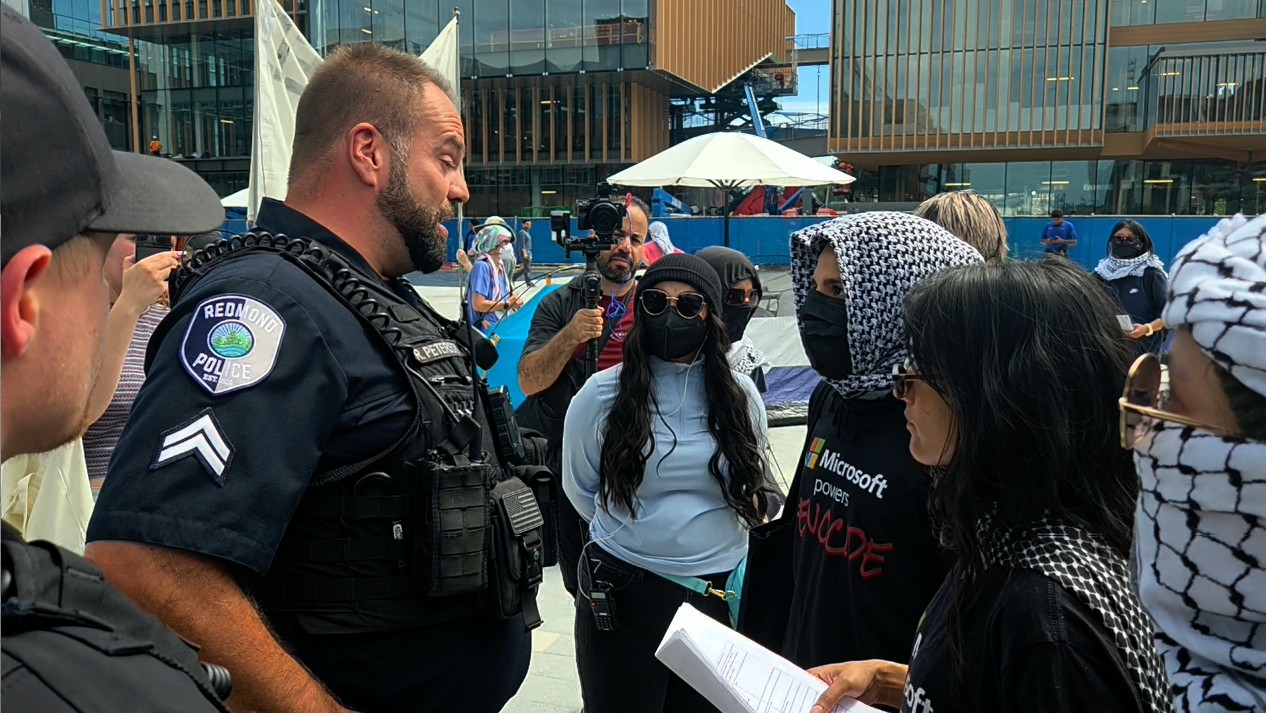
Redmond police explain to members of No Azure for Apartheid that they will be subject to arrest for trespassing if they don't leave the Microsoft campus Tuesday afternoon. (GeekWire Photo / Todd Bishop) Protesters took over part of Microsoft's Redmond, Wash., campus for more than an hour Tuesday — escalating their efforts to pressure the company to stop providing technology to the Israeli government and military. Members of the No Azure for Apartheid group, which includes current and former Microsoft employees, allege that the company's technology is being used in the surveillance, starvation and killing of Palestinians in Gaza. Microsoft has said it complies with its human rights commitments, and that its contracts with Israel's Ministry of Defense are standard commercial agreements, governed by its terms of service and AI Code of Conduct. The protesters created what they called a 'Liberated Zone' in the plaza of the company's East Campus, in front of the Microsoft sign, pitching tents and setting up a 'negotiations table' with a banner that read, 'Microsoft Execs, Come to the Table.' The space was filled with shrouds symbolizing the dead in Gaza, and a large plate reading, 'Stop Starving Gaza.' 'Regardless of your beliefs, regardless of whether or not your work today actually supports Israel, know that Microsoft's money does include blood money,' said one of the speakers at the protest, Julius Shan, a software engineer who said he has worked at Microsoft for nearly five years. A smattering of Microsoft employees looked on from the periphery as security guards and police arrived. One employee who was watching nearby said he empathized with the message but not the approach. 'This isn't going to change anything,' said the employee, who did not give his name. 'It's just going to annoy the people that are here.' The 'Liberated Zone' was in place for more than an hour on Microsoft's Redmond campus. Initially, the protesters appeared to be preparing for an extended encampment, reminiscent of student-led protests at universities during the 2023-24 academic year. In a press release shortly after the action began, the group said it was renaming the plaza 'The Martyred Palestinian Children's Plaza,' and offered interviews at the 'Anas Al-Sharif Media Tent,' named after a Palestinian journalist killed in Gaza last week. However, the group took down the encampment and moved to a nearby public sidewalk after City of Redmond Police told them they were trespassing on private property and would be subject to arrest. Microsoft has not issued a public statement about the latest protest. The company has said in past statements that it does not permit its technology to be used for unlawful surveillance or human rights abuses. Earlier this year, Microsoft said internal and external reviews found no violations. However, the company acknowledged its limited visibility into how its technology is deployed on private or on-premises systems Microsoft announced on Aug.15 that it is launching a formal review into allegations that its Azure cloud services were used by the Israeli military for mass surveillance of Palestinians. The company said it hired the law firm Covington & Burling LLP to lead the review, and pledged to make the findings of the review public once the process is complete. That move came after reports earlier this month in The Guardian, +972 Magazine, and Local Call cited sources alleging that the Israeli Defense Forces stored data from widespread phone monitoring of civilians in Gaza and the West Bank on Microsoft servers. Protesters walk past a security robot as they leave the Microsoft campus. (GeekWire Photo / Todd Bishop) At the time of the initial report by the Guardian, the company explained that its work with an Israeli intelligence unit focused on cybersecurity and that it was not aware of any civilian surveillance. The encampment Tuesday was part of a broader escalation by the group, which has spent much of the past year staging protests inside and outside company events, including Microsoft's 50th anniversary event in Redmond earlier this year, where protesters interrupted executives inside the event. Earlier this month, the group staged a loud protest outside the home of Teresa Hutson, corporate vice president of Microsoft's Trusted Technology Group — pouring red paint on the sidewalk symbolizing blood, and accusing her of being complicit in killing children in Gaza, according to video clips from the protest. The group's latest action comes amid reports of a growing humanitarian crisis in Gaza, and increasing concerns about famine. Hamas has agreed to a proposed 60-day cease-fire with phased hostage releases. Israeli officials today demanded the release of all hostages and said they were not interested in partial deals, according to the BBC.
