



Plan to reduce buffer zones around lakes raises hackles
DK Shivakumar
Tuesday told the assembly that the govt plans to construct public roads and utilities along 300km of buffer zones around water bodies in Bengaluru.
He said this during a heated debate on an amendment to the Karnataka Lake Conservation and Development Authority Act, 2014, which reduces buffer zones around lakes depending on their size. While some BJP members attacked the move as a blow to Bengaluru's environment, others from the coastal districts welcomed it as relief for residents whose homes are located near small water bodies.
Shivakumar said that as minister in charge of Bengaluru, he had identified 300km of buffer zone that need to be safeguarded.
"For this purpose, we plan to construct public roads and set up utility areas to ensure private parties cannot encroach these areas," he said.
You Can Also Check:
Bengaluru AQI
|
Weather in Bengaluru
|
Bank Holidays in Bengaluru
|
Public Holidays in Bengaluru
|
Gold Rates Today in Bengaluru
|
Silver Rates Today in Bengaluru
Unimpressed, BJP legislators from Bengaluru walked out in protest. However, the bill was later passed.
Earlier, BJP members from the city, led by S Suresh Kumar and opposition leader R Ashoka, accused the govt of yielding to the real estate lobby. "As per statements and objectives, the bill was necessitated to assist industries, entertainment, and commercial activities.
by Taboola
by Taboola
Sponsored Links
Sponsored Links
Promoted Links
Promoted Links
You May Like
American Investor Warren Buffett Recommends: 5 Books For Turning Your Life Around
Blinkist: Warren Buffett's Reading List
Undo
This suggests the govt has bowed to the real estate lobby," said Kumar.
Kumar said Bengaluru was already "competing with Delhi" for being the most unliveable city. "Now, by reducing buffer zones, the govt is inviting more people to encroach upon lakes," he said.
Ashoka backed Kumar's call, urging the govt to reconsider the legislation. "There are more concerns than solutions with this decision," he said.
But BJP members from coastal districts welcomed the bill. "I welcome this bill on behalf of coastal districts where water bodies are smaller in size and land for people to construct their homes are in close proximity to them," said Kiran Kumar Kodigi from Kundapur.
Shivakumar insisted that no undue advantage was being extended to builders. "We cannot have one rule for Bengaluru and another for coastal districts," he said.
Stay updated with the latest local news from your
city
on
Times of India
(TOI). Check upcoming
bank holidays
,
public holidays
, and current
gold rates
and
silver prices
in your area.
Hashtags

Try Our AI Features
Explore what Daily8 AI can do for you:
Comments
No comments yet...
Related Articles


Hindustan Times
 27 minutes ago
- Hindustan Times
Himachal: BJP announces to boycott revenue minister
The Bharatiya Janata Party (BJP), the main opposition party in the Himachal Pradesh assembly, announced a boycott of Revenue and Horticulture Minister Jagat Singh Negi. Leader of Opposition Jai Ram Thakur along with BJP legislators staged walkout from assembly during the Himachal Pradesh Vidhan Sabha monsoon session, in Shimla on Tuesday. (Deepak Sansta/ HT) As part of the boycott, the saffron party Members of Legislative Assembly (MLAs) have decided not to ask any questions or listen to his statements inside the House of Jagat Singh Negi, who holds portfolios of Revenue, Tribal affairs and Horticulture. The ruckus was triggered by remarks made by Negi during the recent disaster in Seraj, which the BJP alleged were 'insensitive and derogatory.' The BJP MLA Randhir Sharma raised the matter in the House, saying the minister had made 'mocking and inappropriate' comments at a time when people were in distress due to the disaster. 'The minister should not have made such remarks during this time of crisis. The opposition has decided that we will not ask him any questions and whenever he speaks, we will walk out of the House,' Sharma told media persons outside the Vidhan Sabha. Leader of Opposition and former chief minister, Jai Ram Thakur, said, 'The opposition would not tolerate what he called the minister's 'nonsense.' 'The opposition cannot listen to the rubbish of the minister. That is why we staged a walkout,' Thakur said, accusing Negi of hurting the sentiments of the disaster-affected people. The protests intensified after Minister Jagat Singh Negi hit back at the BJP on the floor of the House, accusing the opposition of double standards. 'The BJP talks of the dignity of the House but indulges in vote theft and insulted the national flag in Seraj. The insult in Seraj was not of me but of the Tricolour. The opposition is breaking democratic traditions and using unparliamentary language. I am not afraid of their threats. I will continue to respond on the basis of the Constitution and truth. Whether the opposition wants to listen or not, that is their choice—but the opposition will be answered with a stone for every brick,' Negi while talking to media persons outside the assembly. The BJP MLAs shouted slogans and staged repeated walkouts, even as the treasury benches accused them of running away from debate. While speaking to media, Chief Minister Sukhvinder Singh Sukhu strongly defended his minister saying 'The BJP is targeting Jagat Singh Negi only because he speaks the truth. He is one of the most effective ministers in the cabinet'. Launching a scathing attack on BJP, Sukhu added, 'Walking out three or four times in an hour shows how directionless the opposition has become. This only shows their level of frustration. The BJP is divided into five factions, which is clearly visible inside the House today. They are not interested in discussions, only in creating headlines and protecting their political chair.'


The Hindu
27 minutes ago
- The Hindu
When DMK opposed a Vice-President candidate from Tamil Nadu 41 years ago
Shortly after the BJP-led NDA fielded Maharashtra Governor and former Coimbatore MP C.P. Radhakrishnan as its candidate for the upcoming polls for the post of Vice-President, several political party leaders, including AIADMK leader Edappadi K. Palaniswami and TMC (Moopanar) leader G.K. Vasan, had appealed to parties in Tamil Nadu to sink differences and back his candidature. The last time a candidate hailing from Tamil Nadu was fielded for the post was 41 years ago – when R. Venkataraman entered the fray. However, now, the Opposition INDIA bloc, of which the ruling DMK in Tamil Nadu is a constituent, has announced former Supreme Court judge B. Sudarshan Reddy, who hails from Telangana, as their nominee to take on Mr Radhakrishnan. While Mr. Radhakrishnan's victory is likely guaranteed on account of the NDA's numbers in both Houses of Parliament, the DMK and its allies shall be opposing the 'son of the soil' for political reasons. However, such a stand is not new for the Dravidian party. On August 1, 1984, the Congress (I) Parliamentary board formally nominated R. Venkataraman, who was serving as the Defence Minister in Prime Minister Indira Gandhi's Cabinet, for the office of Vice-President of India. He had earlier served as a Minister holding various portfolios in Madras State, playing an instrumental role in the State's industrialisation. A report published in The Hindu on August 2, 1984, said that after nominating Venkataraman, also called R.V., Indira Gandhi apprised Satyasadan Chakraborty, the CPI(M) leader in the Lok Sabha, of the views of the Congress board members. The CPI(M) leader, in turn, informed his colleagues in the Opposition about the ruling party's decision, as the Prime Minister had sought their support to ensure Venkataraman's election by consensus, even though the Congress nominee could win comfortably on the party's own strength. Referring to the archival reports of Murasoli, the DMK's mouthpiece, R. Kannan, the author of The DMK Years and biographer of Dravidian stalwarts C.N. Annadurai and M.G. Ramachandran, noted that failing to achieve consensus, leaders of the Opposition parties, including Era. Mohan of the DMK, Atal Bihari Vajpayee of the BJP and Indrajit Gupta of the CPI convened a meeting on August 2, 1984, and decided to field B.C. Kamble, a former MP from the Republican Party, was their joint candidate, fully realising that the contest would only be token in nature. Mr. Chakraborty said the Opposition had nothing personal against R.V. but regretted that the Prime Minister had not followed the procedure of choosing a candidate on the basis of all-party consensus. The Opposition was keen that a member of the weaker sections be given an opportunity to occupy the post of Vice-President, The Hindu reported. Despite not being a part of the Congress-led alliance in the Parliamentary elections in 1980, the AIADMK, which eventually showed signs of moving closer towards the Congress in the early 1980s, supported R.V.'s candidature for the Vice-President post. The election held on August 22, 1984, ended as expected with R.V. defeating Kamble by a comfortable margin. In a statement, Chief Minister M.G. Ramachandran (MGR) thanked Indira Gandhi, saying, 'I am happy that Mr. R. Venkataraman has been elected Vice-President of the Indian Republic. You made it possible by enabling a Tamilian to contest the election and to win it. On behalf of the people and the Government of Tamil Nadu and on my own behalf, I express my sincere thanks to you for having fulfilled a long-cherished wish of the people of Tamil Nadu.' Three years later, when the Congress nominated R.V., the incumbent Vice-President, for the post of President, the AIADMK, by then in alliance with the Congress, backed him. The Opposition parties convened a meeting in New Delhi and unanimously decided to field eminent jurist V.R. Krishna Iyer for the top post. Even this time, the DMK opposed R.V.'s candidature and backed the Opposition as it was part of it. R.V. comfortably won the elections and went on to become the eighth President of India. Chief Minister MGR, in a statement, congratulated R.V. and said, 'Your election to the highest office of the Indian Republic is thus a natural culmination of your eventful public life and is a most fitting tribute to your selfless service. It is a matter of supreme pride for the people of Tamil Nadu, and I am profoundly happy in sharing this pride with them.' The DMK President M. Karunanidhi, in a telegram to R.V., said, 'Please accept my hearty congratulations on your election as the President of India.' AIADMK, DMK both backed Kalam In 2002, when the BJP-led NDA proposed the name of A.P.J. Abdul Kalam, an eminent scientist and native of Tamil Nadu, for the post of President of India, both the ruling AIADMK and the DMK rallied behind him. The DMK was then a key constituent of the NDA. Despite not being a part of the combine, AIADMK supremo and Chief Minister Jayalalithaa described Kalam as the ideal choice and said her party was happy to extend support. In a statement, she said Prime Minister Atal Bihari Vajpayee had spoken to her over the phone about Kalam's candidature. 'I told him that I was delighted with the choice…. Apart from the fact that Dr. Kalam is an eminent and internationally renowned scientist who is respected all over the world, it is a matter of great pride and happiness for the AIADMK that he belongs to Tamil Nadu,' The Hindu reported on June 12, 2002, quoting Jayalalithaa. A report published in this daily on June 16, 2002, noted how the DMK too welcomed Kalam's nomination. Reacting to the Left's contention that Kalam lacked political experience and knowledge of the Constitution, DMK president M. Karunanidhi said political experience was not listed as a necessary qualification for the post of the President of India. Comparing Kalam to former Presidents S. Radhakrishnan and Zakir Hussain, Karunanidhi said all three were eminent in their fields. 'In the current situation, a non-political, secular, non-partisan person like Dr. Kalam was best suited for the role,' he said. On July 18, 2002, the 71-year-old scientist was elected as the President of India. With the support of the NDA, the Congress, the Telugu Desam Party and the Samajwadi Party, Kalam secured nearly 90% of the valid votes against his sole rival Captain Lakshmi Sahgal. After his victory, Kalam addressed his critics who had doubted his suitability for the presidency because of his lack of political background. 'I have been working from 1982 onwards directly with the Government, whether it be related to research, launch vehicles or nuclear programmes. Unless political decisions are taken, satellites will not be in orbit. Political decisions are vital for the success of any programme. I have worked with six Prime Ministers, I know how to handle politics,' a report published in The Hindu on July 19, 2002, quoted Kalam.

Mint
27 minutes ago
- Mint
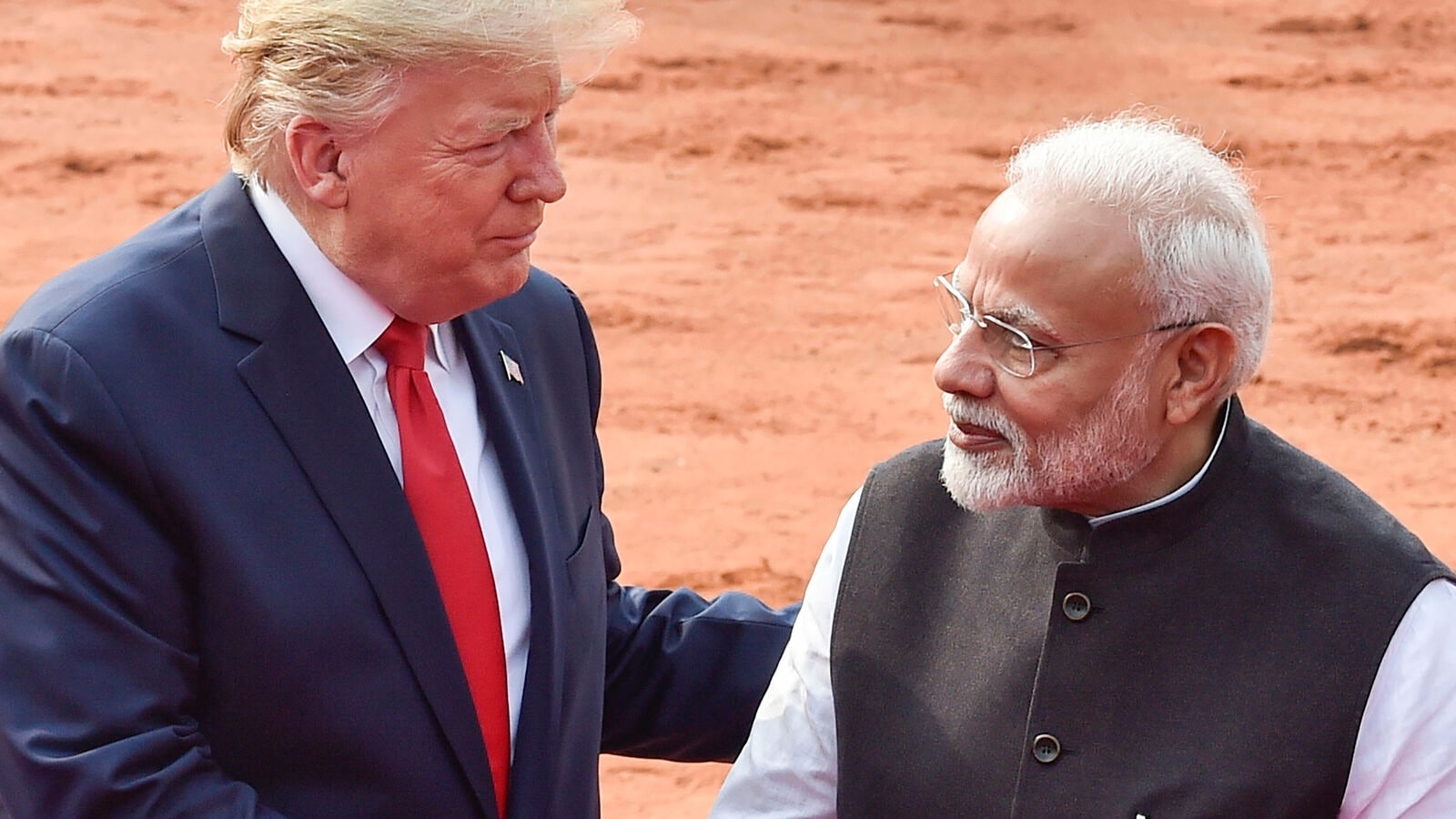
Trump slapped India with 50% tariff to put ‘secondary pressure' on Russia: White House
President Donald Trump's decision to raise tariffs on India was aimed at discouraging Russia from continuing its war in Ukraine, White House Press Secretary Karoline Leavitt said on Tuesday. The move was designed to put secondary pressure on Moscow, she explained during a press briefing Trump has effectively doubled India's tariff burden to 50 percent by adding an extra 25 percent on top of the earlier 25 percent levy. "Look, the president has put tremendous public pressure to bring this war to a close. He's taken actions, as you've seen, sanctions on India and other actions as well. He's made himself very clear that he wants to see this war end, and he has scoffed at the ideas of others that have been raised that we should wait another month before any meeting takes place," she said. Trump met Ukrainian President Volodymyr Zelensky at the White House on Monday and last week he had also met with President Putin. Both have signalled that they are open to start direct talks. Leavitt further said that Trump wishes to bring peace as soon as possible. "The president wants to move and he wants to bring this war to an end as quickly as possible... With all of those European leaders leaving the White House, including the NATO Secretary General, they all agree that this is a great first step. And it's a good thing that these two leaders are going to be sitting down together, and the president expects that to happen," she said. Leavitt further said, "I can assure you that the United States government and the Trump administration are working with both Russia and Ukraine to make that bilateral happen as we speak." Leavitt said that Trump's relentless efforts at brokering peace led to the European leaders being present at the White House within 48 hours of his meeting with Putin. "The President met with all of these European leaders at the White House 48 hours after sitting down with President Putin on American soil. In fact, there was so much progress in the readout that was given to these European leaders immediately following his meeting with President Putin that every single one of them got on a plane 48 hours later and flew to the United States of America," she said. "So these leaders who this war is in their backyard are very grateful that the president took that call and that he was there to provide them with a readout of Russia's thinking on this, something that was not done by the previous administration at all," she added. In response to a reporter's question, Leavitt reiterated that the war would not have broken out had Trump been in office. "The president often says that this war would not have started if he were in office and and Putin confirmed that," the reporter asked. "True. Do you accept that as true? The European leaders do. Well, and President Putin himself said that, by the way," Leavitt said. Trump has repeatedly stated that the war wouldn't have started if he were in office, and surprisingly, Putin seems to agree. When asked about this, Leavitt confirmed that Putin did indeed say that.
